
Scientists find a way to efficiently use visible light from the sun to break down CO2, open doors to novel means of alleviating global warming.
Carbon dioxide (CO2) emissions from human activities have risen drastically over the last century and a half and are seen as the primary cause of global warming and abnormal weather patterns. So, there has been considerable research focus, in a number of fields, on lowering our CO2 emissions and its atmospheric levels. One promising strategy is to chemically break down, or ‘reduce,’ CO2 using photocatalysts — compounds that absorb light energy and provide it to reactions, speeding them up. With this strategy, the solar-powered reduction of CO2, where no other artificial source of energy is used, becomes possible, opening doors to a sustainable path to a sustainable future.
A team of scientists led by Drs. Shinji Kawasaki and Yosuke Ishii from Nagoya Institute of Technology, Japan, have been at the forefront of efforts to achieve efficient solar-energy-assisted CO2 reduction. Their recent breakthrough is published in Nature’s Scientific Reports.
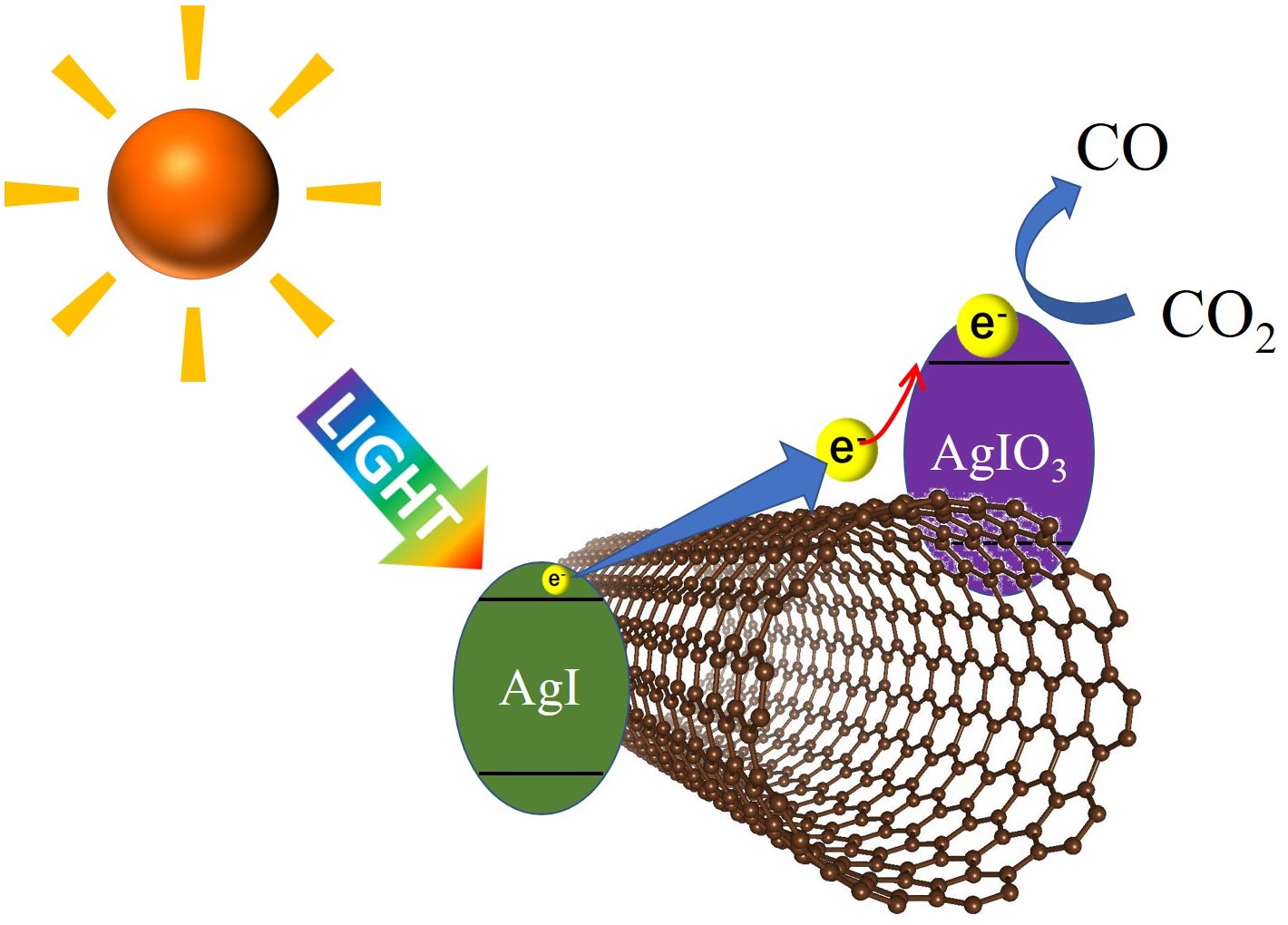
Their research began with the need to solve the limited applicability problem of silver iodate (AgIO3), a photocatalyst that has attracted considerable attention for being useful for the CO2 reduction reaction. The problem is that AgIO3 needs much higher energy than that which visible light can provide to function as an efficient photocatalyst, and visible light is the majority of solar radiation.
Scientists have attempted to work around this efficiency problem by combining AgIO3 with silver iodide (AgI), which can efficiently absorb and utilize visible light. However, AgIO3-AgI composites have complicated synthesis processes, making their large-scale manufacturing impractical. Further, they don’t have structures that offer efficient pathways for the transfer of photoexcited electrons (electrons energized by light absorption) from AgI to AgIO3, which is key to the composite’s catalytic activity.
Carbon Nanotubes to the Rescue
“We have now developed a new photocatalyst that incorporates single-walled carbon nanotubes (SWCNTs) with AgIO3 and AgI to form a three-component composite catalyst,” says Dr. Kawasaki, “The role of the SWCNTs is multimodal. It solves both the synthesis and the electron transfer pathway problems.”
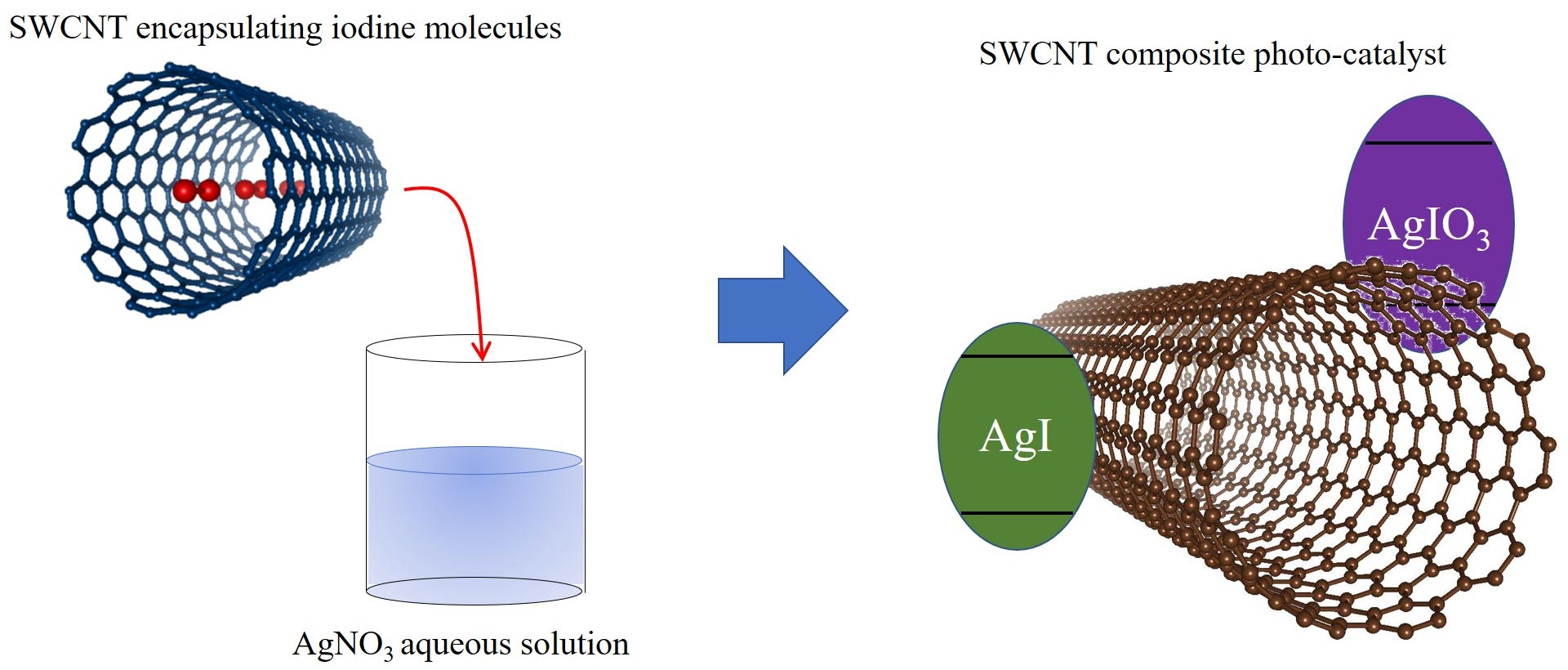
The three-component composite synthesis process is simple and involves just two steps: 1. Encapsulating iodine molecules within the SWCNT using an electrochemical oxidation method; and 2. Preparing the composite by immersing the resultant of the previous step in an aqueous solution of silver nitrate (AgNO3).
Spectroscopic observations using the composite showed that during the synthesis process, the encapsulated iodine molecules received charge from the SWCNT and converted into specific ions. These then reacted with AgNO3 to form AgI and AgIO3 microcrystals, which, due to the initial positions of the encapsulated iodine molecules, were deposited on all the SWCNTs uniformly. Experimental analysis with simulated solar light revealed that the SWCNTs also acted as the conductive pathway through which photoexcited electrons moved from AgI to AgIO3, enabling the efficient reduction of CO2 to carbon monoxide (CO).
Versatile Applications and Future Outlook
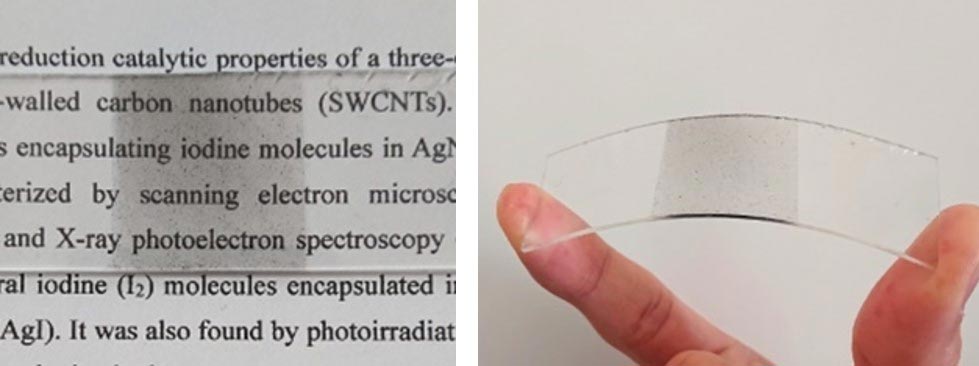
The incorporation of SWCNTs also allowed for the composite dispersion to be easily spray-coated on a thin film polymer to yield flexible photocatalytic electrodes that are versatile and can be used in various applications.
Dr. Ishii is hopeful about their photocatalyst’s potential. “It can make the solar reduction of industrial CO2 emissions and atmospheric CO2 an easy-to-scale and sustainable renewable energy-based solution tackling global warming and climate change, making people’s lives safer and healthier,” he says.
The next step, the team says, is to explore the possibility of using their photocatalyst for solar hydrogen generation. Perhaps, humanity’s future is bright after all!
Reference: “One-step synthesis of visible light CO2 reduction photocatalyst from carbon nanotubes encapsulating iodine molecules” by Ayar Al-zubaidi, Kenta Kobayashi, Yosuke Ishii and Shinji Kawasaki, 12 May 2021, Scientific Reports.
DOI: 10.1038/s41598-021-89706-2
Never miss a breakthrough: Join the SciTechDaily newsletter.
Follow us on Google and Google News.
15 Comments
Convert CO2 to carbon MONOXIDE !!!! – ARE YOU MAD?!
How could anyone with any knowledge of biology and chemistry write this. A better title might be “A New Method for Turning Carbon Dioxide into a Potent Poison.”
Carbon monoxide plus hydrogen have been used in the Fischer- Tropsch synthesis of hydrocarbons since well before WWII. This chemical reaction was the only way Nazi Germany could produce fuel after the Allies interdicted all petroleum imports and destroyed Germany’s limited domestic petroleum production. Pyrolysis of Germany’s abundant coal resources provided the CO.
You might consider doing a bit of background research before showing knee-jerk disdain for well established chemistry. Of course, unreflective, knee-jerk reactions have become tenets of faith in the MAGA-sphere.
From 1960 to the present we’ve been working on ways to convert all the CO to CO2 in any chemical reaction that we use that might create CO. Nobody wants Carbon monoxide, so what’s the point of this? How can you say your going to make CO without saying how your going to get ride of that? Was this story written by AOC!
AOC is in the top percent of IQ and is an accomplished person at her young age. What had you achieved by her age? Not much by comparison I am guessing – which is why you need to put her down. Get some accomplishments under your belt before punching up.
CO2 emissions are huge. We have thousands upon thousands of factories pumping the stuff into the atmosphere. It would take even more “factories” sucking up C02 to make a dent in the problem. So, while it’s possible to demonstrate technologies that use sunlight to decompose CO2, it’s not a practical solution to the problem as long as we keep pumping CO2 into the atmosphere on an industrial scale. The only real sustainable solution is to stop pumping CO2. We know how to do it; we have sustainable net-zero energy sources. We need to implement those sources of energy ASAP and stop oxidizing coal and oil. Then we can figure out how we’re going to clean up the CO2 already in the atmosphere, and try getting back to pre-industrial levels.
I guess I’m ignorant, but turning CO2 into carbon monoxide (the silent killer) doesn’t sound like a great solution. What do we do with all the CO?
I would have aimed for warm-water phytoplankton but I guess some people really want an ig nobel.
CO is combustable, when split by this catalyst it could then be burnt to turn it back to CO2. The heat realeased would probably give much less energy than was taken for free, so overall another useless form of renewable thermal energy.
It’s one saving grace is the CO could be turned back to CO2 after storing it, so a bit like the analog of making hydrogen and burning that later to fill in the power blanks. But then the sun already does that when heating solid mass, heat is released later in the day back out to space.
Now if they had a photo catalyst that turned light, CO2 and water into (methane or alcohol or any common storable fuel) and Oxygen at an efficiency of more than 6% I would be impressed. This is not a solution to anything.
This article was filled with the hopium that huge numbers of people crave. It suggested all this could lead to a sustainable future. It failed to mention how massive quantities of the nanotubes will be easily generated. The byproduct is carbon monoxide which is a gas that prevents blood from caring oxygen from the lungs to the rest of the body. Technological advance history has many examples of unintended consequences that many researchers never take into consideration. These researchers likely are clueless regarding how little time we have left.
UN chief: World has less than 2 years to avoid ‘runaway climate change’
https://thehill.com/policy/energy-environment/406291-un-chief-the-world-has-less-than-2-years-to-avoid-runaway-climate
I agree with most of the above comments. The way I would say it is this: 1st — there is a lot of CO2 out there, several cubic miles of oil per year for at least the last 50 years. 2nd — the CO needs to be sequestered in some manner. So it needs to be converted to … maybe formic acid (add H2O — not easy) … and deep well injected. The scale needed to make a dent would be enormous — and only if we could go carbonless in energy production TODAY! I think this tech is great, and kudos for them, but lets not fool ourselves that it the salvation technology.
My goodness.. What a disaster in the making. CO2 is NOT the problem. The earth needs this vital gas. Pollutants such as carbon particulate, nitrogen and sulfur oxides are problematic. The climate change scheme is just that, a $cheme. This invention may be useful in some industrial capacity but to alleviate global warming?
Is photosynthesis no longer taught in high school biology 101? Co2 is plant food. CO2 + H20 + sunlight = O2 + Carbs. Moar plants and farmers are needed.
I keep seeing strange solutions to the Carbon issues. Yet, it seems so many of the solutions are attempting to validate and encourage the continued use of carbon-chain fuel sources. It’s like trying to burn down your house to stay warm – soon, you no longer HAVE a house.