
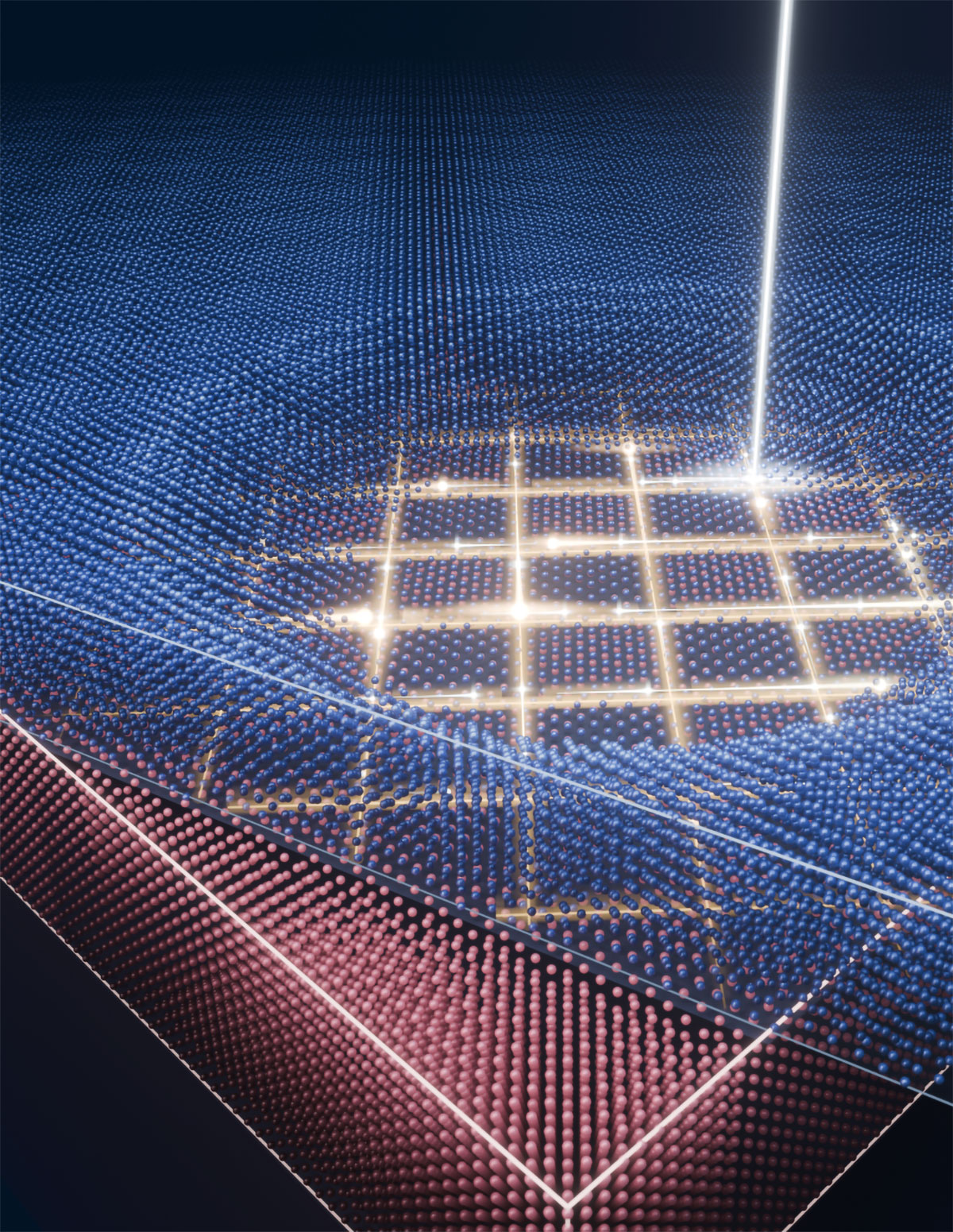
Scientists have discovered that twisting two ultrathin crystal sheets creates a hidden grid of atomic defects that alters how electrical charges are distributed.
Twisting two ultrathin crystal sheets together has allowed scientists to create a hidden grid of atomic defects that influences how electrical charges are arranged. The grid forms where the crystals meet, producing tiny patterns of electrical polarization that could eventually help researchers develop new electronic technologies.
The discovery, led by researchers at the Technical University of Denmark (DTU) and published in Nature, demonstrates how the angle between two bonded crystals can control the spacing of defects at their interface. Although practical applications remain uncertain, the technique offers a way to engineer electrical structures at the nanoscale.
How Twisting Crystals Creates an Atomic Grid
The researchers worked with strontium titanate (SrTiO3), a chemically stable oxide widely studied for its electronic properties. They fabricated crystal sheets just 10 nanometers (about 0.0000004 inches) thick and assembled them with a controlled twist.
The underlying principle resembles a moiré pattern, which appears when two regular grids overlap at slightly different angles. However, strong bonding between the crystal sheets caused their atoms to rearrange at the interface. The remaining mismatch became concentrated along narrow regions of crystal distortion called dislocations, forming a repeating square grid.
“We have spent years learning how to make high-quality sheets, put them together in the right position, bond them and twist them. Once you can do all of that, you can start looking at what happens where these two sheets meet,” says Professor Nini Pryds of DTU.
“So, the bonding is essential to understanding what happens between the layers.”
Computer Simulations Reveal a Hidden Structure
The grid was first predicted by William Sandholt, then a Ph.D. student at DTU, using machine learning simulations to calculate how atoms would rearrange as the crystals bonded and twisted. His results identified a network of dislocations that the researchers subsequently searched for experimentally.
Early electron microscope images showed what appeared to be an ordinary moiré pattern, with no obvious sign of the predicted defects. One difficulty was that the microscope’s electron beam passed through material on both sides of the buried interface, making its atomic structure difficult to isolate.
“The electron beam goes through about ten nanometers of material, reaches the interface, and then goes through another ten nanometers. So, the image is influenced by the material on both sides of what we want to see,” explains John Mangeri, a postdoc at DTU and joint first author of the study.
To overcome this problem, the team simulated how electrons traveled through the samples and examined thin cross sections cut in different directions. Electron microscopy performed with collaborators at the University of Antwerp in Belgium and the SuperSTEM Laboratory in the UK ultimately confirmed the predicted grid.
“Right where the sheets met, we could see the repeating pattern, and it agreed almost perfectly with the theory. That was amazing.”
Pryds emphasizes that the theoretical predictions were essential to the discovery.
“We would never have discovered the dislocations if the calculations had not predicted their existence. The finding highlights the power of combining theory and experiment, bringing together researchers who synthesized the ultrathin sheets, assembled them with a controlled twist, simulated their behavior, and examined the resulting material.”
Controlling Electrical Polarization at the Nanoscale
Further simulations showed that the atomic distortions surrounding the dislocations could slightly separate positive and negative electrical charges. This separation, known as polarization, formed swirling patterns around the grid. Additional microscopy, interpreted alongside the simulations, supported the connection between the atomic distortions and these electrical structures.
The spacing of the grid also depends on the angle between the crystal sheets, providing a means of adjusting the size of the resulting patterns.
“Changing the twist angle changes the spacing between the dislocations. So now, we have a way to control how small the structure becomes,” says joint first author William Sandholt.
“These dislocations could be used for memory applications, for example, and the grid could be tuned through the twist angle.”
Electrical polarization plays a role in technologies such as memory devices and energy storage systems, making these structures potential candidates for future research. The team plans to investigate whether the same approach can produce useful electrical behavior in strontium titanate or other oxides.
Reference: “Designing dislocation-driven polar vortex networks in twisted perovskites” by W. Sandholt, N. Gauquelin, J. Mangeri, A. Annys, J. M. Hansen, A. R. Insinga, E. Dollekamp, N. Vitaliti, G. Panchal, T. Chennit, A. De Backer, D. Kepaptsoglou, R. Mandal, D. R. Rodrigues, S. Van Aert, H. Nguyen, K. I. Wurster, A. Bhowmik, I. E. Castelli, S. B. Simonsen, T. S. Jespersen, Q. M. Ramasse, R. D. James, B. Jalan, J. Verbeeck, J. M. G. Lastra and N. Pryds, 18 November 2026, Nature.
DOI: 10.1038/s41586-026-11330-9
This work was supported by the European Research Council (ERC) Advanced Grant NEXUS and the Villum Investigator Grant EUREKA.
Never miss a breakthrough: Join the SciTechDaily newsletter.
Follow us on Google and Google News.