

Researchers are developing ultra-thin lenses that could transform how future devices capture and control light.
Flat, lightweight lenses are already replacing plastic lenses in smartphone depth-sensing systems. Known as metalenses, they belong to a class of ultra-thin optical devices called metasurfaces, which use nanoscale structures to control light. Making these devices more efficient could open the door to a much wider range of optical technologies.
Researchers at the Harvard John A. Paulson School of Engineering and Applied Sciences (SEAS) have developed a metasurface with built-in protection against unwanted reflections, which redirect light away from its intended path.
Published in Nature Nanotechnology, the research was led by Federico Capasso, the Robert L. Wallace Professor of Applied Physics and Vinton Hayes Senior Research Fellow in Electrical Engineering. His group has long studied metasurfaces and was the first to demonstrate the fabrication of a bilayer titanium dioxide metasurface made of two stacked layers of freestanding nanostructures.
“Antireflection coatings are widely used in technology to minimize residual reflections that are detrimental to device performance,” Capasso said. “The work we have done here is a first application for bilayer metasurfaces that we expect will lead to a wide-ranging impact in photonics.”
Why uniform coatings fall short
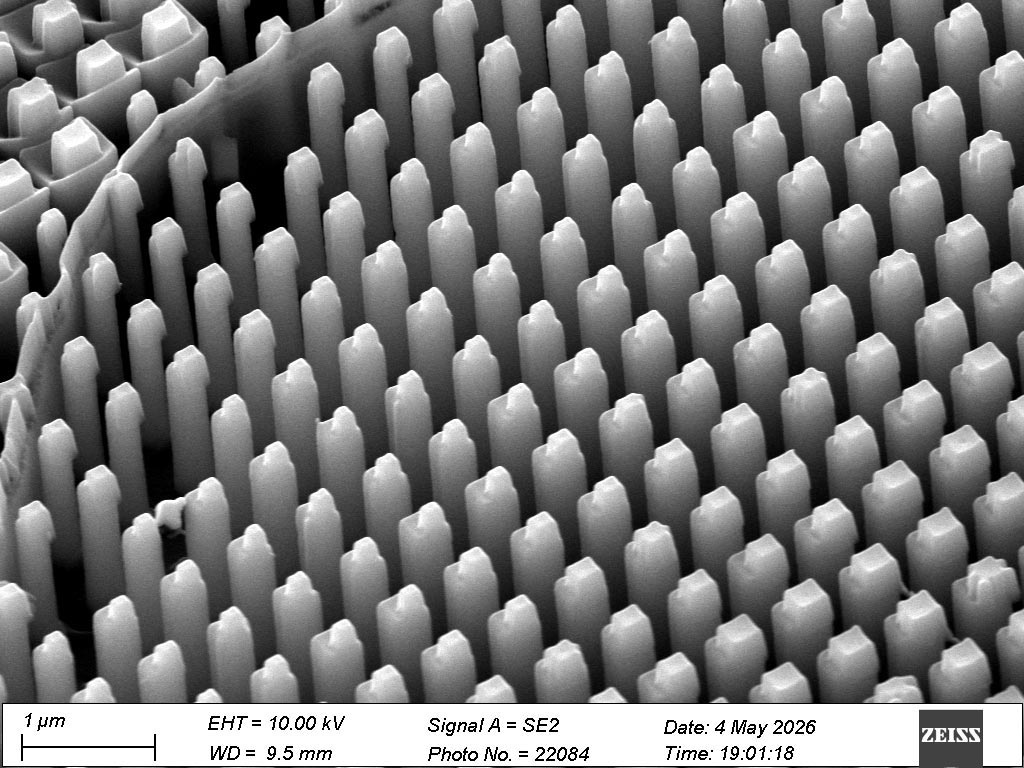
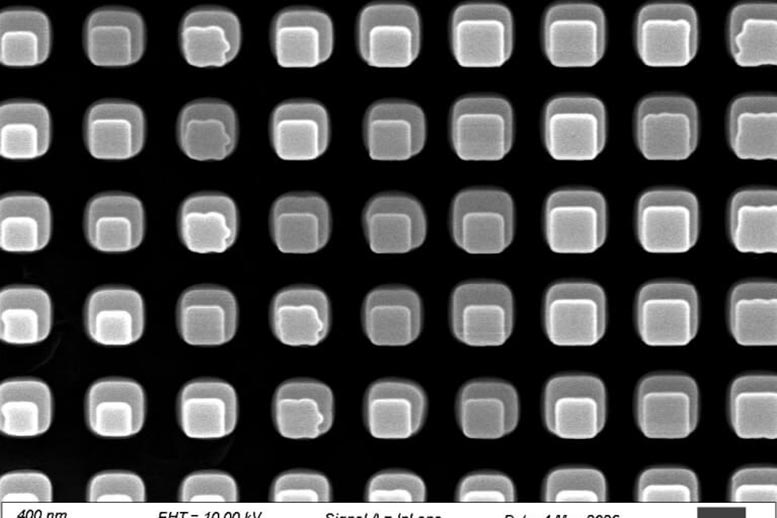
Under close inspection, a seemingly uniform metasurface consists of tiny pillars with varying dimensions. Each has a different effective refractive index, a measure of how much light slows down as it passes through. A conventional antireflection coating could reduce overall reflection, but it would not be optimized for every pillar, explained co-first author Davide Cassara, a graduate student who led the experiments.
Rather than applying a separate coating, the researchers designed the two titanium dioxide layers to work together.
“In the bilayer design, the upper pillar is tailored to the geometry beneath it, allowing local reflection control,” Cassara said.
From sharper images to quantum computing
Stacking layers also makes it possible to introduce optical functions that a single layer cannot provide. Varying their shapes and orientations could control the direction of reflected light or its polarization, which describes how light waves oscillate. Additional layers could further improve efficiency and enable achromatic lenses that correct color distortion for sharper images.
Multilayer metalenses could advance augmented and virtual reality, facial recognition, spectroscopy, and biological imaging. They might even serve as optical traps that use light to hold cold atoms in quantum computers.
Cassara noted that the design approach could extend to other materials, such as silicon, if suitable methods for fabricating two-layer structures become widely available.
The research builds on a longstanding collaboration with Corning Incorporated, a leading innovator in glass, ceramics, and optical physics.
“This research with Harvard showcases the value of long-term collaborations between academia and industry as well as the importance of combining materials science and engineering expertise to real-world product advancements,” said Paulo Dainese, Senior Principal Scientist, Corning. “By combining Corning and Harvard’s deep expertise in optical physics, this research has the potential to drive advancements in optical lens technology across multiple industries.”
Reference: “Antireflective bilayer metasurfaces with complete wavefront control” by Jaewon Oh, Davide Cassara, Alfonso Palmieri, Lorenzo Piatti, Janderson Rocha Rodrigues, Ahmed H. Dorrah, Paulo Dainese and Federico Capasso, 20 November 2026, Nature Nanotechnology.
DOI: 10.1038/s41565-026-02330-x
The work was supported by Corning through industry-sponsored research. Experiments were performed in part at the Harvard University Center for Nanoscale Systems (CNS), a member of the National Nanotechnology Coordinated Infrastructure Network (NNCI), which is supported by the National Science Foundation under NSF award no. ECCS-2025158. Support also came from the Air Force Office of Scientific Research under Award FA9550-21-1-0312.
Disclosure: The Harvard Office of Technology Development enabled the collaboration with Corning, which has led to protected innovations associated with this research, and is actively pursuing commercialization opportunities.
Never miss a breakthrough: Join the SciTechDaily newsletter.
Follow us on Google and Google News.