
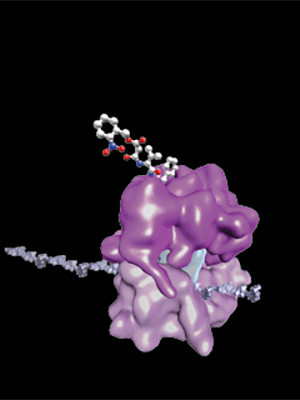
A team of Yale chemists is one step closer to using the ribosome — the cell’s protein-making factory — to create designer polymers, including stronger and more flexible materials and life-saving drugs.
The ribosome has a surprising capacity to insert the novel building blocks of polymers at the beginning of a protein sequence, the researchers report June 26 in the journal ACS Central Science.
“This paper reports that the ribosome can begin protein synthesis with molecules like those found in Kevlar or the precursors to important antibiotics,” said Alanna Schepartz, co-corresponding author of the study, Sterling Professor of Chemistry, and professor of molecular, cellular, and developmental biology.
Ribosomes string together amino acids into long polymer chains that fold into unique structures — the proteins found in every living cell. The sequence of amino acids required to make each protein is encoded genetically and decoded by the ribosome. Scientists like co-corresponding author Dieter Söll, Sterling Professor of Molecular Biophysics and Biochemistry and professor of chemistry, have spent decades figuring out how to introduce novel amino acids into proteins.
This brief animation illustrates the polymer creation process.
In this study, researchers went a step further and found that the ribosome itself can create bonds between amino acids and completely unrelated chemicals.
“Our results were completely unexpected, as the ribosome certainly did not evolve to begin protein synthesis in this way,” Schepartz said.
These findings represent an important first step toward coaxing the ribosome to synthesize chains of unnatural polymers, say the researchers. Since the ribosome synthesizes polymers based on genetically encoded instructions, these unnatural polymers can be programmed in the same way that the cell programs protein synthesis, the authors note.
“One can imagine in the future using these tools to generate novel fabrics, such as those with the sheerness of nylon and strength of Kevlar, or new therapeutics,” said Schepartz.
One molecule introduced to the ribosome is a precursor to valuable natural products, which already serve as the basis for several antibiotics and cholesterol-lowering drugs.
Making chemical polymers that possess a defined sequence and length from living cells is the mission of the Center for Genetically Encoded Materials (C-GEM), led by Schepartz. C-GEM brings together scientists with a broad range of expertise, including co-corresponding authors Söll and Scott Miller, the Irénée du Pont Professor of Chemistry and an expert in synthetic chemistry.
“This discovery is a direct result of the highly collaborative interdisciplinary environment of C-GEM,” Miller said. C-GEM is a National Science Foundation (NSF) Center for Chemical Innovation established at Yale in 2017. Co-workers on this project include Agilent Fellow Omer Ad, postdoctoral associates Kyle Hoffman and Andrew Cairns, and graduate student Aaron Featherston.
“This project, proposed to us in 2017, was considered high-risk yet high-reward,” said Carol Bessel, acting Division Director of NSF Chemistry. “It is great to see progress toward that reward as they work to harness biological chemistries, evolved over thousands of years, to design novel synthetic pathways for new or difficult-to-make molecules and polymers.”
Reference: “Translation of Diverse Aramid- and 1,3-Dicarbonyl-peptides by Wild Type Ribosomes in Vitro” by Omer Ad, Kyle S. Hoffman, Andrew G. Cairns, Aaron L. Featherston, Scott J. Miller, Dieter Söll and Alanna Schepartz, 26 June 2019, ACS Central Science.
DOI: 10.1021/acscentsci.9b00460
Never miss a breakthrough: Join the SciTechDaily newsletter.
Follow us on Google and Google News.