
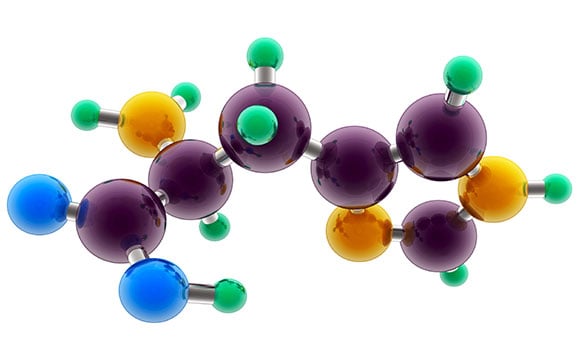
A new technique that can determine whether a molecule is present in a left- or right-handed form may have a multitude of practical applications, potentially leading to new and improved drugs, diagnosis methods, and pesticides.
Scientists have demonstrated for the first time the ability to rapidly, reliably, and simultaneously identify the ‘handedness’ of different molecules in a mixture.
The research, led by chemists at The University of Nottingham and the VU University Amsterdam, and published in the academic journal Nature Communications, could offer a new technique to easily distinguish whether a molecule is present in a left- or right-handed form.
The breakthrough could be important in developing effective molecules for use in a wide range of industries — everything from the development of safer new drugs and disease diagnosis to less toxic pesticides.
Many molecules exist in forms that are essentially identical, apart from being exact mirror images of one another. It is common for these so-called chiral molecules to exist in just one form in biological systems, although scientists still don’t fully understand why. For example, although both forms of amino acid molecules — the building blocks of life itself — can be made in the laboratory, in nature they only occur in the left-handed form.
The chirality of these biomolecules also strongly affects the way in which they interact with other molecules, for instance with chiral drugs. Presently, more than 50 percent of all drugs produced are active in only one of their two-handed forms.
The chemistry of life
Dr. Ivan Powis, Professor of Chemical Physics in the University’s School of Chemistry, who led the research, said: “It’s similar with things like sugars and for much bigger macromolecules such as DNA. People will be familiar with the double helix but may not realize that, apart from some very rare cases, it always spirals in the same direction.
“The chemistry of life is selective to chirality. It’s like having one glove from a pair that will only fit on the corresponding hand. Similarly, it is hard to shake someone else’s left hand with your right hand — it’s the same with molecules interacting. If you have a left-handed molecule it will have a preference for whether it interacts with a left- or right-handed molecule.”
Handedness is significant because it can affect the properties and function of otherwise identical molecules, the impact of which can be large enough to be detectable by the human body.
A classic example is the hundreds of molecule pairs in which the left- and right-handed forms smell completely different. The molecule limonene — used as a citrus fragrance and de-greaser in a wide variety of household cleaning products — is well-known for its ability to smell of either oranges or lemons depending on the handedness of the particular form of the molecule.
In pharmaceuticals, handedness can be crucial because one form of a molecule can be associated with an effective result while the other can lead to associated (severe) side effects, for instance the well-known malformation of the limbs of infants of pregnant women taking the Thalidomide drug to relieve morning sickness that occurred around 1960.
An existing method of differentiating between the left and right forms, called circular dichroism, involves exposing the molecules to circularly polarised light and detecting the difference between how the molecules absorb the light. But the distinguishing effects are weak — tiny fractions of a percent — so the technique struggles to approach the sensitivity of the human nose.
The latest research demonstrates a rapid new technique that can be used to identify the handedness of chiral molecules with more tangible effects and a greater degree of accuracy.
Mass-Selected PhotoElectron Circular Dichroism (MS-PECD) uses circularly polarised light produced by a laser to ionize the molecules — using a couple of photons to knock an electron out of the chiral molecule to leave a positively charged ion behind.
By tracking the direction that the electrons take when they travel out of the molecule — either forwards or backward along the laser beam — it is possible to distinguish between left and right-handed molecules with an accuracy of up to several tens of percent rather than a fraction of a percent.
Wide range of applications
This is combined with a mass spectrometry experiment in which a small electrical potential is applied to the negatively-charged electron and positively-charged ion which draws them out in opposite directions. The scientists look for simultaneous detection of the ion and electron — those reaching the detectors simultaneously are very likely to have come from the same molecule. The mass of the ion can be measured and matched with its partner electron. By combining these methods, it is possible to identify both the handedness of individual molecules and the proportion of left- and right-handed molecules in a mixture.
The scientists can use gas-based samples rather than high concentrations in solution and the technique is much more detailed — by looking at the energies involved scientists can see many other things about the molecule, not only whether it is left or right-handed but the shape which the molecule has taken and whether it interacts with other molecules.
The technique could have a wide range of applications. In addition to the development of effective new drugs and diagnosis methods for diseases including cancer, it could potentially lead to new ‘green’ pesticides using pheromones tailored specifically to attract pollinators or to repel destructive insects.
Chiral molecules are also emitted by some plants and trees when under stress and detectors to identify concentrations in air samples could be used to monitor our changing ecology.
While in the food industry, the technique could allow companies to refine the flavors of the food and drinks that we consume.
The research, Enantiomer Specific Analysis of Multi-Component Mixtures by Correlated Electron Imaging-Ion Mass Spectrometry, was funded by the Division of Chemical Sciences of the Netherlands Organisation for Scientific Research, with further European support from LASERLAB-EUROPE and the Marie Curie Initial Training Network ICONIC.
Reference: “Enantiomer-specific analysis of multi-component mixtures by correlated electron imaging–ion mass spectrometry” by Mohammad M Rafiee Fanood, N. Bhargava Ram, C. Stefan Lehmann, Ivan Powis and Maurice H. M. Janssen, 24 June 2015, Nature Communications.
DOI: 10.1038/ncomms8511
Never miss a breakthrough: Join the SciTechDaily newsletter.
Follow us on Google and Google News.
2 Comments
Right-handed glucose is sugar or sucrose and left-handed glucose is fructose. Humans can digest only right handed glucose or sugars whereas left-handed glucose are found in straw beans, cabbage etc., which animals feed and get them digested by bacterial enzymes of
E-coli. Thus in nature the very basic nature of molecular right handedness and left handedness is established. Even different proteins are made by molecules of right and left handedness, where chaperons make the packing in different modes and make them as epithelial tissue, muscle tissue, and liquid tissues like enzymes and hormones. The same building materials are dexterously or ambidextrously used by nature to build organs and organisms. Even DNA and packing of chromosomes follow this pattern.Thank You.
Sucrose is a combination of glucose and fructose. Glucose has a keto group on the first position and fructose has a keto on the second position, both are digestible. D-glucose is digestible its optical isomer, L-glucose, is not digestible. L-glucose is not fructose!
In pharmaceuticals, one optical isomer may be active while the other may be inactive or even toxic.