
Close Menu
    Facebook X (Twitter) Instagram
    SciTechDaily
    • Biology
    • Chemistry
    • Earth
    • Health
    • Physics
    • Science
    • Space
    • Technology
    Facebook X (Twitter) Pinterest YouTube RSS
    SciTechDaily
    Home»Space»First-Ever Interstellar Comet Captured in Multicolor Image
    Space

    First-Ever Interstellar Comet Captured in Multicolor Image

    By Association of Universities for Research in Astronomy (AURA)September 13, 2019No Comments2 Mins Read
    Facebook Twitter Pinterest Telegram LinkedIn WhatsApp Email Reddit
    Share
    Facebook Twitter LinkedIn Pinterest Telegram Email Reddit
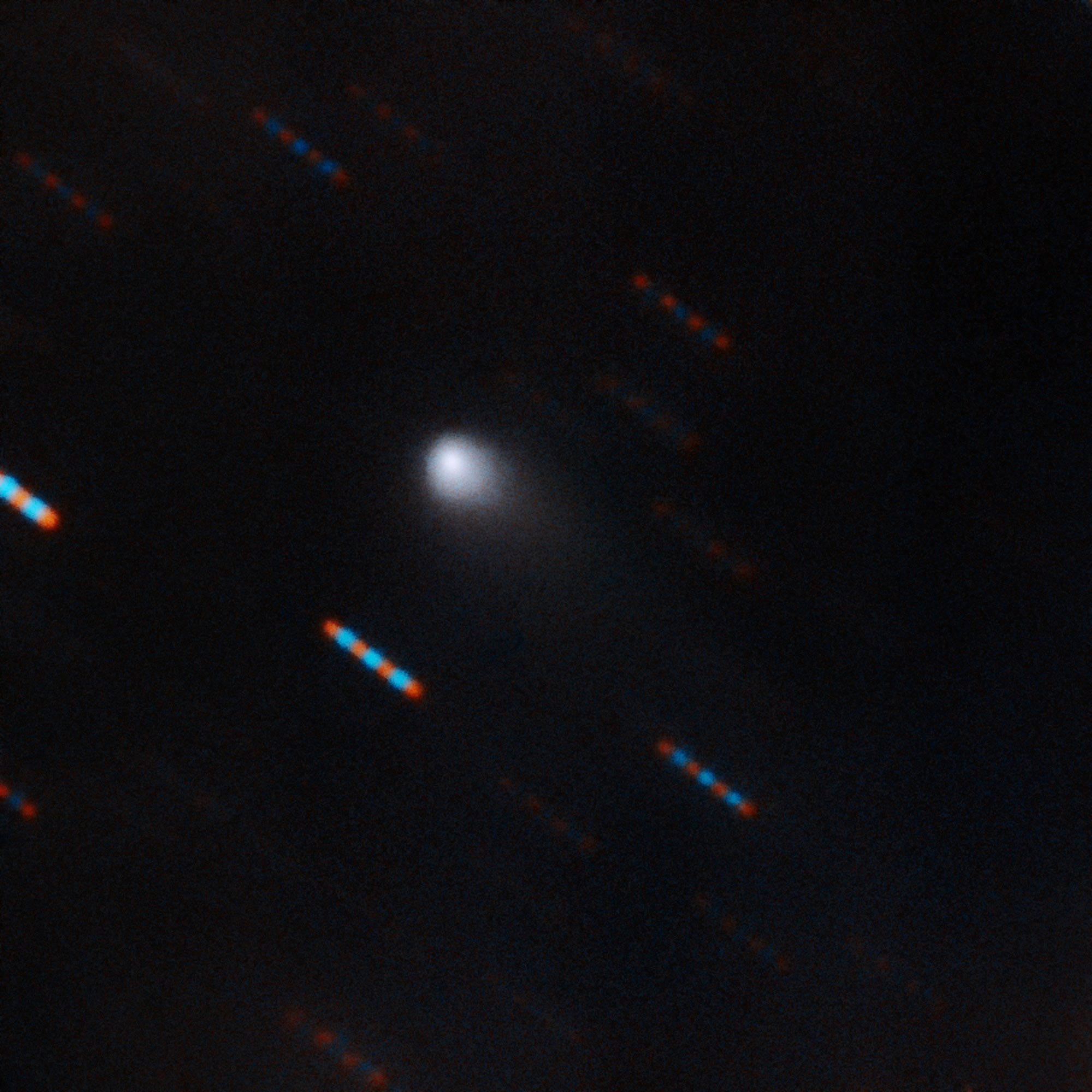
    Interstellar Comet C/2019 Q4 (Borisov)
    Gemini Observatory two-color composite image of C/2019 Q4 (Borisov) which is the first interstellar comet ever identified. This image was obtained using the Gemini North Multi-Object Spectrograph (GMOS) from Hawaii’s Maunakea. The image was obtained with four 60-second exposures in bands (filters) r and g. Blue and red dashes are images of background stars which appear to streak due to the motion of the comet. Composite image by Travis Rector. Credit: Gemini Observatory/NSF/AURA

    The first-ever comet from beyond our Solar System has been successfully imaged by the Gemini Observatory in multiple colors. The image of the newly discovered object, denoted C/2019 Q4 (Borisov), was obtained on the night of 9-10 September using the Gemini Multi-Object Spectrograph on the Gemini North Telescope on Hawaii’s Maunakea.

    “This image was possible because of Gemini’s ability to rapidly adjust observations and observe objects like this, which have very short windows of visibility,” said Andrew Stephens of Gemini Observatory who coordinated the observations. “However, we really had to scramble for this one since we got the final details at 3:00 am and were observing it by 4:45!”

    The image shows a very pronounced tail, indicative of outgassing, which is what defines a cometary object. This is the first time an interstellar visitor to our Solar System has clearly shown a tail due to outgassing. The only other interstellar visitor studied in our Solar System was ‘Oumuamua which was a very elongated asteroid-like object with no obvious outgassing.

    The Gemini observations used for this image were obtained in two color bands (filters) and combined to produce a color image. The observations were obtained as part of a target of opportunity program led by Piotr Guzik and Michal Drahus at the Jagiellonian University in Krakow (Poland). The research team has submitted a paper for publication.

    C/2019 Q4 is currently close to the apparent position of the Sun in our sky and is consequently difficult to observe due to the glow of twilight. The comet’s hyperbolic path, which is evidence of its origin beyond our Solar System, will bring it to more favorable observing conditions over the next few months.

    C/2019 Q4 was discovered by Russian amateur astronomer Gennady Borisov on August 30, 2019.

    Never miss a breakthrough: Join the SciTechDaily newsletter.
    Follow us on Google and Google News.

    Astronomy AURA Comet Gemini Observatory
    Share. Facebook Twitter Pinterest LinkedIn Email Reddit

    Related Articles

    Taffy Galaxies’ Collision Sculptures a Turbulent Bridge Devoid of Star Formation

    Atlas of Peculiar Galaxies: Strong-Arming a Galaxy

    New Discovery Reveals Why Uranus and Neptune Are Different Colors

    Crystal-Clear Images of Sidewinding Young Stellar Jets Captured by Gemini South Telescope’s Adaptive Optics System

    Gemini Catches a Glowing One-Winged Butterfly

    Ruins of Ancient Star Cluster Discovered at the Fringes of Our Galaxy

    Astronomers Discover Surprising Cause of a “Fizzled” Gamma-Ray Burst

    By Jove! Stunning New Images Show Jupiter’s Great Red Spot, Superstorms, and Gargantuan Cyclones

    Are We Missing Other Earths? Dramatic New Evidence Uncovered by Astronomers

    Leave A Reply Cancel Reply

    • Facebook
    • Twitter
    • Pinterest
    • YouTube

    Don't Miss a Discovery

    Subscribe for the Latest in Science & Tech!

    Trending News

    Scientists May Have Discovered How To Heal Damaged Kidneys

    Interstellar Visitor 3I/ATLAS Is Bursting With an Unexpected Chemical

    Scientists Just Found All 5 Genetic “Letters” of DNA and RNA on an Asteroid

    The 4,000-Year-Old City That Defied History’s Rules on Wealth and Power

    The World’s Biggest Population Fear Has Flipped – and It Could Change Everything

    This “Fake” Pill Improved Memory and Physical Performance in Just 3 Weeks

    Scientists Say Frequent Ejaculation May Improve Sperm Quality and Fertility

    Scientists Have Found “The Heaven Sword” After Years of Looking

    Follow SciTechDaily
    • Facebook
    • Twitter
    • YouTube
    • Pinterest
    • Newsletter
    • RSS
    SciTech News
    • Biology News
    • Chemistry News
    • Earth News
    • Health News
    • Physics News
    • Science News
    • Space News
    • Technology News
    Recent Posts
    • Watch What Happened When a Lost Elephant Calf Returned to Her Family
    • 17,000 Brain Scans Reveal Surprising Ethnic Differences in Alzheimer’s Biology
    • New Autism Treatment Strategy Restores Key Brain Receptor Function
    • Younger Generations Are Aging Faster – and It May Be Fueling a Surge in Cancer
    • Scientists Turn Ordinary Sunlight Into UV Light in Major Energy Breakthrough
    Copyright © 1998 - 2026 SciTechDaily. All Rights Reserved.
    • Science News
    • About
    • Contact
    • Editorial Board
    • Privacy Policy
    • Terms of Use

    Type above and press Enter to search. Press Esc to cancel.