
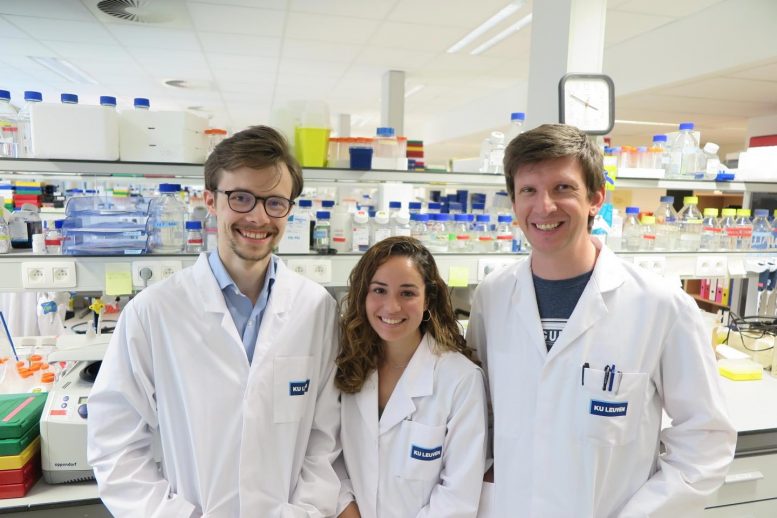
Researchers in Belgium present new findings on X chromosome reactivation.
Vincent Pasque and his team have unraveled parts of a mechanism that may one day help to treat Rett syndrome and other genetic disorders linked to the X chromosome.
Women and most female mammals have two X chromosomes, but only one of these is active in any given cell. This active X chromosome is selected through a flip-of-the-coin process in the very early stages of embryonic development: each chromosome has a 50/50 chance of remaining active and getting to express its genes, or to be inactivated through a process called X chromosome inactivation.
X chromosome inactivation is a perfectly normal process, but the consequences can be devastating when one of the X chromosomes carries a defective gene. This is the case in female patients with Rett syndrome: after one chromosome in each cell becomes inactive, about half of the patient’s cells will use the defective gene. Once born, the girls suffer a progressive loss of motor skills and speech. Male patients with Rett syndrome have only one X chromosome and therefore no healthy copy of the gene to compensate for the defective one; these patients usually die before birth.
So how can we treat Rett syndrome and other X-linked disorders? In theory, the answer is simple: in cells that use the defective gene, we reactivate the healthy copy on the inactive X chromosome. In practice, however, that’s easier said than done.
Stem cell researchers from the Vincent Pasque Lab at KU Leuven, together with researchers from the Jean-Christophe Marine lab (VIB/KU Leuven) and the Edith Heard lab (EMBL, Germany) have now solved part of the puzzle. In a paper published in Genome Research, they present new findings on the underlying mechanism of X chromosome reactivation.
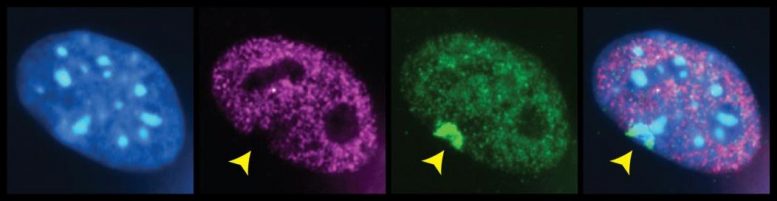
Reactivating genes in the lab
The first step towards developing new treatments is figuring out how X chromosome reactivation actually works, explains Adrian Janiszewski (KU Leuven), a co-lead author of the study. “Under normal circumstances, inactive X chromosomes only become active again during one of the very early stages of embryonic development. Rather than studying embryos, we used a technique known as cell reprogramming: we took adult cells from female mice and reprogrammed them in the culture dish into so-called induced pluripotent stem cells or iPS cells, which resemble embryonic stem cells but are not derived from early embryos.”
When you reprogramme female adult cells into iPS cells, both X chromosomes become active again. In other words: reactivation starts happening right under your microscope. — Vincent Pasque
Assistant Professor Vincent Pasque, the senior author of this study, continues: “Working with iPS cells has numerous advantages. Most importantly, when you reprogramme female adult cells into iPS cells, both X chromosomes become active again. In other words: X chromosome reactivation starts happening right under your microscope.”
Irene Talon (KU Leuven), the second co-lead author of the study, continues: “We monitored almost 200 different X-linked genes throughout the X chromosome reactivation process. What we found is that reactivation happens gradually: different genes require different amounts of time to become active again. Our findings suggest that the explanation for this speed difference is a combination of the location of the gene in 3D space on the X chromosome and the role of proteins (transcription factors), and enzymes (histone deacetylases), in particular.”

Long-term therapeutic potential
While this is one part of the puzzle, a lot of work remains to be done, Vincent Pasque concludes. “It’s important to remember that we’re talking about very fundamental research here. Contributing to the development of a cure for Rett syndrome and similar disorders is our long-term goal, but it will take us a while to get there, and there are many hurdles to overcome.”
“We still need to figure out how to use the mechanism for a single gene, how to do it safely in patients, and how to target the right cells in the brain. We do not yet know how to overcome these formidable challenges but we do know that gaining a fundamental understanding of how things work is the crucial first step. That’s how science works: it’s a slow process.”
We need to know the ins and outs of X chromosome reactivation before we can try to use the mechanism for therapeutic purposes. — Vincent Pasque
“Now that we have pinpointed three factors involved in X chromosome reactivation, we can start experimenting to find out more about their precise role. We need to know the ins and outs of X chromosome reactivation before we can try to use the mechanism for therapeutic purposes. This is why fundamental research is so important.”
Reference: “Dynamic Reversal of Random X Chromosome Inactivation during iPSC Reprogramming” by Adrian Janiszewski, Irene Talon, Joel Chappell, Samuel Collombet, Juan Song, Natalie De Geest, San Kit To, Greet Bervoets, Oskar Marin-Bejar, Caterina Provenzano, Lotte Vanheer, Jean-Christophe Marine, Florian Rambow and Vincent Pasque, 12 September 2019, Genome Research.
DOI: 10.1101/gr.249706.119
Never miss a breakthrough: Join the SciTechDaily newsletter.
Follow us on Google and Google News.