
Close Menu
    Facebook X (Twitter) Instagram
    SciTechDaily
    • Biology
    • Chemistry
    • Earth
    • Health
    • Physics
    • Science
    • Space
    • Technology
    Facebook X (Twitter) Pinterest YouTube RSS
    SciTechDaily
    Home»Biology»CCNE1 Gene Turns Back Cellular Clock
    Biology

    CCNE1 Gene Turns Back Cellular Clock

    By Bill Hathaway, Yale UniversityMay 22, 2015No Comments2 Mins Read
    Facebook Twitter Pinterest Telegram LinkedIn WhatsApp Email Reddit
    Share
    Facebook Twitter LinkedIn Pinterest Telegram Email Reddit
    Researchers Discover Human-Specific Gene That Turns Back Cellular Clock
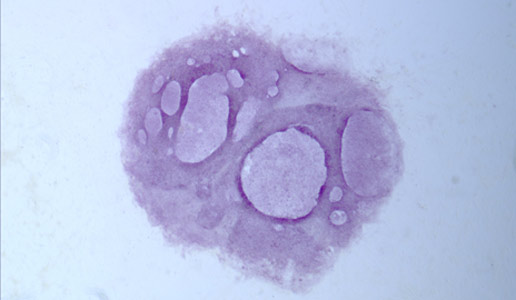
    A colony of embryonic-like cells form after activation of a gene variant only found in humans, essentially reprogramming mature cells. Credit: Yale University

    Yale researchers have discovered a gene that turns back the cellular clock, greatly aiding the reprogramming of mature cells.

    An exhaustive analysis of factors that allow mature cells to become like embryonic stem cells again has revealed a spliced form of a gene found only in primates that greatly aids the reprogramming of mature cells.

    The discovery of a human-specific gene involved in such a fundamental process as the creation of a pluripotent cell, one that can become a variety of tissue types, surprised Yale researchers. The gene called CCNE1 is normally involved in cell cycling, but the variant CCNE1 does not appear to play that role and instead appears critical for reprogramming. It is also unclear why the gene is found only in primate cells.

    The Yale team, led by geneticist In-Hyun Park, is studying how mature cells can be reprogrammed back to their embryonic state. The goal of the research is to better understand the processes of cell fate change and one day develop customized cell therapies for individual patients.

    The Yale team used a new form of transcriptome analysis that allowed them to more fully explore the impact of all types of RNA on cell reprogramming. The work will be published in the June 6 issue of Stem Cell Reports.

    Reference: “Transcriptome Signature and Regulation in Human Somatic Cell Reprogramming” by Yoshiaki Tanaka, Eriona Hysolli, Juan Su, Yangfei Xiang, Kun-Yong Kim, Mei Zhong, Yumei Li, Kartoosh Heydari, Ghia Euskirchen, Michael P. Snyder, Xinghua Pan, Sherman Morton Weissman and In-Hyun Park, 21 May 2015, Stem Cell Reports.
    DOI: 10.1016/j.stemcr.2015.04.009


    Never miss a breakthrough: Join the SciTechDaily newsletter.
    Follow us on Google and Google News.

    Genetics Stem Cells Yale University
    Share. Facebook Twitter Pinterest LinkedIn Email Reddit

    Related Articles

    piRNAs Key Role in Coordinating Biological Activity

    Study Shows that Genetics Play an Important Role in Anti-Tobacco Policies

    The Most Comprehensive Catalog of Human Genome Variations

    Atomic Level Splicing Further Establishes RNA’s Chemical and Structural Complexity

    Disabling MicroRNAs Allows Mice to Regenerate White Cells and Platelets Depleted by Chemotherapy

    Nanoparticle-Based System Advances Stem Cell Culture Techniques

    Stem Cells Regenerate Tissue in an Uninjured Mammal

    Evolutionary Changes Surrounding the NOS1 Gene

    Researchers Study Regulatory Gene’s Role in Sperm Quality Control

    Leave A Reply Cancel Reply

    • Facebook
    • Twitter
    • Pinterest
    • YouTube

    Don't Miss a Discovery

    Subscribe for the Latest in Science & Tech!

    Trending News

    Millions Take These IBS Drugs, But a New Study Finds Serious Risks

    Scientists Unlock Hidden Secrets of 2,300-Year-Old Mummies Using Cutting-Edge CT Scanner

    Bread Might Be Making You Gain Weight Even Without Eating More Calories

    Scientists Discover Massive Magma Reservoir Beneath Tuscany

    Europe’s Most Active Volcano Just Got Stranger – Here’s Why Scientists Are Rethinking It

    Alzheimer’s Symptoms May Start Outside the Brain, Study Finds

    Millions Take This Popular Supplement – Scientists Discover a Concerning Link to Heart Failure

    The Universe Is Expanding Too Fast and Scientists Can’t Explain Why

    Follow SciTechDaily
    • Facebook
    • Twitter
    • YouTube
    • Pinterest
    • Newsletter
    • RSS
    SciTech News
    • Biology News
    • Chemistry News
    • Earth News
    • Health News
    • Physics News
    • Science News
    • Space News
    • Technology News
    Recent Posts
    • Simple Blood Test May Predict Alzheimer’s Years Before Brain Scans Show Signs
    • Scientists Say Adding This Unusual Seafood to Your Diet Could Reverse Signs of Aging
    • U.S. Waste Holds $5.7 Billion Worth of Crop Nutrients
    • Scientists Say a Hidden Structure May Exist Inside Earth’s Core
    • Doctors Surprised by the Power of a Simple Drug Against Colon Cancer
    Copyright © 1998 - 2026 SciTechDaily. All Rights Reserved.
    • Science News
    • About
    • Contact
    • Editorial Board
    • Privacy Policy
    • Terms of Use

    Type above and press Enter to search. Press Esc to cancel.