
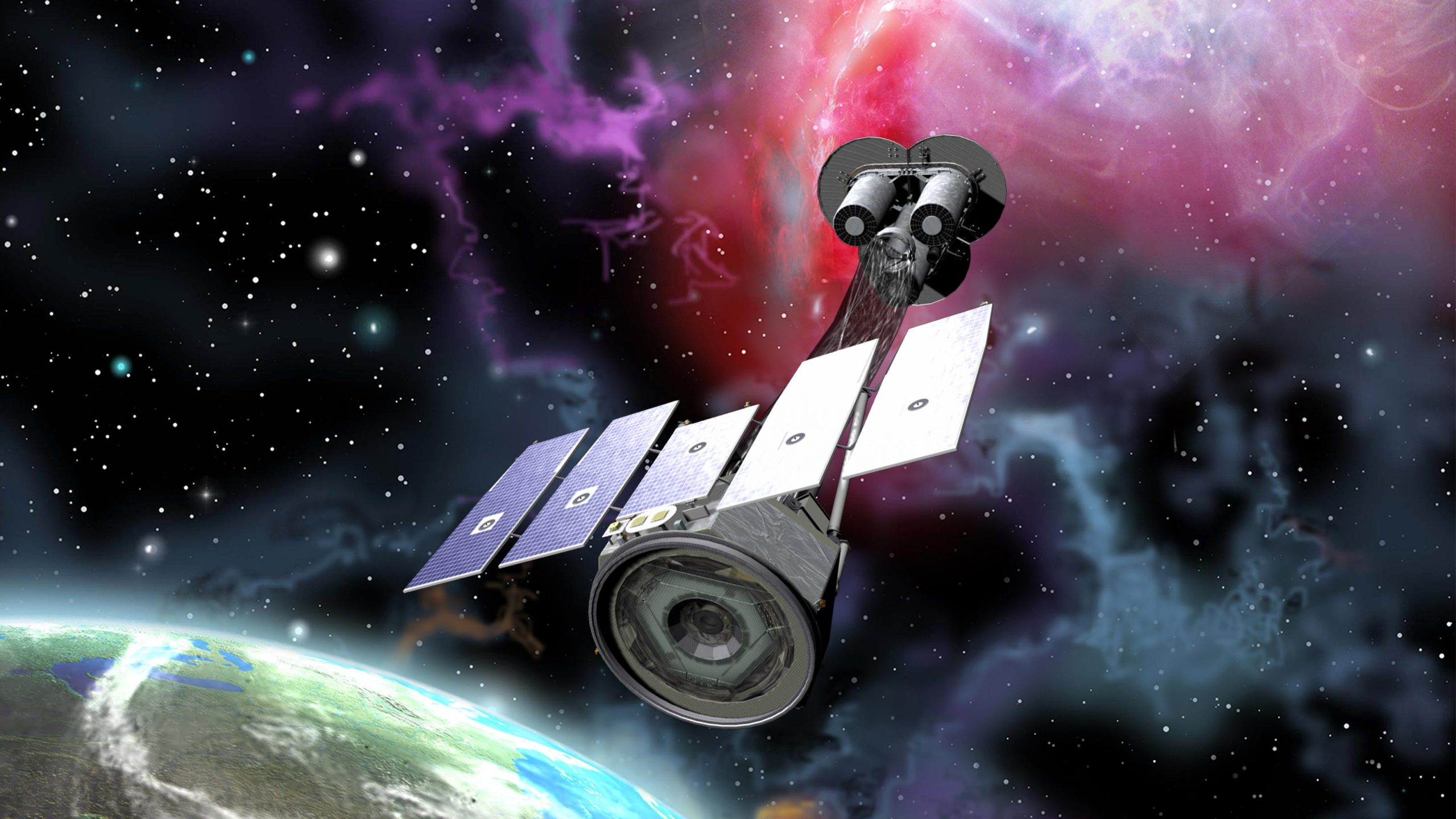
IXPE, an X-ray astronomy mission launched in 2021, has revolutionized our understanding of cosmic phenomena like blazars and supernova remnants.
On December 9, astronomers and physicists commemorated two years of landmark X-ray science by NASA’s IXPE (Imaging X-ray Polarimetry Explorer) mission.
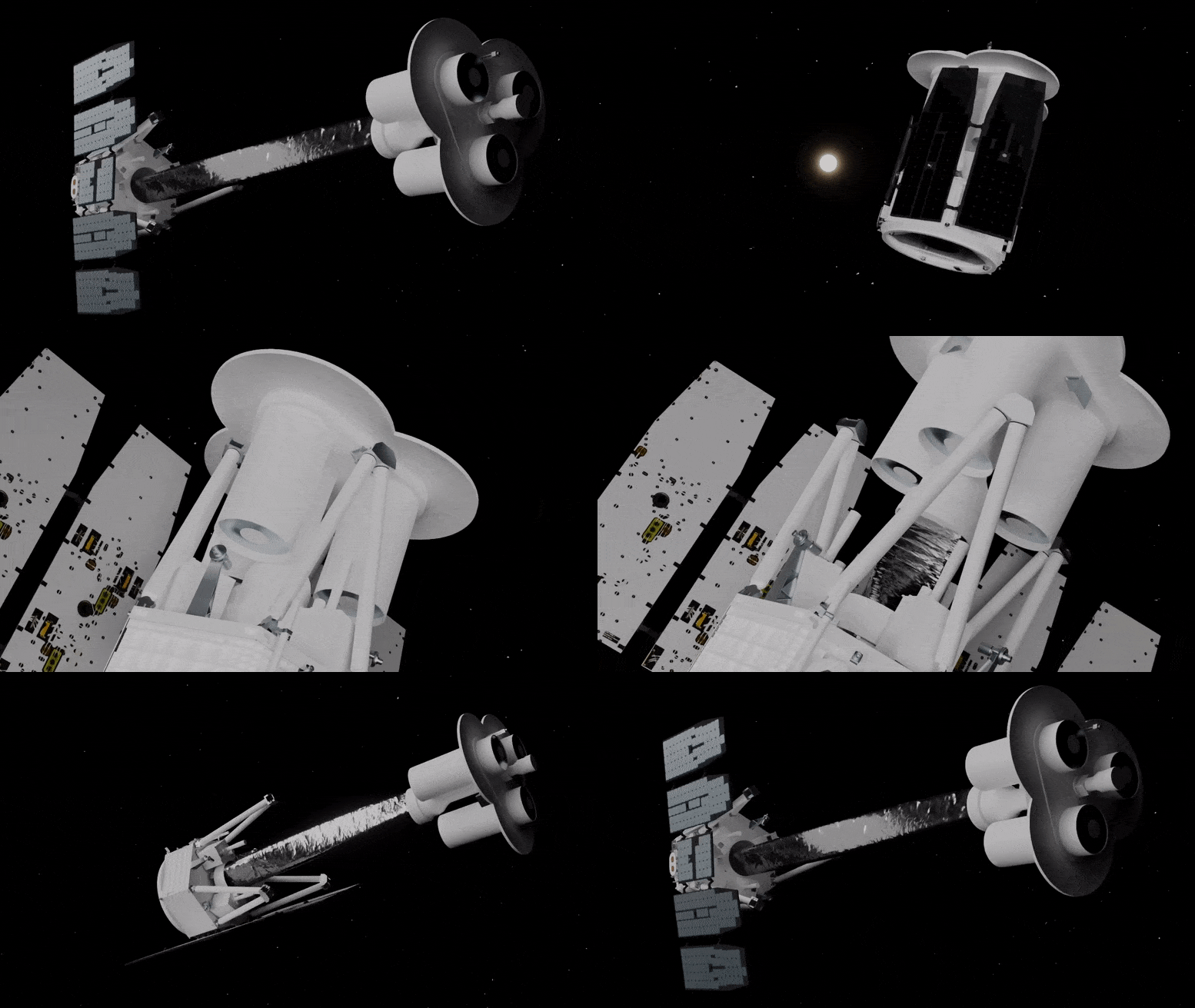
IXPE is the joint NASA-Italian Space Agency mission to study polarized X-ray light. Polarization is a characteristic of light that can help reveal information about where that light came from, such as the geometry and inner workings of the ultra-powerful energy sources from which it emanates.
Launched on December 9, 2021, IXPE orbits Earth some 340 miles high, studying X-ray emissions from powerful cosmic phenomena thousands to billions of light-years from Earth, including quasars, blazars, remnants of supernova explosions such as neutron stars, and high-energy particle streams spewing from the vicinity of black holes at nearly the speed of light.
“Adding X-ray polarization to our arsenal of radio, infrared, and optical polarization is a game changer,” said Alan Marscher, a Boston University astronomer who leads a research group that uses IXPE’s findings to analyze supermassive black holes.
“We’re all familiar with X-rays as a diagnostic medical tool for humans. Here we’re using them in a different way, but they are again revealing information that is otherwise hidden from us,” said Stanford University researcher Josephine Wong, who co-authored findings in October based on IXPE studies of the pulsar wind nebula MSH 15-52, some 16,000 light-years from Earth.
Martin Weisskopf, the astrophysicist who led the development of IXPE and served as its principal investigator until his retirement from NASA in spring 2022, agreed.
“There can be no question that IXPE has shown that X-ray polarimetry is important and relevant to furthering our understanding of how these fascinating X-ray systems work.”
Martin Weisskopf, Retired IXPE Principal Investigator
Scientists have long understood, for example, the fundamentals of blazars such as Markarian 501 and Markarian 421. A blazar is a massive black hole feeding off material swirling around it in a disk, creating powerful jets of high-speed cosmic particles that rush away in two directions perpendicular to the disk. But how are those particles accelerated to such high energies? IXPE data published in November 2022 in the journal Nature identified the culprit at Markarian 501 as a shock wave within the jet.
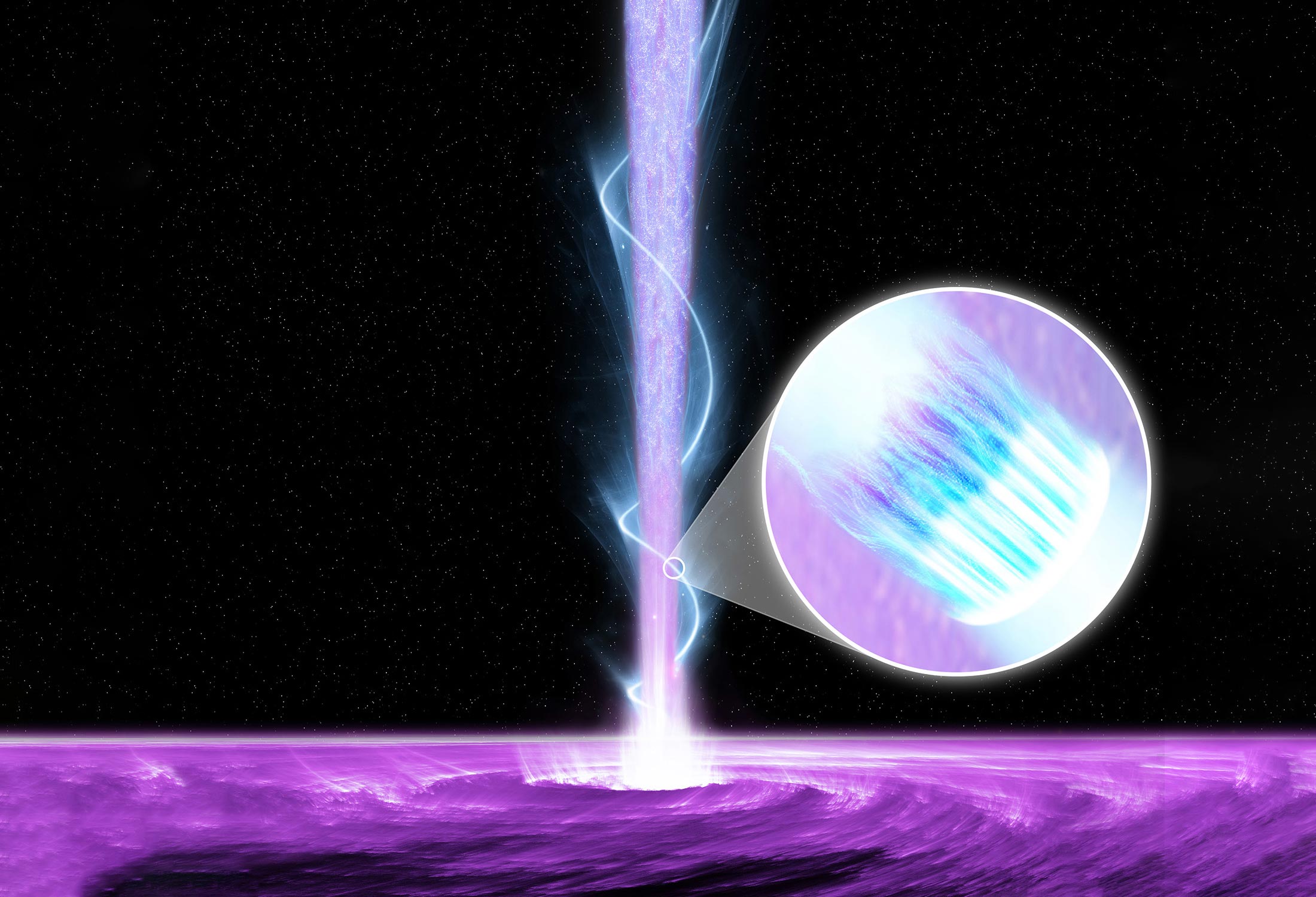
“This is a 40-year-old mystery that we’ve solved,” said Yannis Liodakis, a NASA Postdoctoral Program researcher at NASA’s Marshall Space Flight Center in Huntsville, Alabama. “We finally had all of the pieces of the puzzle, and the picture they made was clear.”
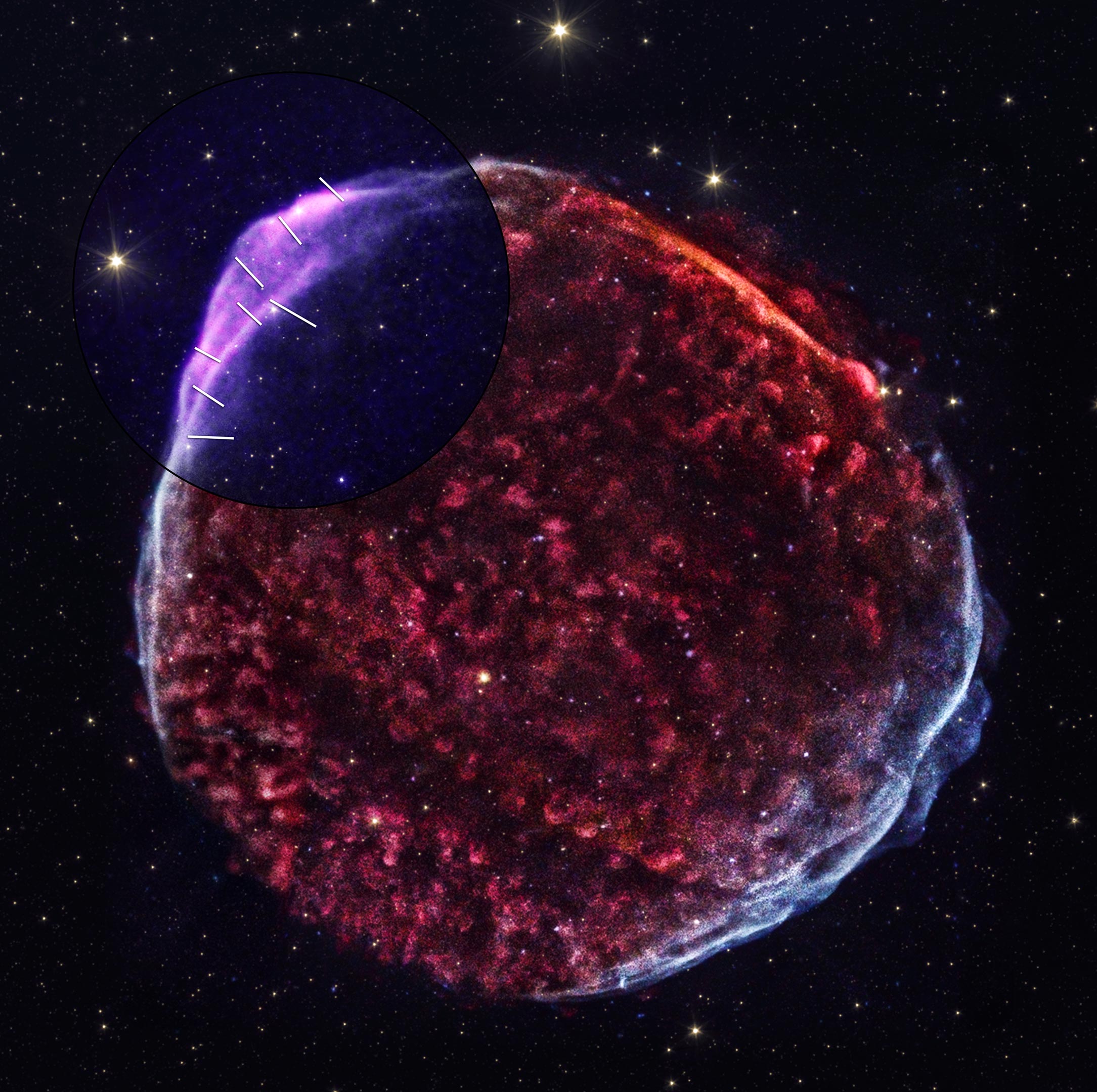
IXPE also conducted unprecedented studies of three supernova remnants – Cassiopeia A, Tycho, and SN 1006 – helping scientists further their understanding of the origin and processes of the magnetic fields surrounding these phenomena.
IXPE is even shedding new light on fundamental mechanisms of our own galaxy. According to studies IXPE conducted in early 2022, Sagittarius A*, the supermassive black hole at the center of the Milky Way, woke up about 200 years ago to devour gas and other cosmic detritus, triggering an intense, short-lived X-ray flare. By combining data from IXPE, Chandra, and the European Space Agency’s XMM-Newton mission, researchers determined the event occurred around the start of the 19th century.
“We know change can happen to active galaxies and supermassive black holes on a human timescale,” said IXPE project scientist Steve Ehlert at NASA Marshall. “IXPE is helping us better understand the timescale on which the black hole at the center of our galaxy is changing. We’re eager to observe it further to determine which changes are typical and which are unique.”
IXPE has also supported observations of unanticipated cosmic events – such as the brightest pulse of intense radiation ever recorded, which abruptly swept through our solar system in October 2022.
The pulse stemmed from a powerful gamma-ray burst likely to occur no more than once in 10,000 years, researchers said. Backing up data from NASA’s Fermi Space Telescope and other imagers, IXPE helped determine how the powerful emission was organized and confirmed that Earth imagers viewed the jet almost directly head-on.
Perhaps most exciting to space scientists is how IXPE data is upending conventional wisdom about various classes of high-energy sources.
“So many of the polarized X-ray results we’ve seen over the past two years were a big surprise, tossing theoretical models right out the window,” Ehlert said.
“Seeing results we didn’t anticipate sparks new questions, new theories. It’s really exciting!”
Steve Ehlert, IXPE Project Scientist
That excitement continues to build among IXPE partners around the world. In June, the mission was formally extended for 20 months beyond its initial two-year flight, meaning IXPE will continue to observe high-energy X-ray emissions across the cosmos through at least September 2025.
The new year also will mark the start of the IXPE General Observer Program, which invites astrophysicists and other space scientists around the world to propose and take part in studies using the IXPE telescope. Beginning in February 2024, as much as 80% of IXPE’s time will be made available to the broader scientific community.
About the IXPE Mission
IXPE is a collaboration between NASA and the Italian Space Agency with partners and science collaborators in 12 countries. IXPE is led by NASA’s Marshall Space Flight Center. Ball Aerospace, headquartered in Broomfield, Colorado, manages spacecraft operations together with the University of Colorado’s Laboratory for Atmospheric and Space Physics in Boulder.
Never miss a breakthrough: Join the SciTechDaily newsletter.
Follow us on Google and Google News.