
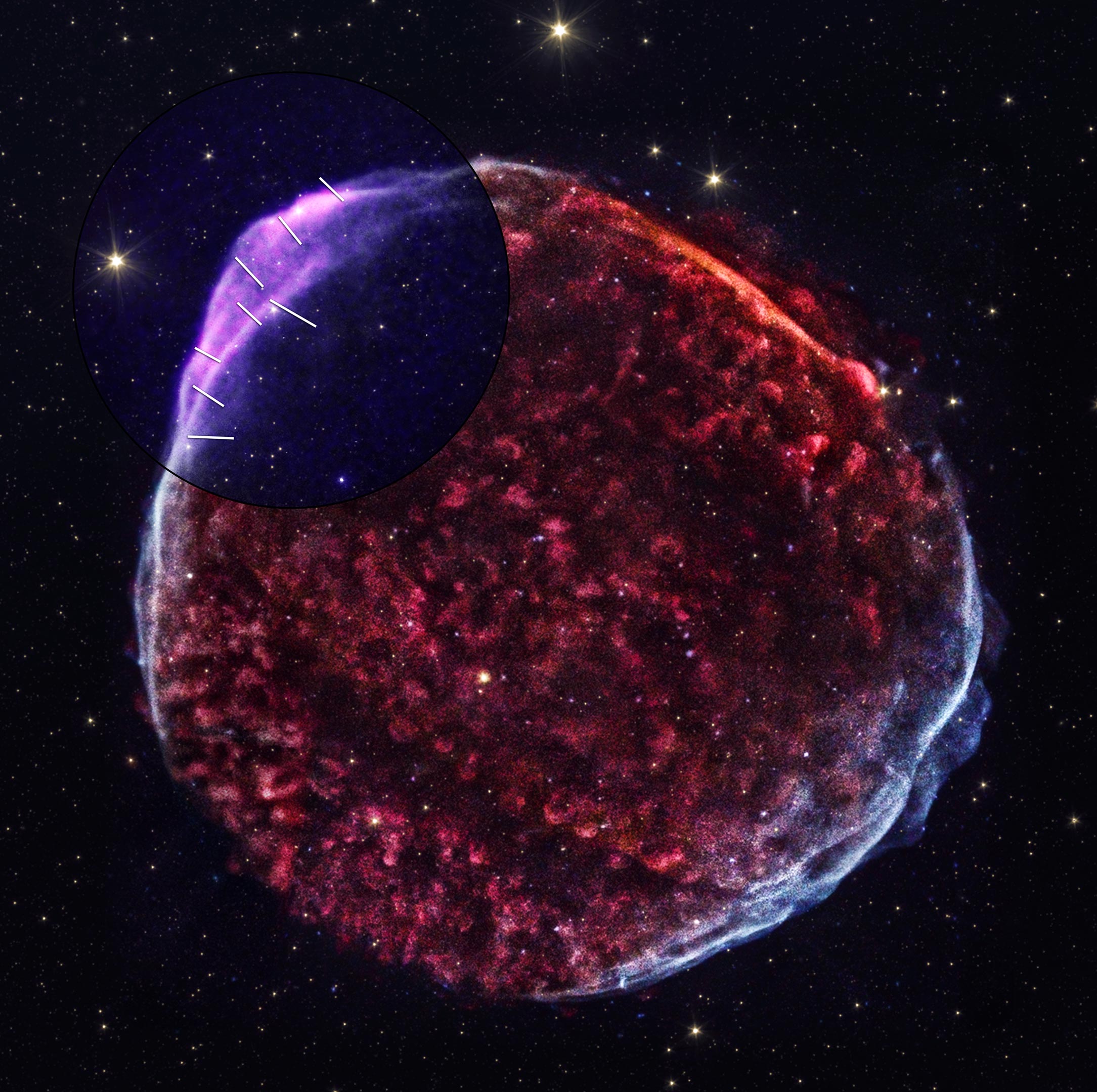
NASA’s IXPE telescope has unveiled groundbreaking images of SN 1006’s magnetic fields, offering new insights into particle acceleration in supernovas and enhancing our understanding of cosmic magnetic phenomena.
NASA’s IXPE (Imaging X-ray Polarimetry Explorer) telescope has captured the first polarized X-ray imagery of the supernova remnant SN 1006. The new results expand scientists’ understanding of the relationship between magnetic fields and the flow of high-energy particles from exploding stars.
“Magnetic fields are extremely difficult to measure, but IXPE provides an efficient way for us to probe them,” said Dr. Ping Zhou, an astrophysicist at Nanjing University in Jiangsu, China, and lead author of a new paper on the findings, published in The Astrophysical Journal. “Now we can see that SN 1006’s magnetic fields are turbulent, but also present an organized direction.”
Historical Significance and Structure of SN 1006
Situated some 6,500 light-years from Earth in the Lupus constellation, SN 1006 is all that remains after a titanic explosion, which occurred either when two white dwarfs merged or when a white dwarf pulled too much mass from a companion star. Initially spotted in the spring of 1006 CE by observers across China, Japan, Europe, and the Arab world, its light was visible to the naked eye for at least three years. Modern astronomers still consider it the brightest stellar event in recorded history.
Since modern observation began, researchers have identified the remnant’s strange double structure, markedly different from other, rounded supernova remnants. It also has bright “limbs” or edges identifiable in the X-ray and gamma-ray bands.
IXPE’s Role in Understanding Supernova Remnants
“Close-proximity, X-ray-bright supernova remnants such as SN 1006 are ideally suited to IXPE measurements, given IXPE’s combination of X-ray polarization sensitivity with the capability to resolve the emission regions spatially,” said Douglas Swartz, a Universities Space Research Association researcher at NASA’s Marshall Space Flight Center in Huntsville, Alabama. “This integrated capability is essential to localizing cosmic-ray acceleration sites.”
Previous X-ray observations of SN 1006 offered the first evidence that supernova remnants can radically accelerate electrons, and helped identify rapidly expanding nebulae around exploded stars as a birthplace for highly energetic cosmic rays, which can travel at nearly the speed of the light.
Scientists surmised that SN 1006’s unique structure is tied to the orientation of its magnetic field, and theorized that supernova blast waves in the northeast and southwest move in the direction aligned with the magnetic field, and more efficiently accelerate high-energy particles.
IXPE’s new findings helped validate and clarify those theories, said Dr. Yi-Jung Yang, a high-energy astrophysicist at the University of Hong Kong and coauthor of the paper.
“The polarization properties obtained from our spectral-polarimetric analysis align remarkably well with outcomes from other methods and X-ray observatories, underscoring IXPE’s reliability and strong capabilities,” Yang said.
“For the first time, we can map the magnetic field structures of supernova remnants at higher energies with enhanced detail and accuracy – enabling us to better understand the processes driving the acceleration of these particles.”
Dr. Yi-Jung Yang, High-energy astrophysicist at the University of Hong Kong
Mapping Magnetic Fields and Particle Acceleration
Researchers say the results demonstrate a connection between the magnetic fields and the remnant’s high-energy particle outflow. The magnetic fields in SN 1006’s shell are somewhat disorganized, per IXPE’s findings, yet still have a preferred orientation. As the shock wave from the original explosion passes through the surrounding gas, the magnetic fields become aligned with the shock wave’s motion. Charged particles are trapped by the magnetic fields around the original point of the blast, where they quickly receive bursts of acceleration. Those speeding high-energy particles, in turn, transfer energy to keep the magnetic fields strong and turbulent.
IXPE has observed three supernova remnants – Cassiopeia A, Tycho, and now SN 1006 – since launching in December 2021, helping scientists develop a more comprehensive understanding of the origin and processes of the magnetic fields surrounding these phenomena.
Scientists were surprised to find that SN 1006 is more polarized than the other two supernova remnants, but that all three show magnetic fields oriented such that they point outward from the center of the explosion. As researchers continue to explore IXPE data, they are re-orienting their understanding of how particles get accelerated in extreme objects like these.
Reference: “Magnetic Structures and Turbulence in SN 1006 Revealed with Imaging X-Ray Polarimetry” by Ping Zhou, Dmitry Prokhorov, Riccardo Ferrazzoli, Yi-Jung Yang, Patrick Slane, Jacco Vink, Stefano Silvestri, Niccolò Bucciantini, Estela Reynoso, David Moffett, Paolo Soffitta, Doug Swartz, Philip Kaaret, Luca Baldini, Enrico Costa, C.-Y. Ng, Dawoon E. Kim, Victor Doroshenko, Steven R. Ehlert, Jeremy Heyl, Frédéric Marin, Tsunefumi Mizuno, Melissa Pesce-Rollins, Carmelo Sgrò, Toru Tamagawa, Martin C. Weisskopf, Fei Xie, Iván Agudo, Lucio A. Antonelli, Matteo Bachetti, Wayne H. Baumgartner, Ronaldo Bellazzini, Stefano Bianchi, Stephen D. Bongiorno, Raffaella Bonino, Alessandro Brez, Fiamma Capitanio, Simone Castellano, Elisabetta Cavazzuti, Chien-Ting Chen, Stefano Ciprini, Alessandra De Rosa, Ettore Del Monte, Laura Di Gesu, Niccolò Di Lalla, Alessandro Di Marco, Immacolata Donnarumma, Michal Dovčiak, Teruaki Enoto, Yuri Evangelista, Sergio Fabiani, Javier A. Garcia, Shuichi Gunji, Kiyoshi Hayashida, Wataru Iwakiri, Svetlana G. Jorstad, Fabian Kislat, Vladimir Karas, Takao Kitaguchi, Jeffery J. Kolodziejczak, Henric Krawczynski, Fabio La Monaca, Luca Latronico, Ioannis Liodakis, Simone Maldera, Alberto Manfreda, Andrea Marinucci, Alan P. Marscher, Herman L. Marshall, Giorgio Matt, Ikuyuki Mitsuishi, Fabio Muleri, Michela Negro, Stephen L. O’Dell, Nicola Omodei, Chiara Oppedisano, Alessandro Papitto, George G. Pavlov, Abel L. Peirson, Matteo Perri, Pierre-Olivier Petrucci, Maura Pilia, Andrea Possenti, Juri Poutanen, Simonetta Puccetti, Brian D. Ramsey, John Rankin, Ajay Ratheesh, Oliver Roberts, Roger W. Romani, Gloria Spandre, Fabrizio Tavecchio, Roberto Taverna, Yuzuru Tawara, Allyn F. Tennant, Nicholas E. Thomas, Francesco Tombesi, Alessio Trois, Sergey S. Tsygankov, Roberto Turolla, Kinwah Wu and Silvia Zane, 27 October 2023, The Astrophysical Journal.
DOI: 10.3847/1538-4357/acf3e6
IXPE is a collaboration between NASA and the Italian Space Agency with partners and science collaborators in 12 countries. IXPE is led by NASA’s Marshall Space Flight Center in Huntsville, Alabama. Ball Aerospace, headquartered in Broomfield, Colorado, manages spacecraft operations together with the University of Colorado’s Laboratory for Atmospheric and Space Physics in Boulder.
Never miss a breakthrough: Join the SciTechDaily newsletter.
Follow us on Google and Google News.
1 Comment
And, for whatever reason, this remnant looks creepily like a Jack o’lantern.