
Close Menu
    Facebook X (Twitter) Instagram
    SciTechDaily
    • Biology
    • Chemistry
    • Earth
    • Health
    • Physics
    • Science
    • Space
    • Technology
    Facebook X (Twitter) Pinterest YouTube RSS
    SciTechDaily
    Home»Physics»New Designs for Optical Tools Inspired by Kaleidoscope Mirror Symmetry
    Physics

    New Designs for Optical Tools Inspired by Kaleidoscope Mirror Symmetry

    By American Institute of PhysicsSeptember 28, 2019No Comments3 Mins Read
    Facebook Twitter Pinterest Telegram LinkedIn WhatsApp Email Reddit
    Share
    Facebook Twitter LinkedIn Pinterest Telegram Email Reddit
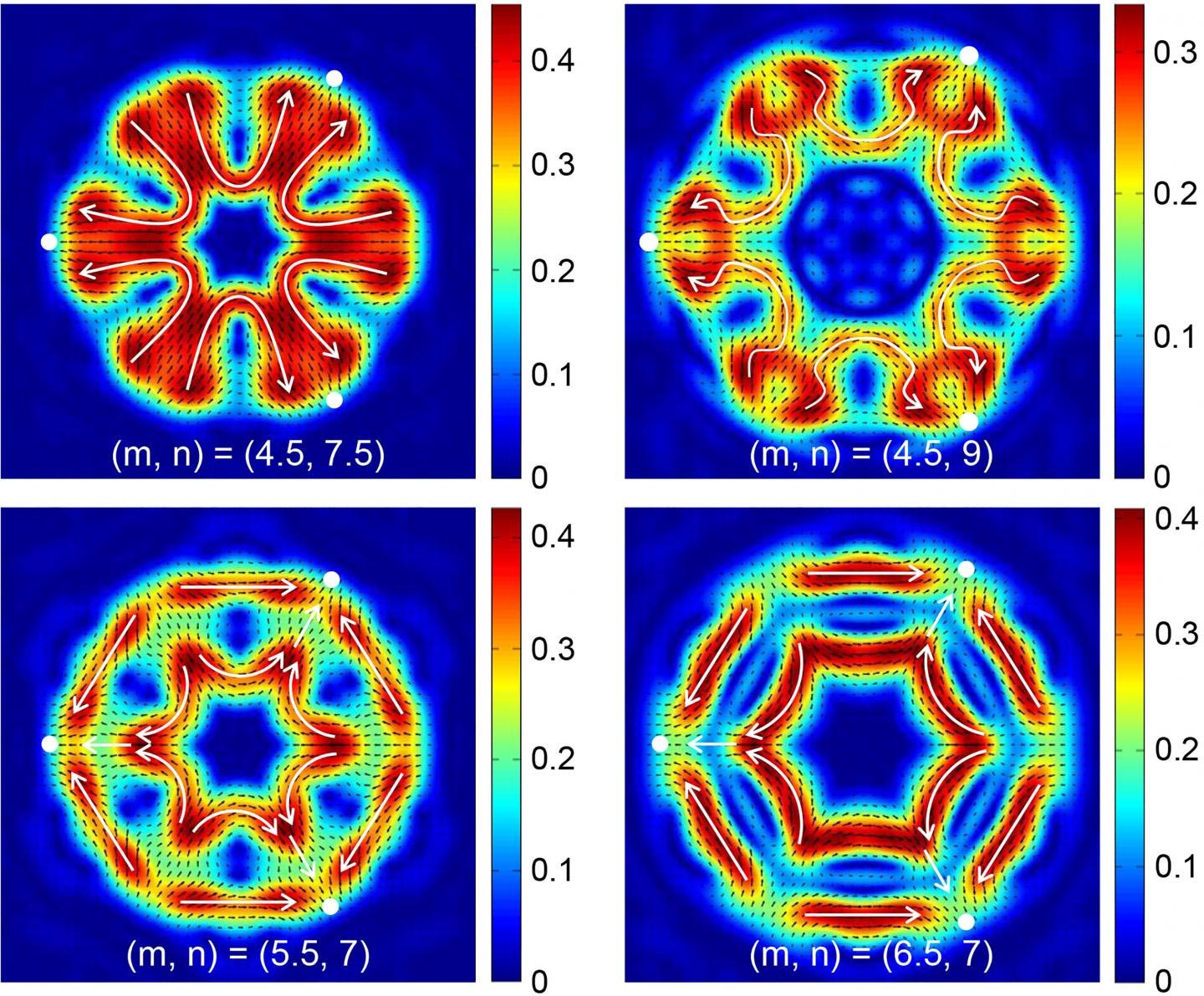
    Kaleidoscope Mirror Symmetry
    Transverse components of the normalized Poynting vectors in the focal plane of the tightly focused kaleidoscope-structured vector optical fields. The direction of the transverse energy flow is shown by the white and black arrows. The transverse energy flow shows six uniform tentacles (top left) and patterns like six spanners (top right), which are useful to trap and transport the particles. Credit: Yue Pan/Qufu Normal University

    Using multiple-axis symmetry inspired by kaleidoscopes, new polarization designs can control spin angular momentum and transverse energy flow for complex optical tools.

    Washington, D.C. — In a kaleidoscope, mirrors are placed at angles to create a visual illusion of multiple, symmetric images from one original object. The number of symmetric axes in the kaleidoscope depends on the number of mirrors and angles inside.

    Drawing inspiration from this multiple-axis symmetry, researchers have discovered a new method for creating mirror-symmetric axes in the polarizations of light, which allows for complex manipulations that are useful in optical tools and technologies.

    For example, optical machining, photodetectors, optical cages and microscopy are all tools that rely on vector optical fields of varying degrees of complexity. Many of them use mirror symmetry in their polarization states and focal manipulation.

    In the paper, published in APL Photonics, from AIP Publishing, the researchers start with a cylindrical vector optical field and introduce a kaleidoscope structure to the polarization states by assigning a parameter for mirror-symmetric axes. That new parameter, which offers an additional degree of freedom, is scheduled into the transmission function on a holographic grating in a spatial light modulator to generate new vector optical fields.

    “Mirror symmetry already exists in vector optical fields,” author Yue Pan said. “However, no research has systematically studied the arbitrary symmetry properties of the original vector optical fields and spin angular momentum and energy flow in the focal plane. We first propose the kaleidoscope-structured vector optical fields with arbitrary symmetry, and gain spin angular momentum and energy flow with good properties and applications.”

    By implementing multiple mirror symmetry axes into the design, they were able to create tightly focused fields in various useful shapes, including a subwavelength flattop sharp line that can be used in optical storage and lithography, and various cross, gear and hexagon shapes with tentacles and spanners that are useful for optical trapping. They were also able to introduce the elliptical polarization into the design of the new vector fields, which Pan said could help to further control the design and generation of kaleidoscope-structured vector optical fields.

    Author Hui-Tian Wang, leader of the group, said they plan to study a theory that can accurately predict and manipulate the symmetry properties of tightly focused optical fields, propose new kinds of vector optical fields with novel orbital angular momentum, and further study the spin-orbital angular momentum conversion and coupling.

    Reference: “Spin angular momentum density and transverse energy flow of tightly focused kaleidoscope-structured vector optical fields” by Yue Pan, Xu-Zhen Gao, Guan-Lin Zhang, Yongnan Li, Chenghou Tu and Hui-Tian Wang, 17 September 2019, APL Photonics.
    DOI: 10.1063/1.5117269

    Never miss a breakthrough: Join the SciTechDaily newsletter.
    Follow us on Google and Google News.

    American Institute of Physics Optics
    Share. Facebook Twitter Pinterest LinkedIn Email Reddit

    Related Articles

    Faster, More Secure Communications Using Structured Light in Quantum Protocols

    Bypassing Moore’s Law With High-Speed Photonic Computers

    Miniaturizing Medical Imaging, Sensing Technology Is a “Big Deal”

    New System Filters Light Waves Based on Direction

    Physicists Develop a New Method to Accelerate Charged Particles

    Cathodoluminescence Used to Probe Metamaterials

    Fastest Laser Blast – 67 Quintillionths of a Second

    Gamma Ray Lens Created Using Amplifying Effect of Virtual Electron-Positron Pairs

    First Universal Quantum Network Prototype Operational

    Leave A Reply Cancel Reply

    • Facebook
    • Twitter
    • Pinterest
    • YouTube

    Don't Miss a Discovery

    Subscribe for the Latest in Science & Tech!

    Trending News

    Largest-Ever Study Finds Medicinal Cannabis Ineffective for Anxiety, Depression, PTSD

    250-Million-Year-Old Egg Solves One of Evolution’s Biggest Mysteries

    Living With Roommates Might Be Changing Your Gut Microbiome Without You Knowing

    Century-Old Cleaning Chemical Linked to 500% Increased Risk of Parkinson’s Disease

    What if Your Memories Never Happened? Physicists Take a New Look at the Boltzmann Brain Paradox

    One of the Universe’s Largest Stars May Be Getting Ready To Explode

    Scientists Discover Enzyme That Could Supercharge Ozempic-Like Weight Loss Drugs

    Popular Sweetener Linked to DNA Damage – “It’s Something You Should Not Be Eating”

    Follow SciTechDaily
    • Facebook
    • Twitter
    • YouTube
    • Pinterest
    • Newsletter
    • RSS
    SciTech News
    • Biology News
    • Chemistry News
    • Earth News
    • Health News
    • Physics News
    • Science News
    • Space News
    • Technology News
    Recent Posts
    • Scientists Find Way to Reverse Fatty Liver Disease Without Changing Diet
    • Could Humans Regrow Limbs? New Study Reveals Promising Genetic Pathway
    • Black Hole Jets Pack Power of 10,000 Suns, Stunning New Study Reveals
    • A Cosmic Crash Turned This Nearby Galaxy Into Chaos
    • This Alien Solar System Doesn’t Follow the Rules – and Scientists Are Intrigued
    Copyright © 1998 - 2026 SciTechDaily. All Rights Reserved.
    • Science News
    • About
    • Contact
    • Editorial Board
    • Privacy Policy
    • Terms of Use

    Type above and press Enter to search. Press Esc to cancel.