
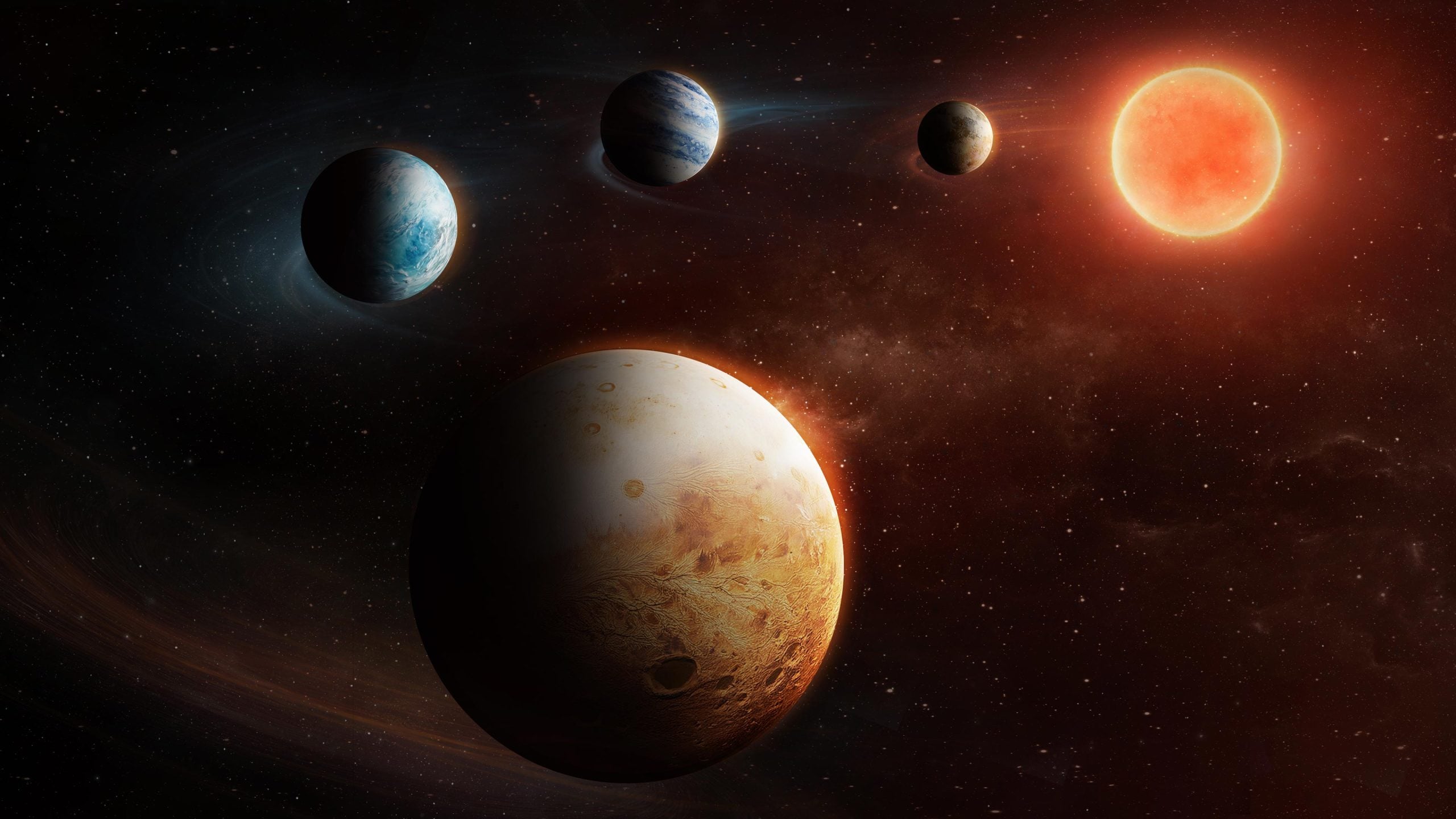
The LHS 1903 system defies expectations with a rocky outer planet, prompting new ideas about how planets form and evolve.
As astronomers discover more exoplanets, it is becoming clear that our solar system and its past may be unusual.
A fourth planet recently identified in the LHS 1903 system by the European Space Agency’s CHEOPS mission has added to that picture. This rocky world sits in a location that current models would not predict. The system appears to have formed in an “inside-out” pattern, which could challenge existing ideas about how planets develop.
In the late 20th century, scientists often described planetary formation using our solar system as a template. In that view, small rocky planets form close to the Sun, while gas and ice giants form farther away. However, the discovery of more than 6,128 exoplanets across 4,560 systems, along with unusual types such as hot Jupiters and planets orbiting pulsars, suggests that our solar system may not be typical.
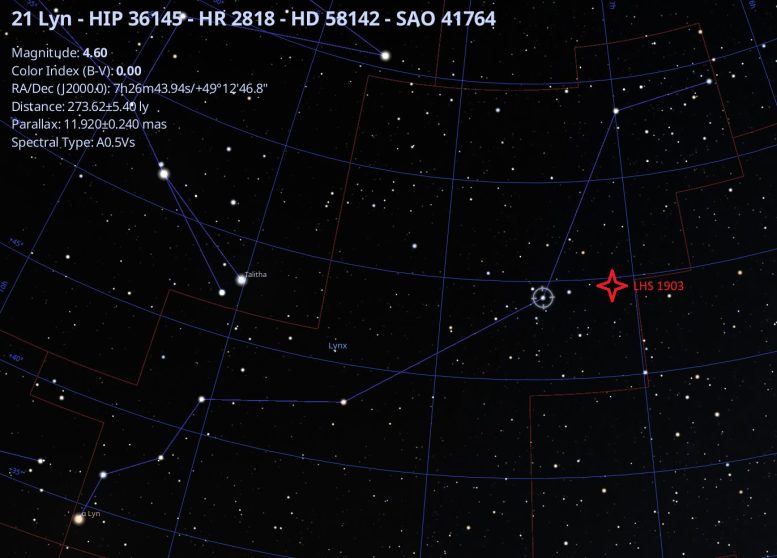
The newly identified fourth planet in the LHS 1903 system has raised questions among researchers. LHS 1903 lies about 116 light-years (about 1.1 quadrillion kilometers) away in the northern constellation Lynx, near the +4.6 magnitude star 21 Lyncis. Its central star is an M-type red dwarf.
The system contains four planets: two rocky worlds, b and e, which are the innermost and outermost planets, and two middle planets, c and d, that are mini Neptune gas dwarfs. These intermediate planets have about six times Earth’s mass and more than twice its diameter.
LHS 1903 System Discovery and Structure
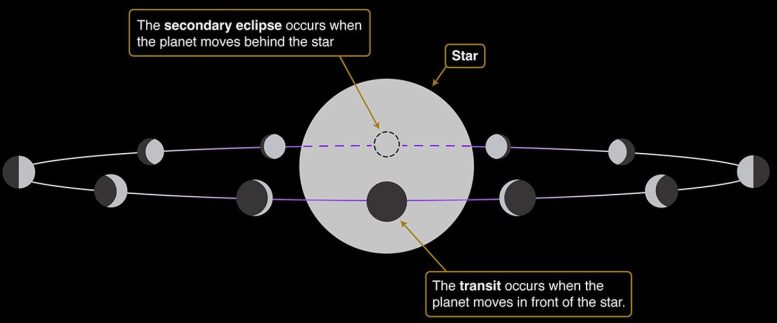
NASA’s Transiting Exoplanet Survey Satellite (TESS) first identified the three inner planets during observations from 2019 to 2023. CHEOPS later confirmed the fourth planet in 2026. Data from the Gaia mission showed no signs of additional distant gas giants, as there were no detectable distortions in the system’s astrometry.
The outermost planet, LHS 1903e, orbits at a distance of 0.15 Astronomical Units (about 22 million kilometers or 14 million miles) and completes one orbit in 29 days. The entire system would fit well within Mercury’s orbit in our solar system.
The study was published in the journal Science and carried out by an international team of astronomers from the University of Bern (UNIBE), the National Centre of Competence in Research PlanetS (NCCRPS), and the University of Geneva (UNIGE).
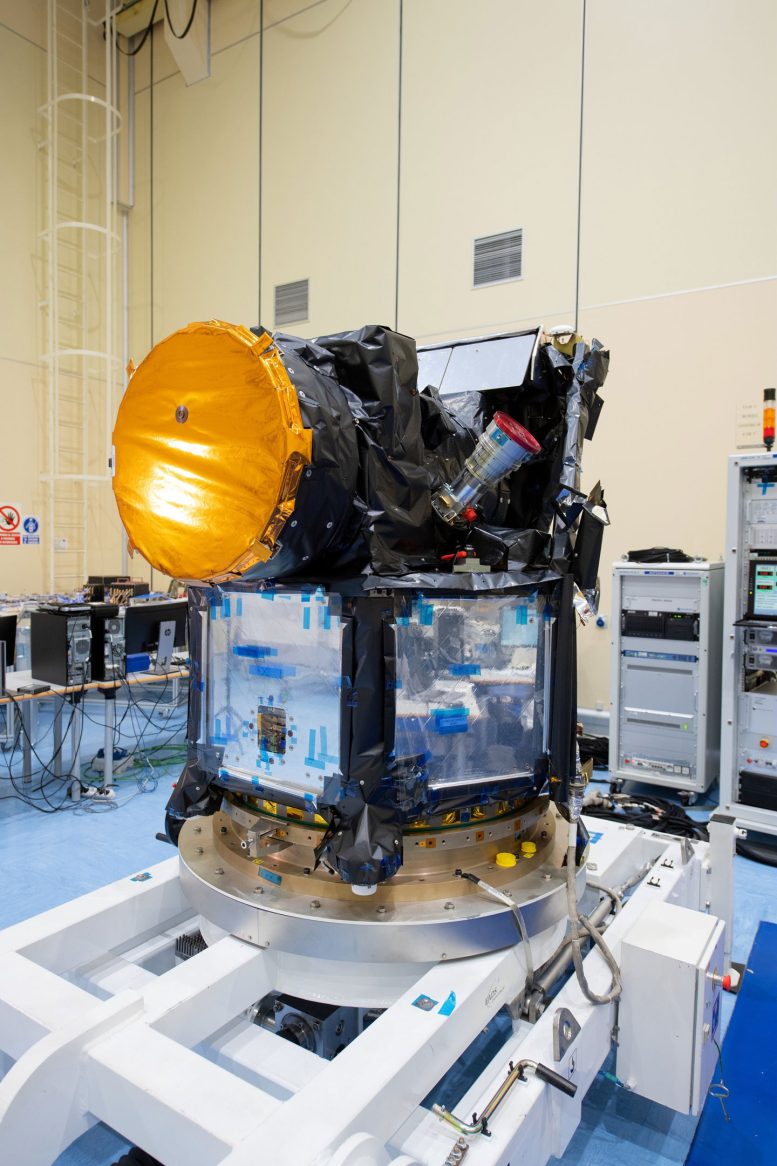
The European Space Agency’s Characterizing Exoplanet Satellite (CHEOPS) mission was launched in 2019. With a 3.5-year nominal mission now still in extended operation, CHEOPS looks for transiting exoplanets. CHEOPS was designed, built, and is largely operated out of UNIBE and UNIGE, located in Switzerland.

CHEOPS Findings and Theory-Defying Planet
“It is thanks to the precision of CHEOPS that we were able to detect this new planet,” says Monika Lendl (UNIGE). “Since rocky planets do not usually form beyond gas giants, this one completely overturns our theories!”
Traditional theories of planetary formation eliminate the formation of gas giants closer in to the host star. High temperatures in the protoplanetary disk close in to the star exclude the accumulation of gas around rocky cores. Farther out, such gaseous envelopes can accumulate and persist.
Any fourth world around LHS 1903 was expected to follow this trend. The discovery of LHS 1903 defied expectations: did the errant world migrate to its current location, or was it perhaps struck by another object early in its formation, stripping it of its gaseous envelope?
New Formation Hypotheses and Implications
Another possibility is that this system may be the first real example of a theory proposed about ten years ago. In this scenario, the four planets formed one after another rather than all at the same time. If that happened, LHS 1903e may have run out of available gas early, preventing it from continuing to grow.
“Indeed, the fourth planet should have accumulated and retained a large amount of gas,” says Yann Alibert (Space Research and Planetary Sciences Division-UNIBE). “Our hypothesis is that it formed after gas disappeared from the protoplanetary disk, and thus after the second and third planets of the system, which are gas giants.”
LHS 1903 shows us an example of just how strange exoplanetary systems can be. As more worlds are discovered, more examples of this type of stalled formation may be found, as we add more exoplanets to the catalog of known worlds.
Reference: “Gas-depleted planet formation occurred in the four-planet system around the red dwarf LHS 1903” by Thomas G. Wilson, Anna M. Simpson, Andrew Collier Cameron, Ryan Cloutier, Vardan Adibekyan, Ancy Anna John, Yann Alibert, Manu Stalport, Jo Ann Egger, Andrea Bonfanti, Nicolas Billot, Pascal Guterman, Pierre F. L. Maxted, Attila E. Simon, Sérgio G. Sousa, Malcolm Fridlund, Mathias Beck, Anja Bekkelien, Sébastien Salmon, Valérie Van Grootel, Luca Fossati, Alexander James Mustill, Hugh P. Osborn, Tiziano Zingales, Matthew J. Hooton, Laura Affer, Suzanne Aigrain, Roi Alonso, Guillem Anglada, Alexandros Antoniadis-Karnavas, Tamas Bárczy, David Barrado Navascues, Susana C. C. Barros, Wolfgang Baumjohann, Thomas Beck, Willy Benz, Federico Biondi, Xavier Bonfils, Luca Borsato, Alexis Brandeker, Christopher Broeg, Lars A. Buchhave, Maximilian Buder, Juan Cabrera, Sebastian Carrazco Gaxiola, David Charbonneau, Sébastien Charnoz, David R. Ciardi, Karen A. Collins, Kevin I. Collins, Rosario Cosentino, Szilard Csizmadia, Patricio E. Cubillos, Shweta Dalal, Mario Damasso, James R. A. Davenport, Melvyn B. Davies, Magali Deleuil, Laetitia Delrez, Olivier D. S. Demangeon, Brice-Olivier Demory, Victoria DiTomasso, Diana Dragomir, Courtney D. Dressing, Xavier Dumusque, David Ehrenreich, Anders Erikson, Emma Esparza-Borges, Andrea Fortier, Izuru Fukuda, Akihiko Fukui, Davide Gandolfi, Adriano Ghedina, Steven Giacalone, Holden Gill, Michaël Gillon, Yilen Gómez Maqueo Chew, Manuel Güdel, Pere Guerra, Maximilian N. Günther, Nathan Hara, Avet Harutyunyan, Yuya Hayashi, Raphaëlle D. Haywood, Rae Holcomb, Keith Horne, Sergio Hoyer, Chelsea X. Huang, Masahiro Ikoma, Kate G. Isaak, James A. G. Jackman, Jon M. Jenkins, Eric L. N. Jensen, Daniel Jontof-Hutter, Yugo Kawai, Laszlo L. Kiss, Ben S. Lakeland, Jacques Laskar, David W. Latham, Alain Lecavelier des Etangs, Adrien Leleu, Monika Lendl, Jerome de Leon, Florian Lienhard, Mercedes López-Morales, Christophe Lovis, Michael B. Lund, Rafael Luque, Demetrio Magrin, Luca Malavolta, Aldo F. Martínez Fiorenzano, Andrew W. Mayo, Michel Mayor, Christoph Mordasini, Annelies Mortier, Felipe Murgas, Norio Narita, Valerio Nascimbeni, Belinda A. Nicholson, Göran Olofsson, Roland Ottensamer, Isabella Pagano, Larissa Palethorpe, Enric Pallé, Hannu Parviainen, Marco Pedani, Francesco A. Pepe, Gisbert Peter, Matteo Pinamonti, Giampaolo Piotto, Don Pollacco, Ennio Poretti, Didier Queloz, Samuel N. Quinn, Roberto Ragazzoni, Nicola Rando, David Rapetti, Francesco Ratti, Heike Rauer, Federica Rescigno, Ignasi Ribas, Ken Rice, George R. Ricker, Paul Robertson, Thierry de Roche, Laurence Sabin, Nuno C. Santos, Dimitar D. Sasselov, Arjun B. Savel, Gaetano Scandariato, Nicole Schanche, Urs Schroffenegger, Richard P. Schwarz, Sara Seager, Ramotholo Sefako, Damien Ségransan, Avi Shporer, André M. Silva, Alexis M. S. Smith, Alessandro Sozzetti, Manfred Steller, Gyula M. Szabó, Motohide Tamura, Nicolas Thomas, Amy Tuson, Stéphane Udry, Andrew Vanderburg, Roland K. Vanderspek, Julia Venturini, Francesco Verrecchia, Nicholas A. Walton, Christopher A. Watson, Robert D. Wells, Joshua N. Winn, Roberto Zambelli and Carl Ziegler, 12 February 2026, Science.
DOI: 10.1126/science.adl2348
Adapted from an article originally published in UniverseToday.
Never miss a breakthrough: Join the SciTechDaily newsletter.
Follow us on Google and Google News.