
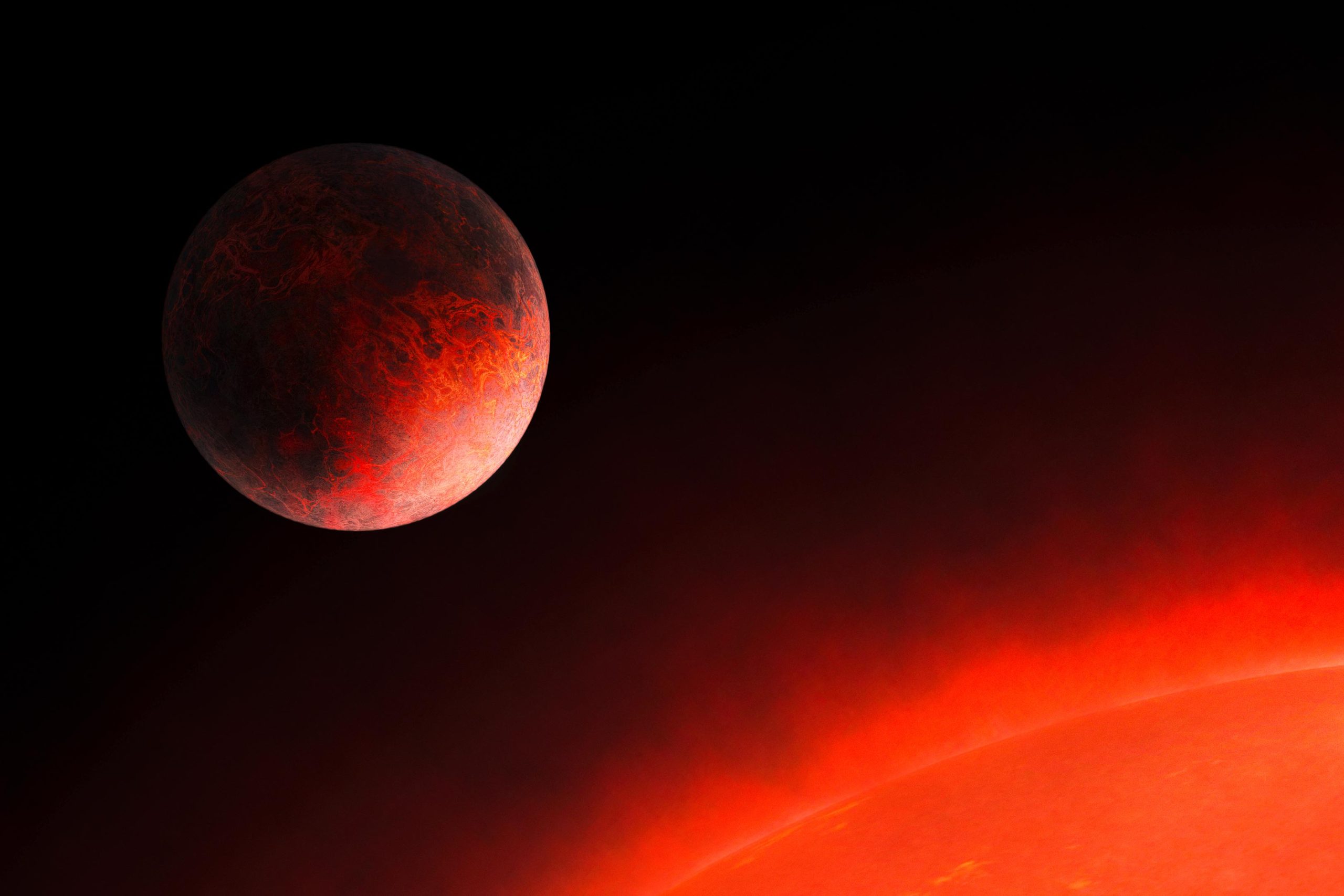
Astronomers have discovered GJ 367 b, a tiny, rocky exoplanet just 31 light-years away that orbits its red dwarf star in only eight hours.
As far as extrasolar planets go, ‘GJ 367 b’ is a featherweight. With half the mass of Earth, the newly discovered planet is one of the lightest among the nearly 5000 exoplanets known today. It takes the extrasolar planet approximately eight hours to orbit its parent star. With a diameter of just over 9000 kilometers, GJ 367 b is slightly larger than Mars. The planetary system is located just under 31 light-years from Earth and is thus ideal for further investigation. The discovery demonstrates that it is possible to precisely determine the properties of even the smallest, least massive exoplanets. Such studies provide a key to understanding how terrestrial planets form and evolve.
An international group of 78 researchers led by Kristine W. F. Lam and Szilárd Csizmadia from the Institute of Planetary Research at DLR (German Aerospace Center) report on the results of their studies in the scientific journal Science. With an orbital period of only one-third of an Earth day, GJ 367 b is a fast mover. “From the precise determination of its radius and mass, GJ 367b is classified as a rocky planet,” reports Kristine Lam. “It seems to have similarities to Mercury. This places it among the sub-Earth-sized terrestrial planets and brings research one step forward in the search for a ‘second Earth’.”
More Accurate Exoplanet Trackers Possible
A quarter of a century after the first discovery of an extrasolar planet, the focus has shifted to characterizing these planets more precisely, in addition to making new discoveries. At present, it is possible to construct a much more precise profile for most known exoplanets. Many exoplanets were discovered using the transit method – the measurement of minute differences in the emitted light, or its apparent magnitude, of a star as a planet passes in front of it (with respect to the observer). GJ 367 b was also discovered using this method, with the help of NASA’s Transiting Exoplanet Survey Satellite (TESS).
Origin of the Small Fast-Moving Planets Still Unknown
GJ 367 b belongs to the ‘ultra-short period’ (USP) group of exoplanets that orbit their star in less than 24 hours. “We already know a few of these, but their origins are currently unknown,” says Kristine Lam. “By measuring the precise fundamental properties of the USP planet, we can get a glimpse of the system’s formation and evolution history.” Following the discovery of this planet using TESS and the transit method, the spectrum of its star was then studied from the ground using the radial velocity method. The mass was determined using the HARPS instrument on the European Southern Observatory’s 3.6m telescope. With the meticulous study and combination of different evaluation methods, the radius and mass of the planet were accurately determined: its radius is 72 percent of Earth’s radius, and its mass 55 percent of Earth’s mass.
Highest Accuracy for Radius and Mass
By determining its radius and mass with an accuracy of 7 and 14 percent respectively, the researchers were also able to draw conclusions about the exoplanet’s inner structure. It is a low-mass rocky planet, but has a higher density than the Earth. “The high density indicates the planet is dominated by an iron core,” explains Szilárd Csizmadia. “These properties are similar to those of Mercury, with its disproportionately large iron and nickel core that differentiates it from other terrestrial bodies in the Solar System.” However, the planet’s proximity to its star means it is exposed to an extreme high level of radiation, more than 500 times stronger than what the Earth experiences. The surface temperature could reach up to 1500 degrees Celsius – a temperature at which all rocks and metals would be melted. GJ 367 b therefore cannot be considered a ‘second Earth’.
Parent Star Is a ‘Red Dwarf’
The parent star of this newly discovered exoplanet, a red dwarf called GJ 367, is only about half the size of the Sun. This was beneficial for its discovery as the transit signal of the orbiting planet is particularly significant. Red dwarfs are not only smaller, but also cooler than the Sun. This makes their associated planets easier to find and characterize. They are among the most common stellar objects in our cosmic neighborhood and are therefore suitable targets for exoplanet research. Researchers estimate that these red dwarfs, also known as ‘class M stars’, are orbited by an average of two to three planets.
More on this discovery:
- Sub-Earth Planet Discovered by Astronomers: Boiling New World Is Ultra-Light and Super-Fast
- In the Search for a “Second Earth,” Astronomers Discover Hot, Dense Planet With Eight-Hour Year
Reference: “GJ 367b: A dense ultra-short period sub-Earth planet transiting a nearby red dwarf star” by Kristine W. F. Lam, Szilárd Csizmadia, Nicola Astudillo-Defru, Xavier Bonfils, Davide Gandolfi, Sebastiano Padovan, Massimiliano Esposito, Coel Hellier, Teruyuki Hirano, John Livingston, Felipe Murgas, Alexis M. S. Smith, Karen A. Collins, Savita Mathur, Rafael A. Garcia, Steve B. Howell, Nuno C. Santos, Fei Dai, George R. Ricker, Roland Vanderspek, David W. Latham, Sara Seager, Joshua N. Winn, Jon M. Jenkins, Simon Albrecht, Jose M. Almenara, Etienne Artigau, Oscar Barragán, François Bouchy, Juan Cabrera, David Charbonneau, Priyanka Chaturvedi, Alexander Chaushev, Jessie L. Christiansen, William D. Cochran, José R. De Meideiros, Xavier Delfosse, Rodrigo F. Díaz, René Doyon, Philipp Eigmüller, Pedro Figueira, Thierry Forveille, Malcolm Fridlund, Guillaume Gaisné, Elisa Goffo, Iskra Georgieva, Sascha Grziwa, Eike Guenther, Artie P. Hatzes, Marshall C. Johnson, Petr Kabáth, Emil Knudstrup, Judith Korth, Pablo Lewin, Jack J. Lissauer, Christophe Lovis, Rafael Luque, Claudio Melo, Edward H. Morgan, Robert Morris, Michel Mayor, Norio Narita, Hannah L. M. Osborne, Enric Palle, Francesco Pepe, Carina M. Persson, Samuel N. Quinn, Heike Rauer, Seth Redfield, Joshua E. Schlieder, Damien Ségransan, Luisa M. Serrano, Jeffrey C. Smith, Ján Šubjak, Joseph D. Twicken, Stéphane Udry, Vincent Van Eylen and Michael Vezie, 2 December 2021, Science.
DOI: 10.1126/science.aay3253
Never miss a breakthrough: Join the SciTechDaily newsletter.
Follow us on Google and Google News.