
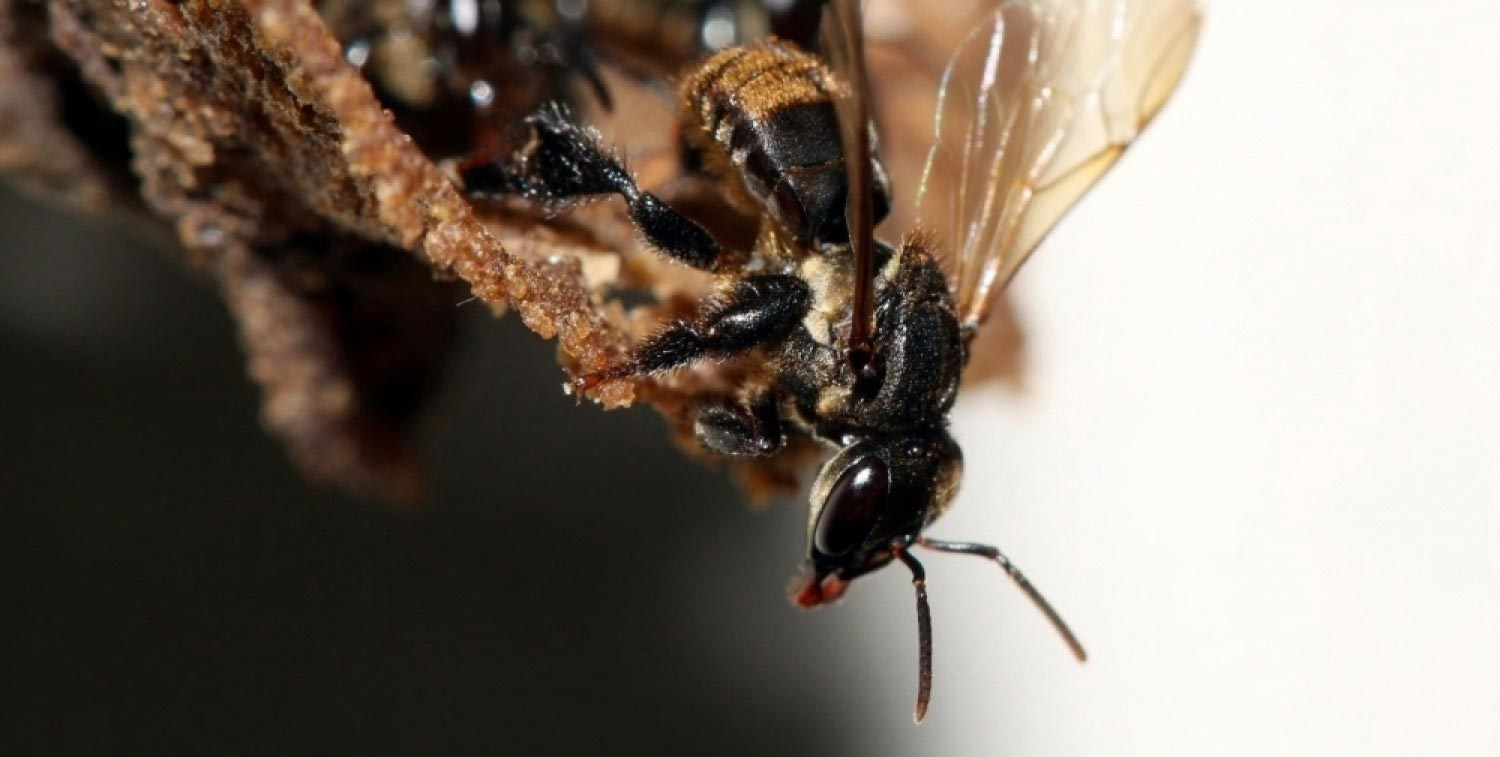
A report published in PLOS ONE describes key roles of various microorganisms in the development of the larvae of Scaptotrigona depilis. Researchers warn that this symbiotic relationship is threatened by the indiscriminate use of pesticides.
A study published in PLOS ONE shows that the larvae of the Brazilian stingless bee Scaptotrigona depilis depend on interactions between three different species of fungus to complete their development and reach adulthood.
The complex process of symbiosis was studied by Brazilian and US researchers as part of a Thematic Project supported by FAPESP and the US National Institutes of Health (NIH). The study was conducted under the auspices of the FAPESP Research Program on Biodiversity Characterization, Conservation, Restoration and Sustainable Use (BIOTA-FAPESP).
In a previous study, a group led by Mônica Tallarico Pupo, Professor of Medicinal Chemistry and Natural Products at the University of São Paulo’s Ribeirao Preto School of Pharmaceutical Sciences (FCFRP-USP) in Brazil, and Jon Clardy, Professor of Biological Chemistry and Molecular Pharmacology at Harvard Medical School in the US, discovered that filaments of the fungus Zygosaccharomyces sp. found in brood cells serve as food for these stingless bees in the initial stage of their development. The symbiont microorganism supplies the larvae with compounds that are precursors of the pupating hormone required for the completion of their metamorphosis into adult bees.
Scientists have now discovered that the brood cells of these bees contain filaments of two other fungi besides Zygosaccharomyces sp.: Candida sp. and Monascus ruber. In vitro analysis showed that compounds produced by the last two species interact with those of the former and modulate its growth; thus, all three fungi interact to contribute to larval development.
“The new findings demonstrate that the interactions between these social insects and their microbiota are much more complex than we can imagine. This should serve as a warning against the indiscriminate use of pesticides in agriculture, since many are lethal to fungi. They may not affect bees directly, but they can be harmful to the microorganisms bees require to survive,” Pupo told Agência FAPESP.
Unraveling the interaction
In an article published in 2015 in Current Biology, a research group led by Cristiano Menezes, who works in the Eastern Amazon unit of the Brazilian Agricultural Research Corporation (EMBRAPA) and is a co-author of the paper now published in PLOS ONE, revealed that S. depilis cultivates a fungus for food inside its colonies.
During the Ph.D. research of Camila Raquel Paludo, supervised by Pupo, with funding from FAPESP, the researchers identified the species of fungus involved and discovered its key role in larval metamorphosis. The findings were published in 2018 in Scientific Reports.
Additionally, during Paludo’s Ph.D. research, the group discovered the presence of the other species of fungi in brood cells. The same three species of fungi were identified in all colonies of S. depilis analyzed, suggesting they are indeed important to these bees. The researchers isolated the microorganisms and placed them in Petri dishes in pairs to study their interactions.
“We analyzed every possible combination of the fungi,” Pupo said. “When we put Candida sp. and M. ruber together, for example, we observed that the latter completely changed shape and became orange in color. Candida, meanwhile, practically disappeared from the coculture, which means M. ruber inhibited its growth.”
When the researchers analyzed the orange pigment secreted by M. ruber in the presence of Candida, they identified the active compound monascin. When M. ruber was cocultured with Zygosaccharomyces sp., it produced lovastatin (used in cholesterol-lowering drugs), and this substance inhibited the latter fungus’s growth.
On the other hand, its growth was stimulated in the presence of Candida, which released ethanol and other volatile organic compounds into the culture medium.
“These results are a strong indication that the interaction among the three fungi is important to bee survival. A master’s student is currently studying other stingless bee species and has also found a symbiotic relationship with fungi,” Pupo said.
The student in question is Gabriela Toninato de Paula, who is conducting her master’s research under a scholarship from FAPESP.
Reference: “Microbial community modulates growth of symbiotic fungus required for stingless bee metamorphosis” by Camila Raquel Paludo, Gleb Pishchany, Andres Andrade-Dominguez, Eduardo Afonso Silva-Junior, Cristiano Menezes, Fabio Santos Nascimento, Cameron R. Currie, Roberto Kolter, Jon Clardy and Mônica Tallarico Pupo, 25 July 2019, PLOS ONE.
DOI: 10.1371/journal.pone.0219696
Never miss a breakthrough: Join the SciTechDaily newsletter.
Follow us on Google and Google News.