
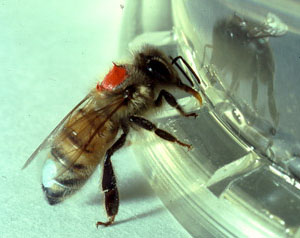
Experiments show that scouting bees, much like novelty-seeking humans, have differences in brain activity in genes related to dopamine and glutamate signaling between neurons. Genomic analysis of the bees revealed significant differences between scouts and non-scouts in the abundance of specific mRNAs and researchers were able to increase and decrease the bees scouting tendencies by giving them monosodium glutamate and glutamate transport blockers, respectively.
A new study in Science reveals that honeybees that scout for new food sources or nest sites have patterns of gene activity in their brains known to be associated with novelty-seeking in humans.
The study found that certain bees in a colony show consistently high levels of exploratory behavior. To determine the molecular basis for this tendency to scout, the research looked across the bees’ genome for differences in the activity of genes in the brains of scouts and non-scouts. They found that genes related to dopamine and glutamate signaling between neurons, which are involved in regulating novelty-seeking in humans, are differentially expressed in scouting and non-scouting bees.
This work shows that the molecular machinery that controls scouting behavior in honeybees has similarities to processes that lead to differences in food-searching behavior in nematodes (roundworms), exploratory behavior in rats in mazes, and even thrill-seeking behavior in humans.
The findings suggest that such processes may be a basic mechanism in the evolution of behavior across various species.
“The questions driving this study were, what makes some bees boldly go where no bee has gone before? What underlies the tendency of some bees to function as scout bees — to seek novelty when foraging and house-hunting?” said co-author Thomas Seeley, Cornell professor of neurobiology and behavior, who made the discovery with researchers at the University of Illinois at Urbana-Champaign (UIUC) and Wellesley College. Zhengzheng S. Liang, a graduate student in entomology at UIUC, is the paper’s lead author.
Food-scouts search for new food sources whereas non-scouts rely on the information that they get through scouts’ “waggle dances” for foraging. Similarly, nest-scouts search for candidate nest sites.
In experiments carried out using behavioral techniques developed in Seeley’s lab, nest-scouts were more than three times as likely as other bees to later become food-scouts in different circumstances, showing that the tendency of the nest-scouts to seek novelty could be retained and transferred across different behavioral contexts.
Genomic analysis of the bees, carried out by the UIUC researchers, revealed significant differences between scouts and non-scouts in the abundance of specific mRNAs — messenger molecules that carry coding information from DNA to sites of protein synthesis in cells. There was strong differentiation between the two groups in the expression of 10 genes, especially those related to dopamine, glutamate and gamma-aminobutyric acid (GABA) signaling.
The researchers provided further evidence for this mechanism by feeding non-scout bees monosodium glutamate and observing a significant increase in their scouting tendency. Further, feeding the same bees glutamate transport blockers diminished their scouting abilities. The findings reveal a direct causal effect of these neurotransmitter levels in the brain on the bees’ scouting behavior.
Since similar neurochemical signaling pathways have been implicated in personality differences between humans, Seeley believes such studies could further our understanding of a long-standing question in biology: What gives rise to personality differences in organisms?
Seeley, who has worked with honeybees for the past 30 years, strives to understand “swarm intelligence” or how a group of individuals can solve problems far exceeding the ability of any one member. He has previously shown how bee colonies engage in democratic debate to choose their new home and demonstrated similarities between how bees in a swarm and neurons in a brain operate.
The research was funded by the National Science Foundation, National Institutes of Health and Illinois Sociogenomics Initiative.
Never miss a breakthrough: Join the SciTechDaily newsletter.
Follow us on Google and Google News.