
Close Menu
    Facebook X (Twitter) Instagram
    SciTechDaily
    • Biology
    • Chemistry
    • Earth
    • Health
    • Physics
    • Science
    • Space
    • Technology
    Facebook X (Twitter) Pinterest YouTube RSS
    SciTechDaily
    Home»Space»Space Is Not Empty: Why Photons Flying From Other Galaxies Do Not Reach Earth
    Space

    Space Is Not Empty: Why Photons Flying From Other Galaxies Do Not Reach Earth

    By Immanuel Kant Baltic Federal UniversityDecember 8, 20191 Comment3 Mins Read
    Facebook Twitter Pinterest Telegram LinkedIn WhatsApp Email Reddit
    Share
    Facebook Twitter LinkedIn Pinterest Telegram Email Reddit
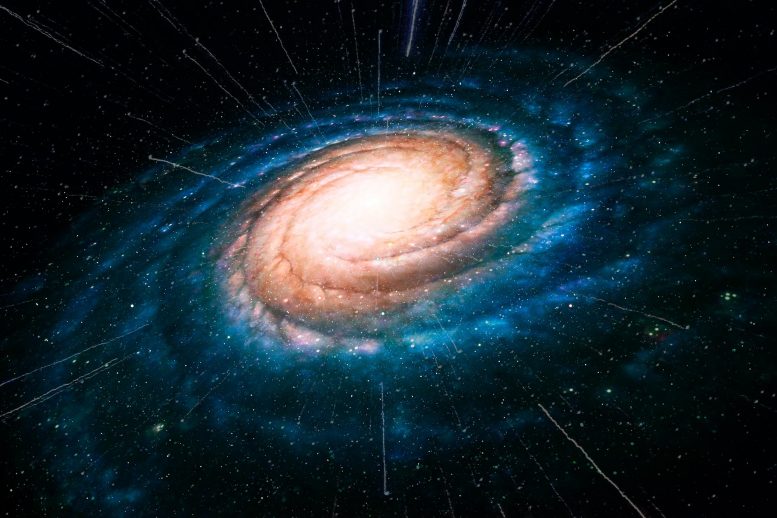
    Illustration Photons Galaxy
    Many people assume space is empty between galaxies. There’s a lot of hydrogen in a state of plasma, that is, very strongly heated hydrogen.

    An international group of scientists, including Andrey Savelyev, associate professor of the Institute of Physical and Mathematical Sciences and Information Technologies of the IKBFU, has improved a computer program that helps simulate the photons.

    “In the Universe there are extragalactic objects such as blazars, which very intensively generate a powerful gamma-ray flux, part of photons from this stream reaches the Earth, as they say, directly, and part — are converted along the way into electrons, then again converted into photons and only then get to us,” said Andrey Saveliev. “The problem here is that mathematical calculations say that a certain number of photons should reach the Earth, and in fact it gets much less.”

    Scientists, according to Andrey Savelyev, today have two versions of why this happens. The first is that a photon, after being converted into an electron (and this, as is known, in contrast to a neutral photon, a charged particle) falls into a magnetic field, deviates from its path, and does not reach the Earth, even after being transformed again in the photon. The second version explains the behavior of particles flying to our planet not by their interaction with an electromagnetic field, but by contact with hydrogen “spilled” in the intergalactic space.

    “Many people believe that space is completely empty and that there is nothing between the galaxies. In fact, there is a lot of hydrogen in a state of plasma, that is, in other words, very strongly heated hydrogen,” the scientist explains. “And our report is about how particles interact with this plasma. There is a special computer program that calculates models of particle behavior in intergalactic space. We can say that we improved this program by considering several possible options for the development of events in interaction with plasma.”

    Unfortunately, it is not yet possible to verify the calculations empirically, because people have not yet learned how to create extreme space conditions on Earth, but Andrey Savelyev is sure that someday this will become possible to some extent.

    It is important to note that the results of the research, despite the fact that while they are what is called “pure science,” can theoretically be applied in practice in the future.

    “Plasma — the fourth state of matter (in addition to gas, liquid, and solid) — is very difficult for research,” says Andrey Savelyev. “At the same time, humanity has high hopes for it, as a source of cheap and very powerful energy. And our study is a small contribution to the collection of plasma knowledge. Perhaps they will be useful in developing effective nuclear fusion.”

    Reference: “The impact of plasma instabilities on the spectra of TeV blazars” by Rafael Alves Batista, Andrey Saveliev and Elisabete M de Gouveia Dal Pino, 2 September 2019, Monthly Notices of the Royal Astronomical Society.
    DOI: 10.1093/mnras/stz2389

    Never miss a breakthrough: Join the SciTechDaily newsletter.
    Follow us on Google and Google News.

    Astronomy Astrophysics Immanuel Kant Baltic Federal University Popular
    Share. Facebook Twitter Pinterest LinkedIn Email Reddit

    Related Articles

    NASA’s Webb Just Revealed Something Astonishing in Saturn’s Atmosphere

    Mysterious “Universe Breaker” Red Dots Could Be Black Holes in Disguise

    Scientists Just Found a Way to Simulate the Universe on a Laptop

    “Like Nothing Anyone Has Ever Seen Before” – Bizarre Supernova Stuns Scientists

    90% Chance: Physicists Predict a Black Hole Could Explode This Decade

    Astronomers Just Found a “Zombie Star” With a Shocking Backstory

    Webb Telescope Spots a “Blob” Near a Star, but Is It a Planet?

    Astronomers Discover Mysterious New World at Edge of the Solar System

    Webb Telescope Spots Sparkling Crystals and Life’s Ingredients in the Butterfly Nebula

    1 Comment

    1. emilia on October 27, 2020 2:18 am

      i like space good as my wallpaper

      Reply
    Leave A Reply Cancel Reply

    • Facebook
    • Twitter
    • Pinterest
    • YouTube

    Don't Miss a Discovery

    Subscribe for the Latest in Science & Tech!

    Trending News

    Scientists May Have Discovered How To Heal Damaged Kidneys

    Interstellar Visitor 3I/ATLAS Is Bursting With an Unexpected Chemical

    Scientists Just Found All 5 Genetic “Letters” of DNA and RNA on an Asteroid

    The 4,000-Year-Old City That Defied History’s Rules on Wealth and Power

    The World’s Biggest Population Fear Has Flipped – and It Could Change Everything

    This “Fake” Pill Improved Memory and Physical Performance in Just 3 Weeks

    Scientists Say Frequent Ejaculation May Improve Sperm Quality and Fertility

    Scientists Have Found “The Heaven Sword” After Years of Looking

    Follow SciTechDaily
    • Facebook
    • Twitter
    • YouTube
    • Pinterest
    • Newsletter
    • RSS
    SciTech News
    • Biology News
    • Chemistry News
    • Earth News
    • Health News
    • Physics News
    • Science News
    • Space News
    • Technology News
    Recent Posts
    • Scientists Create Tiny “Mini Livers” That Could One Day Replace Liver Transplants
    • This Surprising Factor May Predict Heart Disease Decades Before It Strikes
    • New Nonsurgical Knee Treatment Delivers Lasting Pain Relief
    • Scientists Discover Hidden Rule That Could Make Fuel Cells Cheaper and More Powerful
    • New Water-Harvesting Jacket Pulls up to 30 Ounces of Drinking Water From the Air Daily
    Copyright © 1998 - 2026 SciTechDaily. All Rights Reserved.
    • Science News
    • About
    • Contact
    • Editorial Board
    • Privacy Policy
    • Terms of Use

    Type above and press Enter to search. Press Esc to cancel.