
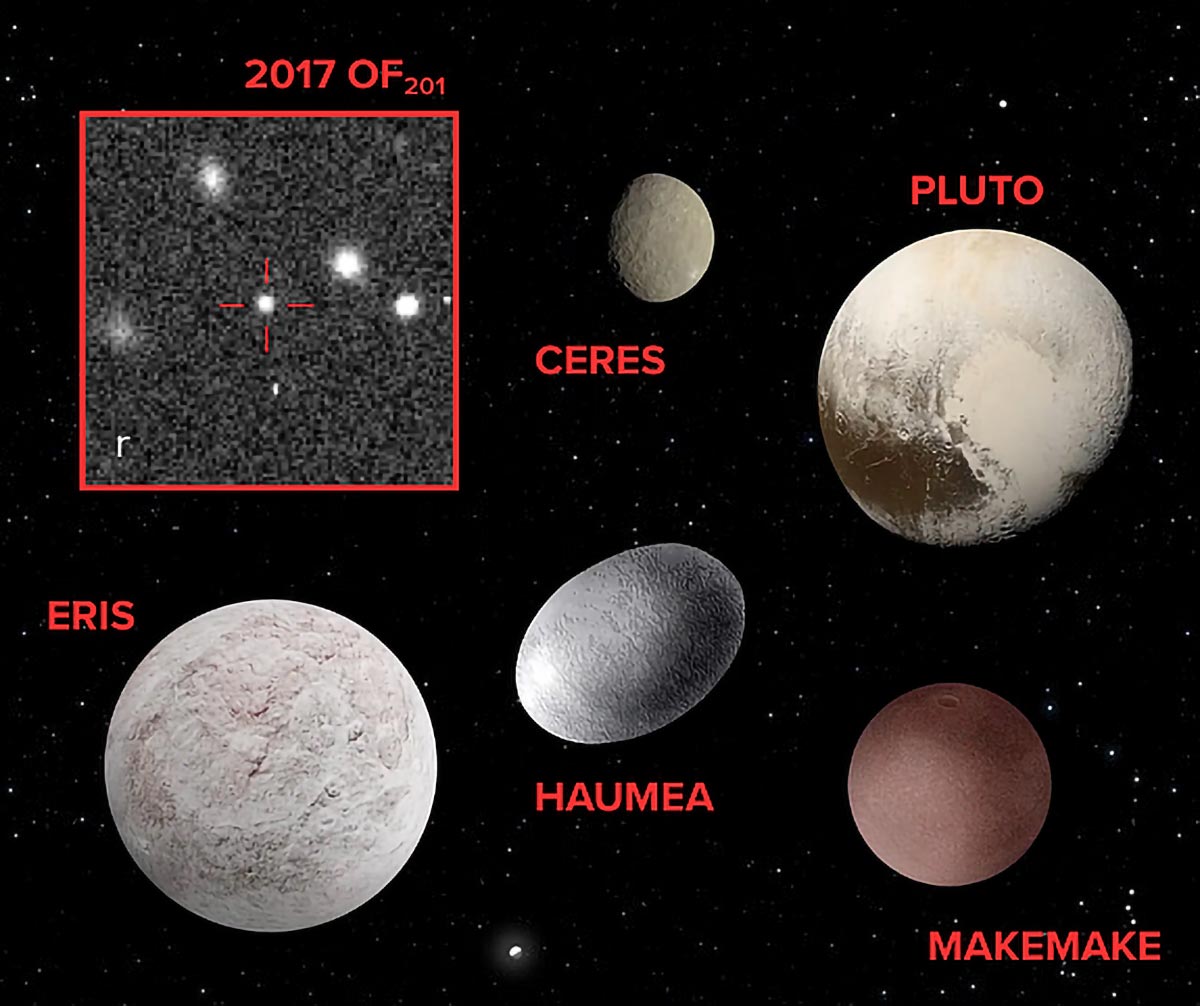
A new trans-Neptunian object, 2017 OF201, has been found with a vast orbit and potential dwarf planet size. The finding hints at more hidden bodies beyond Neptune.
A research team led by Sihao Cheng at the Institute for Advanced Study’s School of Natural Sciences has identified a remarkable trans-Neptunian object (TNO) at the far reaches of the solar system. The object has been designated 2017 OF201.
Based on its estimated size, 2017 OF201 could meet the criteria for classification as a dwarf planet, placing it in the same category as Pluto. It is among the most distant objects ever observed in the solar system and indicates that the region beyond Neptune in the Kuiper Belt, long assumed to be nearly empty, may in fact harbor more bodies than expected.
Cheng, working with Princeton University collaborators Jiaxuan Li and Eritas Yang, detected the object using advanced computational techniques designed to reveal distinctive orbital patterns across the sky. The discovery was confirmed by the International Astronomical Union’s Minor Planet Center on May 21, 2025, and was also described in a preprint released on arXiv.
Trans-Neptunian objects are minor planets whose orbits lie, on average, farther from the Sun than Neptune’s. What makes 2017 OF201 particularly noteworthy is both its extreme orbital characteristics and its unusually large size.
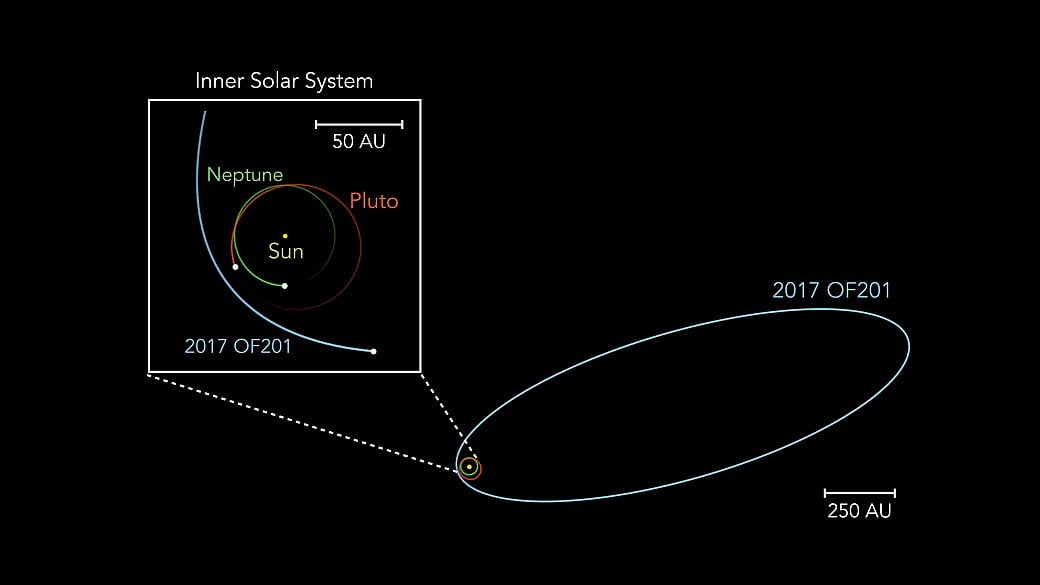
“The object’s aphelion—the farthest point on the orbit from the Sun—is more than 1600 times that of the Earth’s orbit,” explains Cheng. “Meanwhile, its perihelion—the closest point on its orbit to the Sun—is 44.5 times that of the Earth’s orbit, similar to Pluto’s orbit.”
Complex history of gravitational encounters
This extreme orbit, which takes the object approximately 25,000 years to complete, suggests a complex history of gravitational interactions. “It must have experienced close encounters with a giant planet, causing it to be ejected to a wide orbit,” says Yang. “There may have been more than one step in its migration. It’s possible that this object was first ejected to the Oort cloud, the most distant region in our solar system, which is home to many comets, and then sent back,” Cheng adds.
“Many extreme TNOs have orbits that appear to cluster in specific orientations, but 2017 OF201 deviates from this,” says Li. This clustering has been interpreted as indirect evidence for the existence of another planet in the solar system, Planet X or Planet Nine, which could be gravitationally shepherding these objects into their observed patterns. The existence of 2017 OF201 as an outlier to such clustering could potentially challenge this hypothesis.
Cheng and his team estimate that 2017 OF201 is about 700 km in diameter, which would make it the second largest object discovered with such an extended orbit. For comparison, Pluto’s diameter is 2,377 km. The researchers note that further observations, possibly with radio telescopes, will be required to measure the object’s true size more precisely.
Identifying the object in telescope data
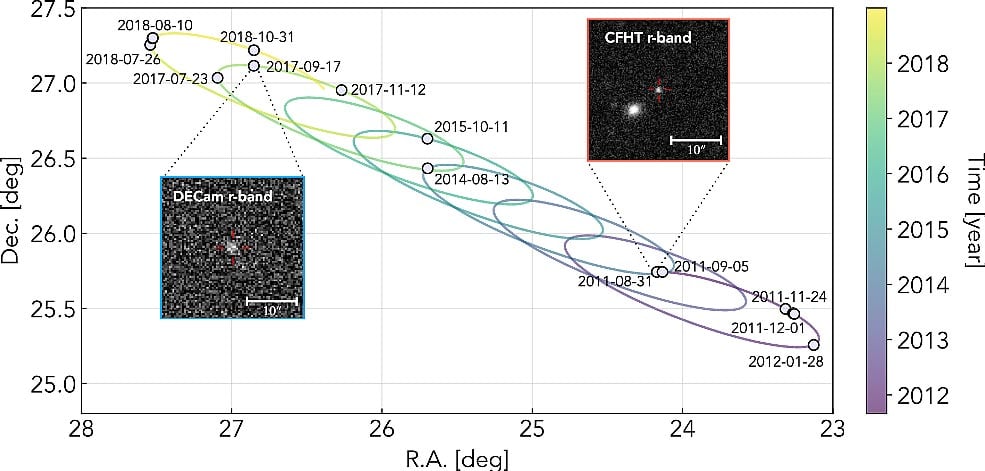
Cheng discovered the object as part of an ongoing research project to identify TNOs and possible new planets in the outer solar system. The object was identified by pinpointing bright spots in an astronomical image database from the Victor M. Blanco Telescope and Canada France Hawaii Telescope (CFHT), and trying to connect all possible groups of such spots that appeared to move across the sky in the way a single TNO might. This search was carried out using a computationally efficient algorithm produced by Cheng. Ultimately, they identified 2017 OF201 in 19 different exposures, captured over 7 years.
The discovery has significant implications for our understanding of the outer solar system. The area beyond the Kuiper Belt, where the object is located, has previously been thought to be essentially empty, but the team’s discovery suggests that this is not so.
“2017 OF201 spends only 1% of its orbital time close enough to us to be detectable. The presence of this single object suggests that there could be another hundred or so other objects with similar orbit and size; they are just too far away to be detectable now,” Cheng states. “Even though advances in telescopes have enabled us to explore distant parts of the universe, there is still a great deal to discover about our own solar system.”
The detection also demonstrates the power of open science. “All the data we used to identify and characterize this object are archival data that are available to anyone, not only professional astronomers,” says Li. “This means that groundbreaking discoveries aren’t limited to those with access to the world’s largest telescopes. Any researcher, student, or even citizen scientist with the right tools and knowledge could have made this discovery, highlighting the value of sharing scientific resources.”
Reference: “Discovery of a dwarf planet candidate in an extremely wide orbit: 2017 OF201” by Sihao Cheng, Jiaxuan Li and Eritas Yang, 21 May 2025, arXiv.
DOI: 10.48550/arXiv.2505.15806
Never miss a breakthrough: Join the SciTechDaily newsletter.
Follow us on Google and Google News.
15 Comments
Information is so clear and can be understand
It’s outstanding, clear,and fantastic . Such information gives rise to knowledge. Thanks.
Outstanding
Sure , it’s clear and fantastic
Hi it maybe sort of fantastic, that science has found a new Neptune planet out there, But Still but Still ‘ No Sign ‘ Of Any Advanced extetestrial alien species, or Civilisation ‘ When Are we Ever Gonna find Such Civilisations??
Hi it maybe sort of fantastic, that science has found a new Neptune planet out there, But Still but Still ‘ No Sign ‘ Of Any Advanced extetestrial alien species, or Civilisation ‘ When Are we Ever Gonna find Such Civilisations??
If there are civilizations – either from this planet before ours or visitors from elsewhere (I believe both are true) – then they would either be already in control of our civilization and/or they would be cautious to make themselves known (which I believe all possibilities plausible are also true).
Our civilization is currently ruled by reptilian humanoids who have enslaved us using (gold>money>debt, technology, illness, religion and fear). The signs of this are everywhere.
Visitors and benign ancient native civilizations are watching and waiting for us to wake up and see what is happening, waiting for us to become less dangerous. We are a civilization uncivilized, focused on the temporal, hateful to our own kind and harmful to theirs.
True regarding our “civilisation”. So tragic.
How can we define civilization when we haven’t gotten there yet?
It’s very clear
Hi hello there, it maybe great that certain people of science, have found various planets Outthere , even a new Neptune style planet but Still ‘ no Real’ Solid Evidence of Any Real Exterterstial alien civilisation ‘ Species out there, when are we ever gonna find it??
Mike,
City of London United kingdom
Hi hello there, it maybe great that certain people of science, have found various planets Outthere , even a new Neptune style planet but Still ‘ no Real’ Solid Evidence of Any Real Exterterstial alien civilisation ‘ Species out there, when are we ever gonna find it??
Mike,
City of London United kingdom
All we know for a fact is that there has to be a case of initial emergence of intelligence in the universe.
Assuming humans are examples of intelligence emerging (maybe begging this question) , why can’t we assume we could be the first intelligent beings in the universe? How would we know how long this emergence should take? No telling what could be the basis for the Drake equation formula when you consider the confounding variables ignored at each step. I will not respond to comments supporting a Drake rationale that fails to appreciate our possible firstness (as the Peirce term defines it). We may be alone . . . sorry Hollywood.
Very advanced aliens have been monitoring our transmissions, and from analyzing Star Trek, have learned that earth shouldn’t have interference from advanced civilization, and thus, actively evade detection.
We are complete alone in the whole universe.The only one.None one else.Period !!!