

New research provides important constraints on the sequence of events that led to the formation of the Pluto system, revealing the resonant interactions and chaotic rotation of Pluto’s small moons.
Two of the most reliable changes in the sky are the daily rising of the sun in the east and setting of the sun in the west. But if you lived on a couple of Pluto’s moons you wouldn’t know when the day would begin, or even what direction the sun would rise. That’s because, unlike Earth’s moon, at least two of Pluto’s small moons, Hydra and Nix, are tumbling chaotically through space. Why? Because they orbit inside a dynamically shifting gravitational field caused by the system’s two central bodies, Pluto and Charon, that are whirling around each other. The moons are also football-shaped, and this contributes to the chaotic rotation.
By contrast, Earth’s moon keeps the same face toward us, because the gravitational forces between Earth and the moon cause the moon to dynamically settle into a condition called tidal lock, where it keeps one hemisphere facing Earth. Almost all of the solar system’s major moons also behave similarly. But the Pluto moons essentially orbit a “double planet.” And this makes life complicated. Over the past several years, the Hubble Space Telescope has discovered four tiny satellites orbiting Pluto and Charon. Researchers were puzzled by unpredictable changes in the sunlight reflected off the two brighter moons. They finally concluded that at least two of the moons must be tumbling unpredictably.
If you lived on one of Pluto’s moons, you might have a hard time determining when, or from which direction, the sun will rise each day. A comprehensive analysis of data from NASA’s Hubble Space Telescope shows that two of Pluto’s moons, Nix and Hydra, wobble unpredictably.
“Hubble has provided a new view of Pluto and its moons revealing a cosmic dance with a chaotic rhythm,” said John Grunsfeld, associate administrator of NASA’s Science Mission Directorate in Washington. “When the New Horizons spacecraft flies through the Pluto system in July we’ll get a chance to see what these moons look like up close and personal.”
The moons wobble because they’re embedded in a gravitational field that shifts constantly. This shift is created by the double planet system of Pluto and Charon as they whirl about each other. Pluto and Charon are called a double planet because they share a common center of gravity located in the space between the bodies. Their variable gravitational field sends the smaller moons tumbling erratically. The effect is strengthened by the football-like, rather than spherical, shape of the moons. Scientists believe it’s likely Pluto’s other two moons, Kerberos and Styx, are in a similar situation.
The astonishing results, found by Mark Showalter of the SETI Institute in Mountain View, California and Doug Hamilton of the University of Maryland at College Park, were published in the journal Nature.
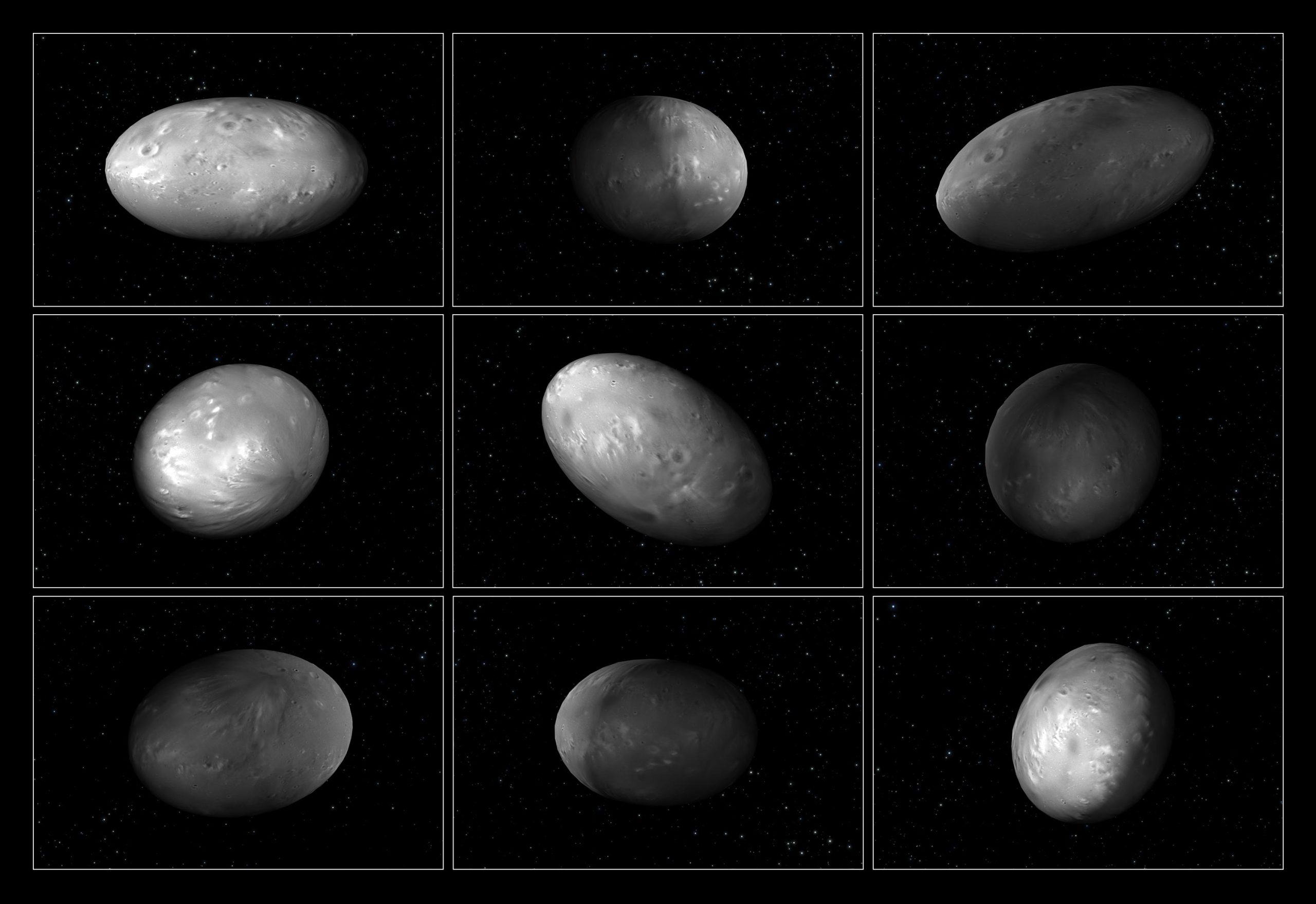
“Prior to the Hubble observations, nobody appreciated the intricate dynamics of the Pluto system,” Showalter said. “Our research provides important new constraints on the sequence of events that led to the formation of the system.”
Showalter also found three of Pluto’s moons are presently locked together in resonance, meaning there is a precise ratio for their orbital periods.
“If you were sitting on Nix, you would see that Styx orbits Pluto twice for every three orbits made by Hydra,” noted Hamilton.
Hubble data also reveal the moon Kerberos is as dark as a charcoal briquette, while the other frozen moons are as bright as sand. It was predicted that dust blasted off the moons by meteorite impacts should coat all the moons, giving their surfaces a homogenous look, which makes Kerberos’ coloring very surprising.
NASA’s New Horizons spacecraft, which will fly by the Pluto system in July, may help settle the question of the asphalt-black moon, as well as the other oddities uncovered by Hubble. These new discoveries are being used to plan science observations for the New Horizons flyby.
The turmoil within the Pluto-Charon system offers insights into how planetary bodies orbiting a double star might behave. For example, NASA’s Kepler space observatory has found several planetary systems orbiting double stars.
“We are learning chaos may be a common trait of binary systems,” Hamilton said. “It might even have consequences for life on planets if found in such systems.”
Clues to the Pluto commotion first came when astronomers measured variations in the light reflected off Nix and Hydra. Analyzing Hubble images of Pluto taken from 2005 to 2012, scientists compared the unpredictable changes in the moons’ brightness to models of spinning bodies in complex gravitational fields.
Pluto’s moons are believed to have been formed by a collision between the dwarf planet and a similar-sized body early in the history of our solar system. The smashup flung material that consolidated into the family of moons observed around Pluto today. Its binary companion, Charon, is almost half the size of Pluto and was discovered in 1978. Hubble discovered Nix and Hydra in 2005, Kerberos in 2011, and Styx in 2012. These little moons, measuring just tens of miles in diameter, were found during a Hubble search for objects that could be hazards to the New Horizons spacecraft as it passes the dwarf planet in July.
Researchers say a combination of Hubble data monitoring and New Horizon’s brief close-up look, as well as future observations with NASA’s James Webb Space Telescope will help settle many mysteries of the Pluto system. No ground-based telescopes have yet been able to detect the smallest moons.
“Pluto will continue to surprise us when New Horizons flies past it in July,” Showalter said. “Our work with the Hubble telescope just gives us a foretaste of what’s in store.”
Reference: “Resonant interactions and chaotic rotation of Pluto’s small moons” by M. R. Showalter and D. P. Hamilton, 3 June 2015, Nature.
DOI: 10.1038/nature14469
The Hubble Space Telescope is a project of international cooperation between NASA and the European Space Agency. NASA’s Goddard Space Flight Center in Greenbelt, Maryland, manages the telescope. The Space Telescope Science Institute (STScI) in Baltimore conducts Hubble science operations. STScI is operated for NASA by the Association of Universities for Research in Astronomy, Inc., in Washington.
Never miss a breakthrough: Join the SciTechDaily newsletter.
Follow us on Google and Google News.