
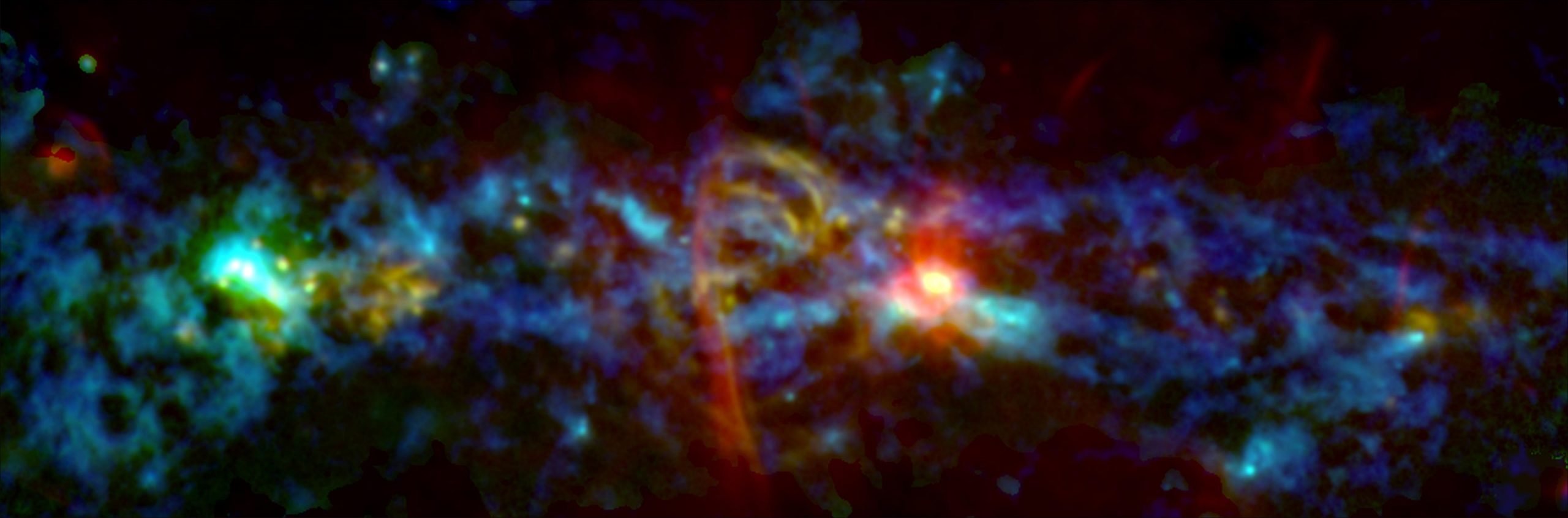
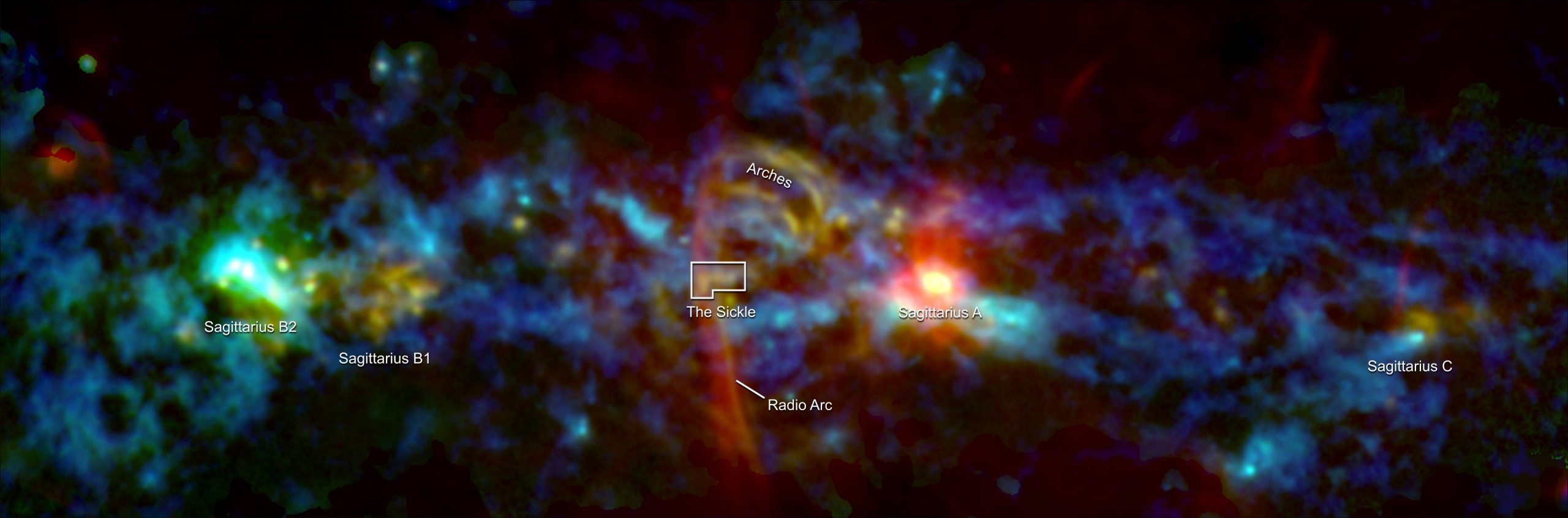
A team of astronomers has produced a new image of an arc-shaped object in the center of our Milky Way galaxy. The feature, which resembles a candy cane, is a magnetic structure that covers an enormous region of some 160 light-years. A light-year is the distance light travels in one year — almost 6 trillion miles.
Mark Morris, a UCLA professor of physics and astronomy and a member of the research team, discovered the structure, also called the radio arc, with a former student, Farhad Yusef-Zadeh, back in 1983, but they did not have such a complete and colorful image of it then.
The new image shows the inner part of our galaxy, which houses the largest, densest collection of giant molecular clouds in the Milky Way. These vast, cool clouds contain enough dense gas and dust to form tens of millions of stars like the sun, Morris said.
In the image, blue and greenish-blue features reveal cold dust in molecular clouds where star formation is still in its infancy. Yellow features reveal the presence of ionized gas and show where hundreds of massive stars have recently formed. Red and orange regions show areas where high-energy electrons emit radiation by a process called “synchrotron emission,” such as in the radio arc and Sagittarius A, the bright source at the galaxy’s center that hosts its supermassive black hole.
Many of the universe’s secrets are being revealed through the parts of the electromagnetic spectrum of light that are not visible to the human eye. The electromagnetic spectrum encompasses the complete range of light — seen and unseen — from gamma rays, X-rays and ultraviolet light on one end to infrared and radio waves on the other. In the middle is the small visible spectrum that includes the colors humans can detect with the unaided eye. Gamma rays have wavelengths billions of times smaller than those of visible light, while radio waves have wavelengths billions of times longer than those of visible light. Astronomers use the entire electromagnetic spectrum. In the study that led to the new image, the research team observed radio waves with a wavelength of 2 millimeters.
“The candy cane is a magnetic feature in which we can literally see the magnetic field lines illuminated by the radio emission,” Morris said. “The new result revealed by this image is that one of the filaments is inferred to contain extremely high-energy electrons, the origin of which remains an interesting and unsettled issue.”
The candy cane arc is part of a set of radio-emitting filaments extending 160 light-years. It is more than 100 light-years away from the central supermassive black hole. However, in another study recently, Morris and colleagues saw similar magnetic radio filaments that they believe are connected to the supermassive black hole, which may lead to important new ways to study black holes, he said.
To produce the new image, the astronomers used a NASA 2-millimeter camera instrument called GISMO, along with a 30-meter radio telescope located at Pico Veleta, Spain. They also took archival observations from the European Space Agency’s Herschel satellite to model the infrared glow of cold dust. They added infrared data from the SCUBA-2 instrument at the James Clerk Maxwell Telescope near the summit of Maunakea, Hawaii, and radio observations from the National Science Foundation’s Very Large Array, located near Socorro, New Mexico.
The team’s research describing the composite image was published last month in Astrophysical Journal.
Morris’ research interests include the center of the Milky Way, star formation, massive stellar clusters, and red giant stars, which are dying stars in the last stages of stellar evolution.
For more on this research, read NASA GISMO Reveals 1,000 Trillion Mile Long Cosmic ‘Candy Cane’ in Milky Way.
References:
“2 mm GISMO Observations of the Galactic Center. I. Dust Emission” by Richard G. Arendt, Johannes Staguhn, Eli Dwek, Mark R. Morris, Farhad Yusef-Zadeh, Dominic J. Benford, Attila Kovács and Junellie Gonzalez-Quiles, 1 November 2019, The Astrophysical Journal.
DOI: 10.3847/1538-4357/ab451c
“2 mm GISMO Observations of the Galactic Center. II. A Nonthermal Filament in the Radio Arc and Compact Sources” by Johannes Staguhn, Richard G. Arendt, Eli Dwek, Mark R. Morris, Farhad Yusef-Zadeh, Dominic J. Benford, Attila Kovács and Junellie Gonzalez-Quiles, 1 November 2019, The Astrophysical Journal.
DOI: 10.3847/1538-4357/ab451b
Never miss a breakthrough: Join the SciTechDaily newsletter.
Follow us on Google and Google News.