
Close Menu
    Facebook X (Twitter) Instagram
    SciTechDaily
    • Biology
    • Chemistry
    • Earth
    • Health
    • Physics
    • Science
    • Space
    • Technology
    Facebook X (Twitter) Pinterest YouTube RSS
    SciTechDaily
    Home»Technology»Successful Test for Superconducting 3.6 Megawatt Wind Turbine
    Technology

    Successful Test for Superconducting 3.6 Megawatt Wind Turbine

    By IOP PublishingJanuary 2, 2020No Comments2 Mins Read
    Facebook Twitter Pinterest Telegram LinkedIn WhatsApp Email Reddit
    Share
    Facebook Twitter LinkedIn Pinterest Telegram Email Reddit
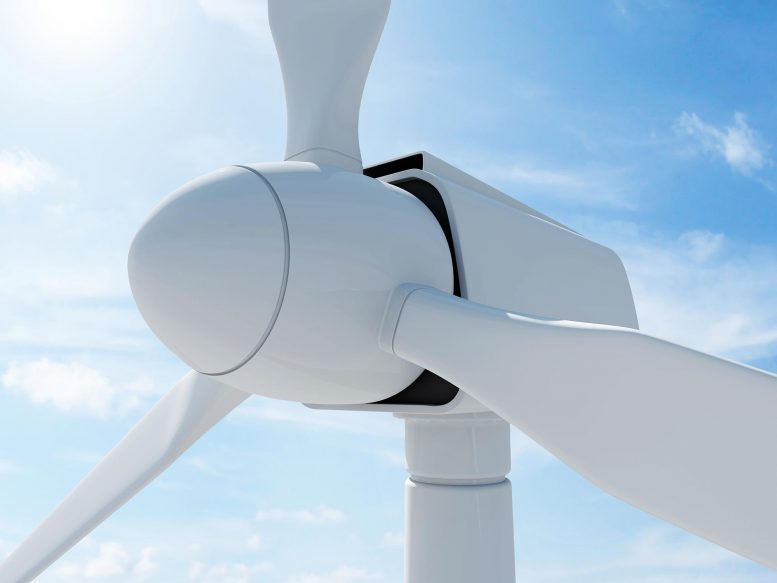
    Modern Wind Turbine
    For the first time, a superconducting rotor has been successfully tested on a working wind turbine.

    A superconducting rotor has been successfully tested on an active wind turbine for the first time.

    The EcoSwing consortium designed, developed, manufactured a full-size superconducting generator for a 3.6 megawatt wind turbine, and field-tested it in Thyborøn, Denmark.

    They report their results in the IOP Publishing journal Superconductor Science and Technology.

    Corresponding author Anne Bergen, from the University of Twente, The Netherlands, said: “Wind turbine size has grown significantly over the last few decades. However, today’s technology has trouble keeping up with the trend toward ever-increasing unit power levels.

    “Permanent-magnet (PM) based direct-drive (DD) generators offer a solution in state-of-the-art multi-megawatt generators, but the feasibility of 10+ megawatt PM-DD turbines requires significant weight reduction. Pseudo-magnetic direct-drive (PDD) machines, integrating magnetic gearing and generator functions are a possible solution to this, but they can be expensive and highly complex to produce.”

    To tackle this challenge, the team employed rare-earth barium copper oxide (ReBCO) high-temperature superconducting generators. These require a smaller amount of rare-earth materials than PM machines, resulting in a lower cost. Superconductors can also carry high current densities, which results in more power-dense coils and lower weight.

    Ms. Bergen said: “The field test of the generator was extremely successful. When the generator was installed at Thyborøn, the turbine achieved its targeted power range, including more than 650 hours of grid operation. This shows the compatibility of superconductive generator technology with all the elements of an operational environment such as variable speeds, grid faults, electromagnetic harmonics, and vibrations.

    “The project made several other substantial pieces of progress. It demonstrated that HTS coil production is not limited to specialized laboratories, and constitutes a successful technology transfer from science to industry. The HTS rotor was also assembled in an industrial setting, showing superconducting components can be deployed in a `standard’ manufacturing environment.

    “Now the concept has been proven, we hope to see superconducting generator technology begin to be widely applied on wind turbines.”

    Reference: “Design and in-field testing of the world’s first ReBCO rotor for a 3.6 MW wind generator” by Anne Bergen, Rasmus Andersen, Markus Bauer, Hermann Boy, Marcel ter Brake, Patrick Brutsaert, Carsten Bührer, Marc Dhallé, Jesper Hansen and Herman ten Kate, 25 October 2019, Superconductor Science and Technology.
    DOI: 10.1088/1361-6668/ab48d6

    Never miss a breakthrough: Join the SciTechDaily newsletter.
    Follow us on Google and Google News.

    Green Energy Popular Superconduction Wind Turbine
    Share. Facebook Twitter Pinterest LinkedIn Email Reddit

    Related Articles

    Experts Predict Wind Energy Costs to Drop Significantly in the Future

    MIT Device Cools With No Electricity or Moving Parts – Even Under the Blazing Sun

    Solar Cell Performance Boosted by Biological Material That Mimics Photosynthesis

    30x Improvement in Renewable Energy Solution Inspired by Croissant Making

    Scientists Pave the Way for Quantum Computing by Coupling Magnetization to Superconductivity

    New Aluminum Batteries Increase the Range of UUVs Tenfold

    Floating Nuclear Power Plant that is Safer and Cheaper

    High-Altitude Blimp Wind Turbine Will Harness Stronger Winds

    Scottish Wind Turbine Explodes

    Leave A Reply Cancel Reply

    • Facebook
    • Twitter
    • Pinterest
    • YouTube

    Don't Miss a Discovery

    Subscribe for the Latest in Science & Tech!

    Trending News

    Popular Supplement Ingredient Linked to Shorter Lifespan in Men

    Scientists May Have Found a Way To Repair Nerve Damage in Multiple Sclerosis

    “Totally Unexpected” – Scientists Discover Pancreatic Cancer’s Fatal Addiction

    A Strange Quantum Effect May Explain One of Biology’s Greatest Mysteries

    James Webb Telescope Reveals the Universe’s Hidden Cosmic Web in Stunning Detail

    Scientists Identify Simple Supplement That Greatly Reduces Alzheimer’s Damage

    You May Have a Dangerous Type of Cholesterol Even if Your Tests Look Normal

    Your Blood Pressure Reading Could Be Wrong Because of One Simple Mistake

    Follow SciTechDaily
    • Facebook
    • Twitter
    • YouTube
    • Pinterest
    • Newsletter
    • RSS
    SciTech News
    • Biology News
    • Chemistry News
    • Earth News
    • Health News
    • Physics News
    • Science News
    • Space News
    • Technology News
    Recent Posts
    • Cancer Mystery Solved: Scientists Discover How Melanoma Becomes “Immortal”
    • Scientists Uncover Cancer-Fighting Power of Popular Fatty Liver Drug
    • Beyond Pain Relief: Scientists Discover a Protein That Could Stop Osteoarthritis in Its Tracks
    • NASA’s New AI Processor Is 500x Faster Than Current Space Computers
    • Scientists Find Evidence Earth Is Drifting Through the Ashes of an Exploded Star
    Copyright © 1998 - 2026 SciTechDaily. All Rights Reserved.
    • Science News
    • About
    • Contact
    • Editorial Board
    • Privacy Policy
    • Terms of Use

    Type above and press Enter to search. Press Esc to cancel.