
Scientists working at the frontier of nanotechnology face huge challenges.
The position of a single atom in a material can change the fundamental properties of that material, so scientists need something in their toolbox to measure how that atom will behave.
A research team led by the University of Leeds, in collaboration with colleagues at the Sorbonne University in Paris, France, have shown for the first time that it is possible to develop a diagnostic technique loosely related to the idea of a tuning fork.
A tuning fork produces a fixed tone when energy is applied to it — in that case, when it is struck. But if the fork is somehow altered, it goes out of tune — the tone changes.
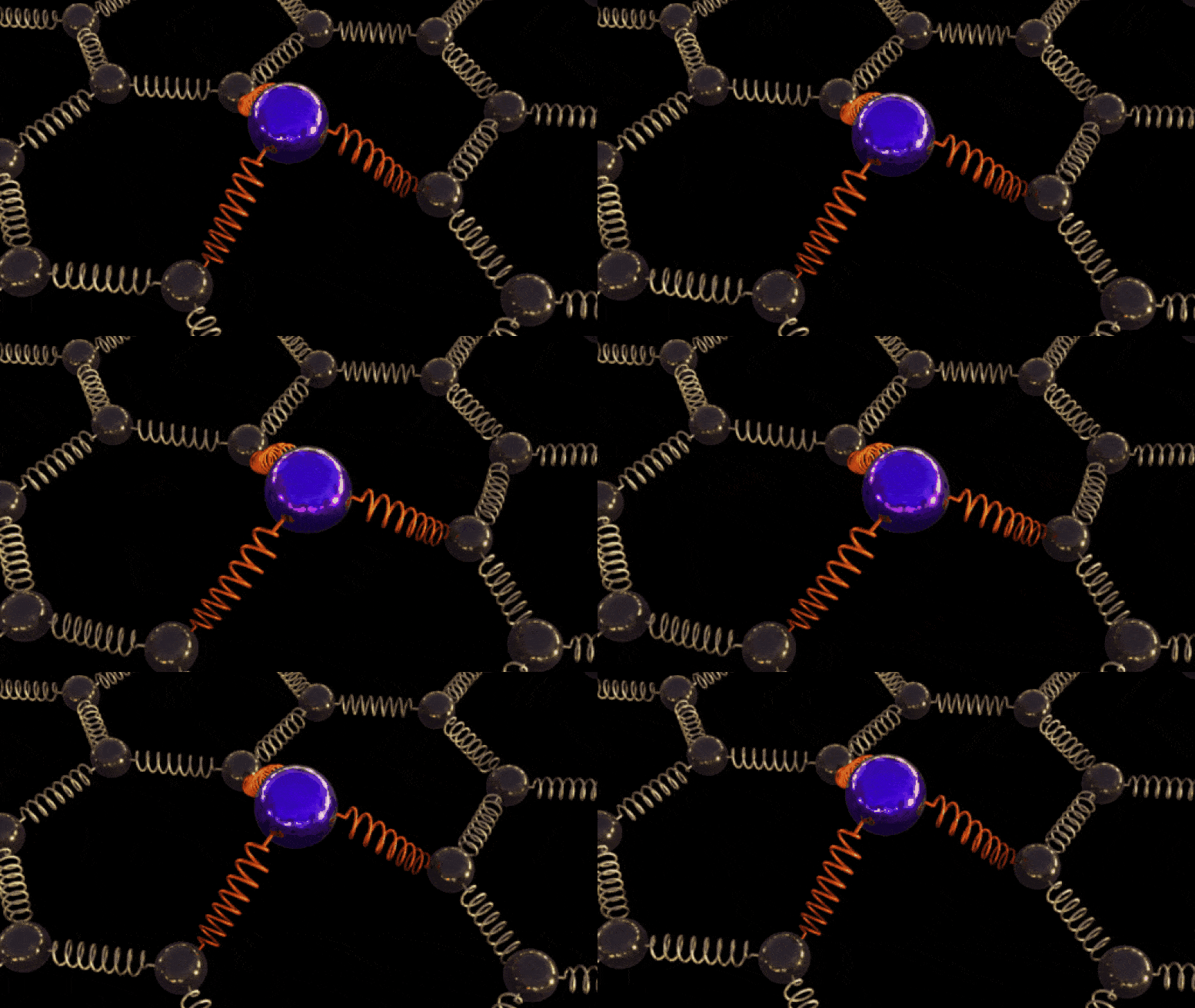
The technique being used by the research team involves firing a beam of electrons at a single atom in a solid. That energy stream causes it and the atoms that surround it to vibrate. This creates a unique vibrational energy fingerprint, akin to the fixed tone from a tuning fork, which can be recorded by an electron microscope. But if a single atom impurity is present, another chemical element, for instance, the vibrational energy fingerprint of that impurity will change: the material will ‘sound’ different at this precise location.
The research opens up the possibility that scientists will be able to monitor materials for atomic impurities.
The findings, Single Atom Vibrational Spectroscopy in the Scanning Electron Microscope, have been published in the journal Science.
Quentin Ramasse, Professor of Advanced Electron Microscopy at Leeds who led the project, said: “We now have direct evidence that a single “foreign” atom in a solid can change its vibrational property at the atomic scale.
“This has been predicted for decades, but there has not been any experimental technique to observe these vibrational changes directly. We have been able to show for the first time that you can record that defect signature with atomic precision.”
The researchers used the SuperSTEM Laboratory, the UK National Research Facility for Advanced Electron Microscopy, supported by the Engineering and Physical Sciences Research Council. The facility houses some of the most advanced facilities in the world for investigating the atomic structure of matter, and is operated under the auspices of an academic consortium led by the University of Leeds (also including the Universities of Oxford and York, who were both involved in this project, as well as Manchester, Glasgow, and Liverpool).
Taking the vibrational “fingerprint”
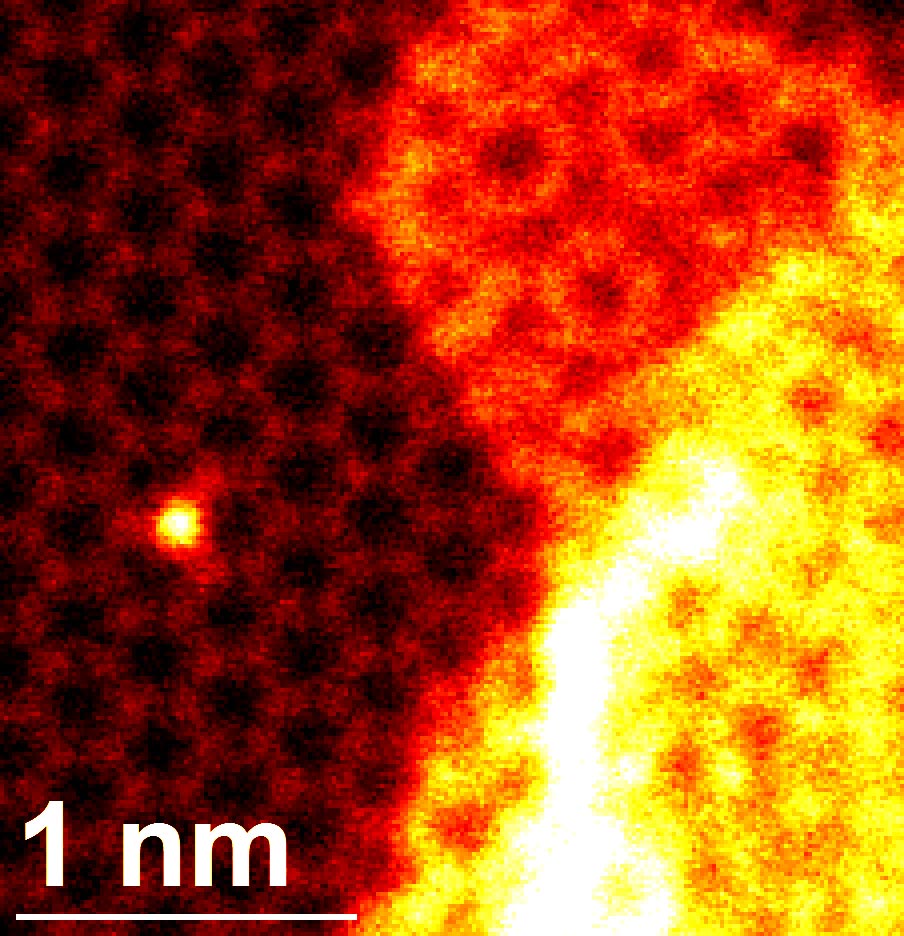
The scientists located a single impurity atom of silicon in a large graphene crystal (a form of carbon only one atom thick) – and then focused the beam of their electron microscope directly on that atom.
Professor Ramasse said: “We are hitting it with an electron beam, which makes the silicon atom move around or vibrate, absorbing some of the energy of the incoming beam of electrons in the process – and we are measuring the amount of energy that is being absorbed.”
Dr. Guillaume Radtke, of the Sorbonne University who collaborated on this project, said: “The vibrational response we observed is unique to how this particular silicon atom is located within the graphene lattice.”
“We could predict how its presence would perturb the surrounding network of carbon atoms. These experiments represent a real technical achievement because we are now able to measure with atomic precision such a subtle change.”
Reference: “Single-atom vibrational spectroscopy in the scanning transmission electron microscope” by F. S. Hage, G. Radtke, D. M. Kepaptsoglou, M. Lazzeri and Q. M. Ramasse, 6 March 2020, Science.
DOI: 10.1126/science.aba1136
The research was funded by the Engineering and Physical Sciences Research Council.
Never miss a breakthrough: Join the SciTechDaily newsletter.
Follow us on Google and Google News.