
Close Menu
    Facebook X (Twitter) Instagram
    SciTechDaily
    • Biology
    • Chemistry
    • Earth
    • Health
    • Physics
    • Science
    • Space
    • Technology
    Facebook X (Twitter) Pinterest YouTube RSS
    SciTechDaily
    Home»Earth»“Most Dangerous Place in the History of Planet Earth” Revealed by Paleontologists
    Earth

    “Most Dangerous Place in the History of Planet Earth” Revealed by Paleontologists

    By University of PortsmouthApril 25, 20201 Comment3 Mins Read
    Facebook Twitter Pinterest Telegram LinkedIn WhatsApp Email Reddit
    Share
    Facebook Twitter LinkedIn Pinterest Telegram Email Reddit
    Predator Paradise
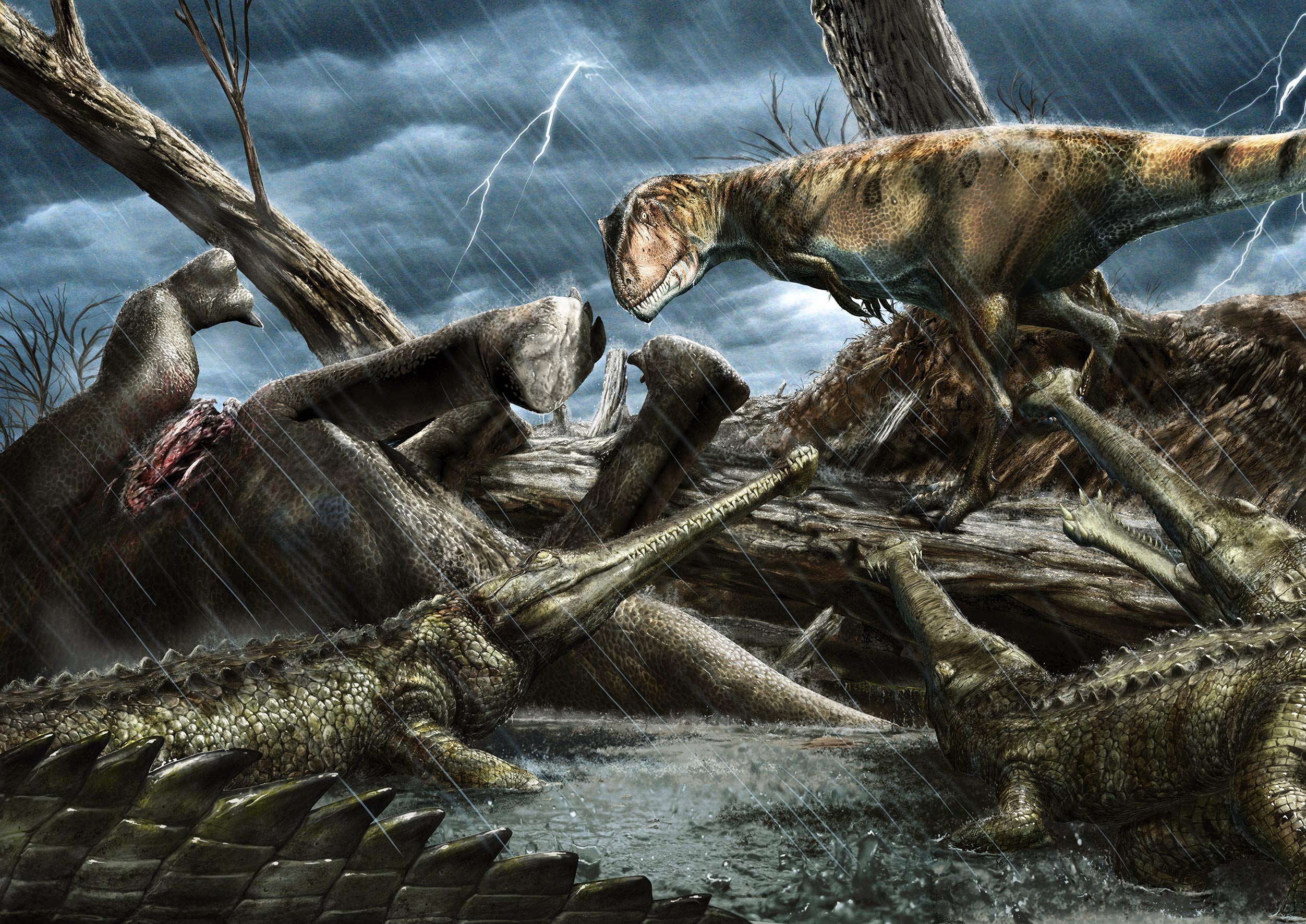
    Predator paradise — The giant predatory dinosaur Carcharodontosaurus eyes a group of Elosuchus — crocodile-like hunters — near a carcass. Credit: Artwork by Davide Bonadonna

    100 million years ago, ferocious predators, including flying reptiles and crocodile-like hunters, made the Sahara the most dangerous place on Earth.

    This is according to an international team of scientists, who have published the biggest review in almost 100 years of fossil vertebrates from an area of Cretaceous rock formations in south-eastern Morocco, known as the Kem Kem Group.

    The review, published in the journal ZooKeys, “provides a window into Africa’s Age of Dinosaurs” according to lead author Dr. Nizar Ibrahim, an Assistant Professor of Biology at the University of Detroit Mercy and Visiting Researcher from the University of Portsmouth.

    About 100 million years ago, the area was home to a vast river system, filled with many different species of aquatic and terrestrial animals. Fossils from the Kem Kem Group include three of the largest predatory dinosaurs ever known, including the saber-toothed Carcharodontosaurus (over 8m or 26ft in length with enormous jaws and long, serrated teeth up to eight inches or 20 centimeters long) and Deltadromeus (around 8m in length, a member of the raptor family with long, unusually slender hind limbs for its size), as well as several predatory flying reptiles (pterosaurs) and crocodile-like hunters. Dr. Ibrahim said: “This was arguably the most dangerous place in the history of planet Earth, a place where a human time-traveler would not last very long.”

    Many of the predators were relying on an abundant supply of fish, according to co-author Professor David Martill from the University of Portsmouth. He said: “This place was filled with absolutely enormous fish, including giant coelacanths and lungfish. The coelacanth, for example, is probably four or even five times large than today’s coelacanth. There is an enormous freshwater saw shark called Onchopristis with the most fearsome of rostral teeth, they are like barbed daggers, but beautifully shiny.”

    Researchers from the Universities of Detroit, Chicago, Montana, Portsmouth (UK), Leicester (UK, David Unwin), Casablanca (Morocco), and McGill (Canada), as well as the Paris Museum of Natural History, have produced the first detailed and fully illustrated account of the fossil-rich escarpment, previously known as the “Kem Kem beds”. The researchers now define this sedimentary package as the Kem Kem Group, which consists of two distinct formations, the Gara Sbaa Formation and the Douira Formation.

    To assemble the huge datasets and fossil images, which were originally included in his Ph.D. thesis, Dr. Ibrahim visited Kem Kem collections on several continents.

    Shedding light on Africa’s ancient past is important says Professor Martill, “This is the most comprehensive piece of work on fossil vertebrates from the Sahara in almost a century, since the famous German paleontologist Ernst Freiherr Stromer von Reichenbach published his last major work in 1936.”

    Reference: “Geology and paleontology of the Upper Cretaceous Kem Kem Group of eastern Morocco” by Nizar Ibrahim, Paul C. Sereno, David J. Varricchio, David M. Martill, Didier B. Dutheil, David M. Unwin, Lahssen Baidder, Hans C. E. Larsson, Samir Zouhri and Abdelhadi Kaoukaya, 21 April 2020, ZooKeys.
    DOI: 10.3897/zookeys.928.47517

    Never miss a breakthrough: Join the SciTechDaily newsletter.
    Follow us on Google and Google News.

    Geology Paleontology Popular University of Portsmouth
    Share. Facebook Twitter Pinterest LinkedIn Email Reddit

    Related Articles

    Remarkably Well-Preserved Fossils Helping to Solve Baffling Puzzle That Vexed Darwin

    World’s Longest Erupting Supervolcanoes Fueled by Magma “Conveyor Belt”

    Dramatic Tale of Environmental Change Told by Ancient Fossil Trees on Peru’s Central Andean Plateau

    “Carnian Pluvial Episode” Revealed: Climate Change During Origin of Dinosaurs

    New Insight Into the Great Dying – Earth’s Most Deadly Mass Extinction Event Disrupted Ocean Chemistry

    How a Selfie Stick and Fishing Rod Accessed an Ancient Skeleton to Shed First Light on 145 Million-Year-Old Reptile

    Ancestor of All Animals – Including Humans – Identified in Australian Fossils

    Mutated Ferns Show Poisonous Factor in Ancient Mass Extinction

    It Really Was the Asteroid That Ended the Dinosaurs – Here’s How It Went Down

    1 Comment

    1. 010101001010 on April 27, 2020 7:25 am

      Pffff, most dangerous..
      have you seen my neighborhood 20 years ago?

      Reply
    Leave A Reply Cancel Reply

    • Facebook
    • Twitter
    • Pinterest
    • YouTube

    Don't Miss a Discovery

    Subscribe for the Latest in Science & Tech!

    Trending News

    Doctors May Need To Rethink Calcium and Vitamin D Recommendations After Major Review

    Scientists Discover a Hidden Cause of Cellular Aging That Can Be Reversed

    Archaeologists Have Found Something Unexpected Inside a 1,600-Year-Old Egyptian Mummy

    Scientists May Have Found a Completely New Way To Treat Depression

    New 7-Dimensional Theory May Finally Solve the Black Hole Information Paradox

    Scientists Made Older Mice Biologically Younger Using Gut Microbes

    Scientists Finally Uncover Why Ozempic Stops Working for Some People

    Wasp Colonies Explode Into Violence After Losing Their Queen

    Follow SciTechDaily
    • Facebook
    • Twitter
    • YouTube
    • Pinterest
    • Newsletter
    • RSS
    SciTech News
    • Biology News
    • Chemistry News
    • Earth News
    • Health News
    • Physics News
    • Science News
    • Space News
    • Technology News
    Recent Posts
    • Researchers Solve the Mystery Behind a Billion-Dollar Dental Implant Disease
    • Scientists Finally Uncover How a “Forever Chemical” Causes Birth Defects
    • Scientists Uncover the Earliest Brain Changes That May Predict Alzheimer’s Decades Before Symptoms
    • Mystery Solved: The Decades-Old Secret Lurking Beneath North Carolina’s Blueberry Farms
    • Surprising New Study Challenges a Century-Old Theory of Habit Formation
    Copyright © 1998 - 2026 SciTechDaily. All Rights Reserved.
    • Science News
    • About
    • Contact
    • Editorial Board
    • Privacy Policy
    • Terms of Use

    Type above and press Enter to search. Press Esc to cancel.