
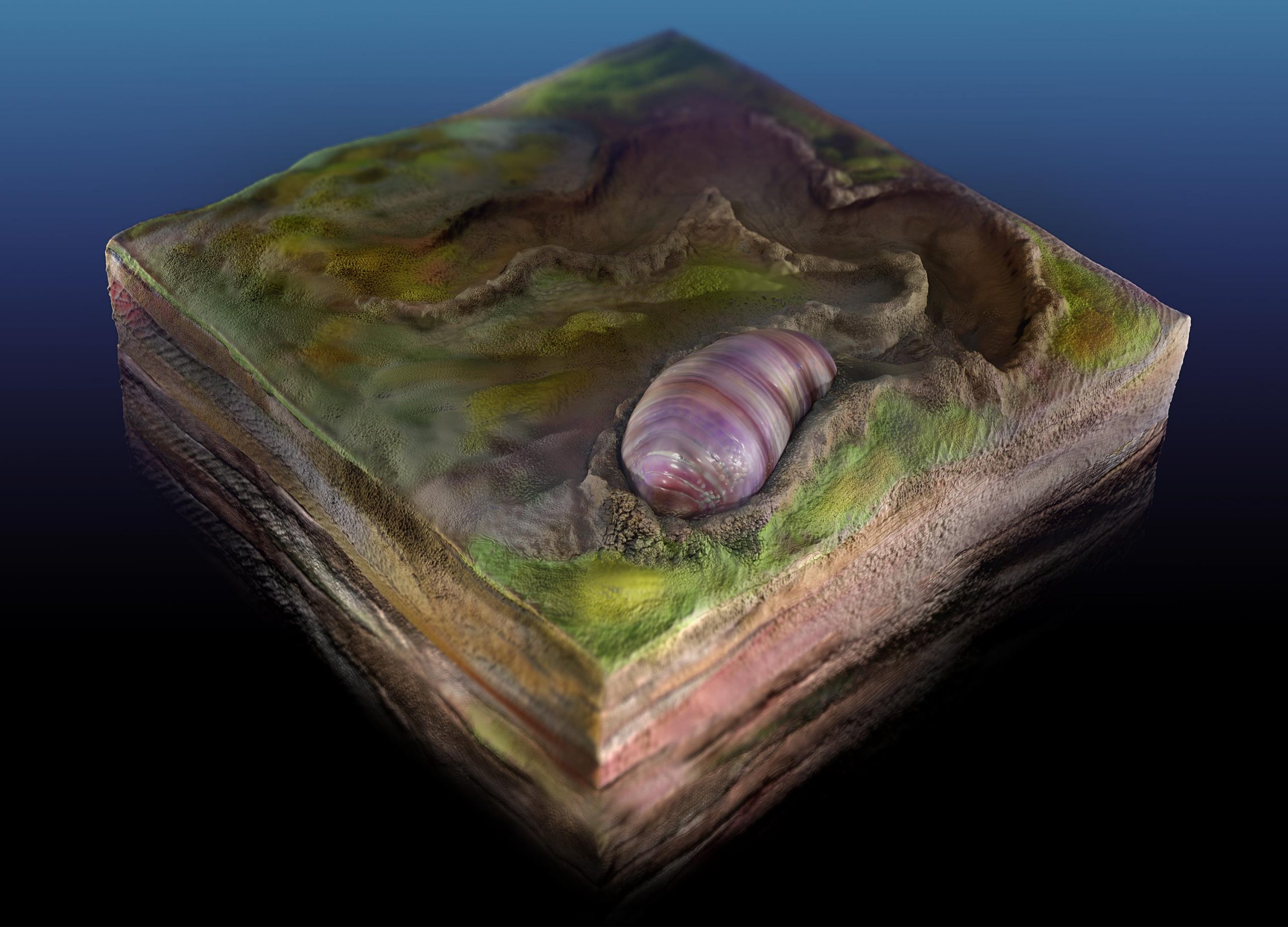
A wormlike creature that lived more than 555 million years ago is the earliest bilaterian.
A team led by UC Riverside geologists has discovered the first ancestor on the family tree that contains most familiar animals today, including humans.
The tiny, wormlike creature, named Ikaria wariootia, is the earliest bilaterian, or organism with a front and back, two symmetrical sides, and openings at either end connected by a gut. The paper is published today (March 23, 2020) in Proceedings of the National Academy of Sciences.
The earliest multicellular organisms, such as sponges and algal mats, had variable shapes. Collectively known as the Ediacaran Biota, this group contains the oldest fossils of complex, multicellular organisms. However, most of these are not directly related to animals around today, including lily pad-shaped creatures known as Dickinsonia that lack the basic features of most animals, such as a mouth or gut.
The development of bilateral symmetry was a critical step in the evolution of animal life, giving organisms the ability to move purposefully and a common, yet successful way to organize their bodies. A multitude of animals, from worms to insects to dinosaurs to humans, are organized around this same basic bilaterian body plan.
Evolutionary biologists studying the genetics of modern animals predicted the oldest ancestor of all bilaterians would have been simple and small, with rudimentary sensory organs. Preserving and identifying the fossilized remains of such an animal was thought to be difficult, if not impossible.
For 15 years, scientists agreed that fossilized burrows found in 555 million-year-old Ediacaran Period deposits in Nilpena, South Australia, were made by bilaterians. But there was no sign of the creature that made the burrows, leaving scientists with nothing but speculation.
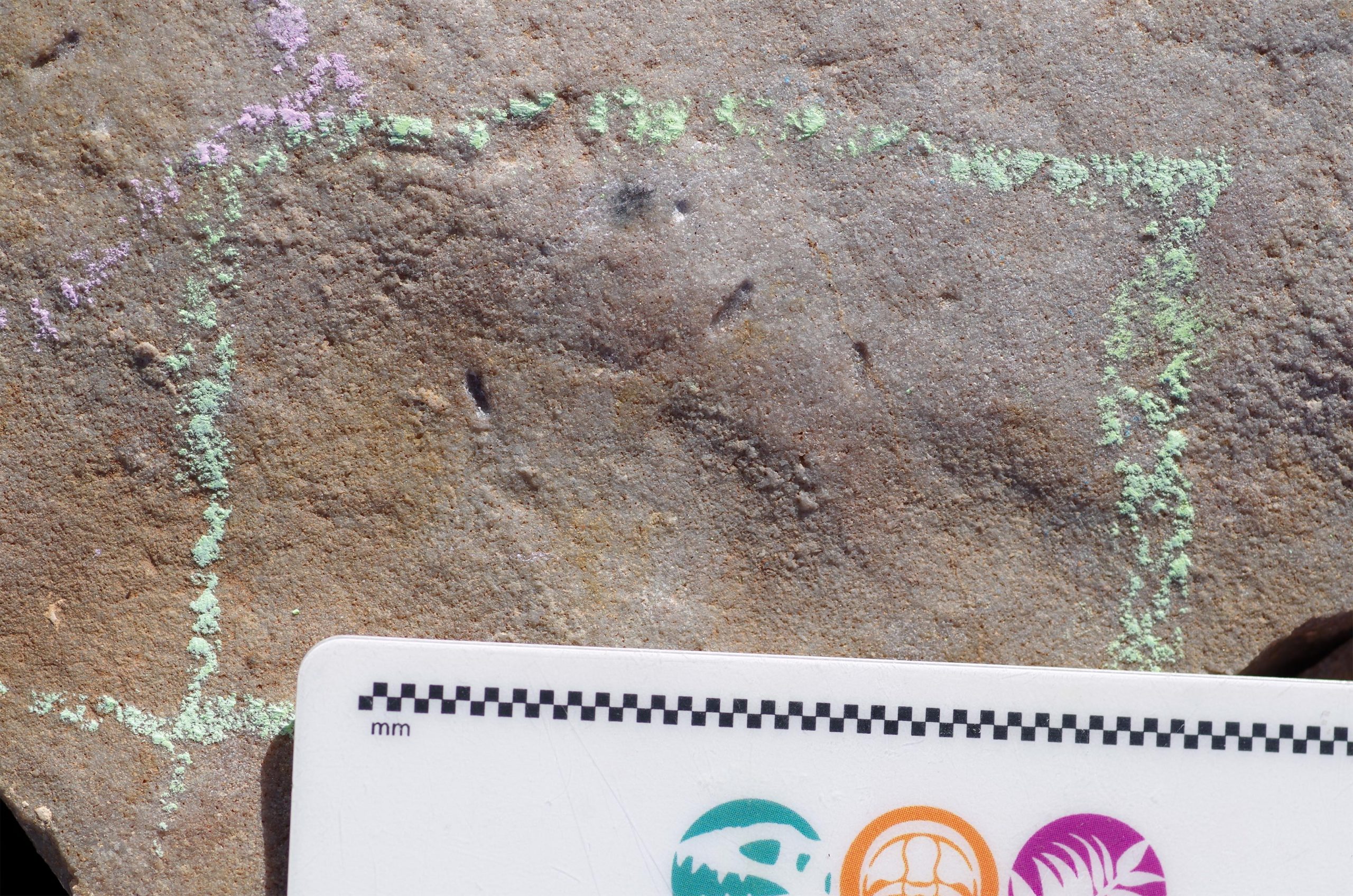
Scott Evans, a recent doctoral graduate from UC Riverside; and Mary Droser, a professor of geology, noticed miniscule, oval impressions near some of these burrows. With funding from a NASA exobiology grant, they used a three-dimensional laser scanner that revealed the regular, consistent shape of a cylindrical body with a distinct head and tail and faintly grooved musculature. The animal ranged between 2-7 millimeters long and about 1-2.5 millimeters wide, with the largest the size and shape of a grain of rice — just the right size to have made the burrows.

“We thought these animals should have existed during this interval, but always understood they would be difficult to recognize,” Evans said. “Once we had the 3D scans, we knew that we had made an important discovery.”
The researchers, who include Ian Hughes of UC San Diego and James Gehling of the South Australia Museum, describe Ikaria wariootia, named to acknowledge the original custodians of the land. The genus name comes from Ikara, which means “meeting place” in the Adnyamathanha language. It’s the Adnyamathanha name for a grouping of mountains known in English as Wilpena Pound. The species’ name comes from Warioota Creek, which runs from the Flinders Ranges to Nilpena Station.
“Burrows of Ikaria occur lower than anything else. It’s the oldest fossil we get with this type of complexity,” Droser said. “Dickinsonia and other big things were probably evolutionary dead ends. We knew that we also had lots of little things and thought these might have been the early bilaterians that we were looking for.”
In spite of its relatively simple shape, Ikaria was complex compared to other fossils from this period. It burrowed in thin layers of well-oxygenated sand on the ocean floor in search of organic matter, indicating rudimentary sensory abilities. The depth and curvature of Ikaria represent clearly distinct front and rear ends, supporting the directed movement found in the burrows.
The burrows also preserve crosswise, “V”-shaped ridges, suggesting Ikaria moved by contracting muscles across its body like a worm, known as peristaltic locomotion. Evidence of sediment displacement in the burrows and signs the organism fed on buried organic matter reveal Ikaria probably had a mouth, anus, and gut.
“This is what evolutionary biologists predicted,” Droser said. “It’s really exciting that what we have found lines up so neatly with their prediction.”
Reference: “Discovery of the oldest bilaterian from the Ediacaranof South Australia” by Scott D. Evans, Ian V. Hughes, James G. Gehlingc and Mary L. Drosera, March 2020, Proceedings of the National Academy of Sciences.
DOI: 10.1073/pnas.2001045117
Never miss a breakthrough: Join the SciTechDaily newsletter.
Follow us on Google and Google News.
15 Comments
Your DOI link is incorrect.
It looks like it is working fine now. Sometimes the link doesn’t go live at the same time as the publication, which was also the same time this article was published, as the journalistic embargo was lifted.
The planet’s only 6,000 years old, the Bibble says so. This worm, it’s just an old worm stuck in the mud. Dig it out and use it for fishing.
Besides the Bible, we also have Pb and He retention rates in Precambrian zircons that are consistent with an age of thousands of years, and U/Pb ratios in Triassic coalified wood that yields ages that differ from those assumed by evolutionists by a factor of at least 760.
The earth is most definitely older than 6000 years. Young earth science isn’t…science
The post say to dig it out and use it for fishing is evidence that not all humans evolved, some, like that poster are actively devolving
I think Mr. Bauls was using sarcasm as a tool.
He needed that tool to dig it out.
“Which was the son of Enos, which was the son of Seth, which was the son of Adam, which was the son of God” (Luke 3:38).
This article is fairly clear that evolutionists reject the idea that Adam was a son of God, in order to embrace the rather insulting idea that man is descended from a worm.
The question would be, Why? Certainly not because geology mandates no other conclusion.
I suspect the dates are wrong. While this is probably that old, it is not the oldest animal on the planet. You simply won’t have a record old enough to prove it, that a scientist today will publish. I suspect that there have been several civilizations on this rock, going back billions of years. They disappeared, as all humans traces will disappear over a billion years.
I suspect you are wrong. Science has clear evidence of the early stages of life on earth and what was possible to exist at that time, according to geology of earth
Pretty serious stretch, and looking at the 3d rendering, based on my highly evolved opinion, this is a gross misuse of confirmation bias.
A tiny lump in the stone. I’m almost impressed at the effort made to make this look significant, except that is all that evolution has left. Rocks and fables.
Being a liberal retard doesn’t make you smart. Evolution is a FACT and Trump is the first president in decades trying to fix the s#!t infested trash fire that all the previous presidents have laid out to ruin this country. I don’t know why you’re even reading articles on this site. You’re not even remotely intelligent.
Evolution Is a belief system, like a religion and the definition of science (secular science) excludes other religions just as Judaism, Christianity, Islam and other religions exclude other belief systems. It takes allot of faith to believe evolution and all the circular reasoning, changing evidence, and lack of evidence. I choose to have faith In God.