
Close Menu
    Facebook X (Twitter) Instagram
    SciTechDaily
    • Biology
    • Chemistry
    • Earth
    • Health
    • Physics
    • Science
    • Space
    • Technology
    Facebook X (Twitter) Pinterest YouTube RSS
    SciTechDaily
    Home»Earth»We’re Surprisingly Similar to Earth’s First Animals – Humans Share Genes With Ancient Oceanic Creatures Missing Heads
    Earth

    We’re Surprisingly Similar to Earth’s First Animals – Humans Share Genes With Ancient Oceanic Creatures Missing Heads

    By University of California - RiversideMarch 22, 202111 Comments4 Mins Read
    Facebook Twitter Pinterest Telegram LinkedIn WhatsApp Email Reddit
    Share
    Facebook Twitter LinkedIn Pinterest Telegram Email Reddit
    Ediacaran Sealife
    Recreation of Ediacaran sealife displayed at the Smithsonian Institution. Credit: Ryan Somma

    Ancient sea creatures had genetic traits still present in humans today, shedding light on our earliest evolutionary roots.

    The earliest multicellular organisms may have lacked heads, legs, or arms, but pieces of them remain inside of us today, new research shows.

    According to a UC Riverside study, 555-million-year-old oceanic creatures from the Ediacaran period share genes with today’s animals, including humans.

    “None of them had heads or skeletons. Many of them probably looked like three-dimensional bathmats on the sea floor, round discs that stuck up,” said Mary Droser, a geology professor at UCR. “These animals are so weird and so different, it’s difficult to assign them to modern categories of living organisms just by looking at them, and it’s not like we can extract their DNA — we can’t.”

    However, well-preserved fossil records have allowed Droser and the study’s first author, recent UCR doctoral graduate Scott Evans, to link the animals’ appearance and likely behaviors to genetic analysis of currently living things. Their research on these links has been recently published in the journal Proceedings of the Royal Society B.

    The Four Fossil Ambassadors of the Ediacaran Era
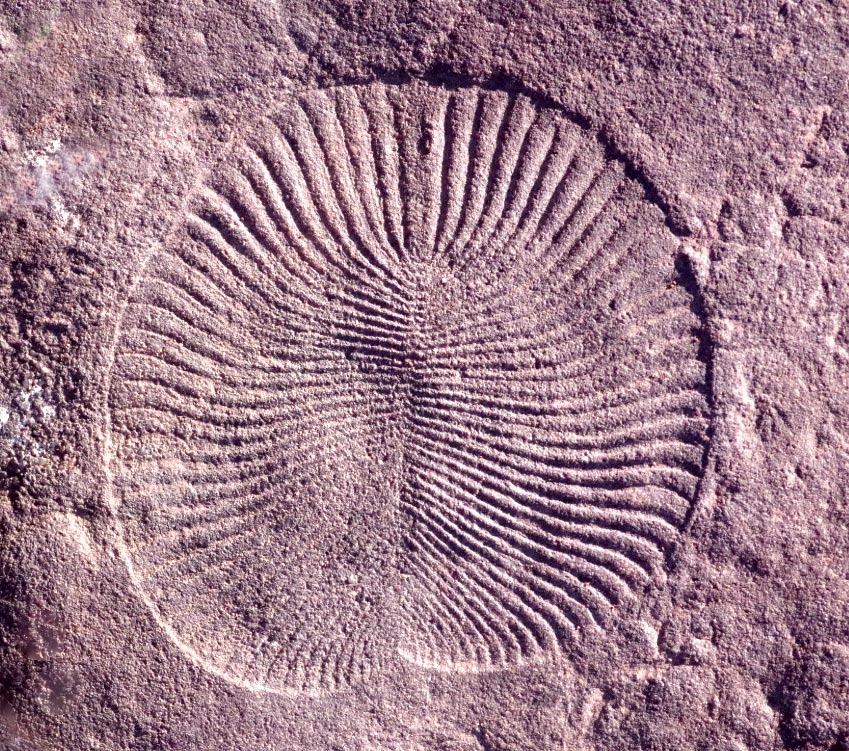
    Fossil of Dickinsonia
    Fossil of Dickinsonia, an Ediacaran-era animal. Credit: Mary Droser/UCR

    For their analysis, the researchers considered four animals representative of the more than 40 recognized species that have been identified from the Ediacaran era. These creatures ranged in size from a few millimeters to nearly a meter in length.

    Kimberella were teardrop-shaped creatures with one broad, rounded end and one narrow end that likely scraped the sea floor for food with a proboscis. Further, they could move around using a “muscular foot” like snails today. The study included flat, oval-shaped Dickinsonia with a series of raised bands on their surface, and Tribrachidium, who spent their lives immobilized at the bottom of the sea.

    Also analyzed were Ikaria, animals recently discovered by a team including Evans and Droser. They were about the size and shape of a grain of rice, and represent the first bilaterians — organisms with a front, back, and openings at either end connected by a gut. Evans said it’s likely Ikaria had mouths, though those weren’t preserved in the fossil records, and they crawled through organic matter “eating as they went.”

    All four of the animals were multicellular, with cells of different types. Most had symmetry on their left and right sides, as well as noncentralized nervous systems and musculature.

    Paleontologist Scott Evans
    Paleontologist Scott Evans studying fossils in the Australian outback. Credit: Droser Lab/UCR

    Additionally, they seem to have been able to repair damaged body parts through a process known as apoptosis. The same genes involved are key elements of human immune systems, which helps to eliminate virus-infected and pre-cancerous cells. 

    These animals likely had the genetic parts responsible for heads and the sensory organs usually found there. However, the complexity of interaction between these genes that would give rise to such features hadn’t yet been achieved. 

    The Link Between the Ancient and Us

    “The fact that we can say these genes were operating in something that’s been extinct for half a billion years is fascinating to me,” Evans said. 

    The work was supported by a NASA Exobiology grant, and a Peter Buck postdoctoral fellowship.      
                                                                                      
    Going forward, the team is planning to investigate muscle development and functional studies to further understand early animal evolution.

    “Our work is a way to put these animals on the tree of life, in some respects,” Droser said. “And show they’re genetically linked to modern animals, and to us.”

    Reference: “Developmental processes in Ediacara macrofossils” by Scott D. Evans, Mary L. Droser and Douglas H. Erwin, 24 February 2021, Proceedings of the Royal Society B.
    DOI: 10.1098/rspb.2020.3055

    Never miss a breakthrough: Join the SciTechDaily newsletter.
    Follow us on Google and Google News.

    Biodiversity Evolution Genetics Paleontology Popular UC Riverside
    Share. Facebook Twitter Pinterest LinkedIn Email Reddit

    Related Articles

    Earth’s Worst Mass Extinction Took Ten Times Longer on Land Than in the Water

    Ancestor of All Animals – Including Humans – Identified in Australian Fossils

    Absolutely Massive Extinct Turtle Weighed 2,500 Pounds and Had Giant Horned Shell

    Remarkable New Species of Meat-Eating Jurassic Dinosaur Discovered in Utah

    New Fossils of Ancient Snake With Hind Legs Reveals Tantalizing Details of Evolution

    Lichens Are Way Younger Than Scientists Thought – Likely Evolved Millions of Years After Plants

    Gap in Fossil Record Filled by Find From School Class Hike – Ancient Rhinos Roamed the Yukon

    It Really Was the Asteroid That Ended the Dinosaurs – Here’s How It Went Down

    Guppies Unlock a Key Question About Evolution

    11 Comments

    1. 4NDR0M3D4 on March 24, 2021 4:39 am

      This is ridiculous. Give me a break.

      Reply
    2. xABBAAA on March 24, 2021 9:53 am

      … well at least we have legs…

      Reply
    3. kamir bouchareb st on March 25, 2021 4:55 am

      very good thanks

      Reply
    4. Dick Dick Dick on March 27, 2021 2:55 pm

      my weiner evolved from a T-rex. not the arms tho

      Reply
    5. Giovanni on March 27, 2021 6:41 pm

      This stuff contains no new revelations. Basic but important known concepts here with regard to animal somatic architecture It all can be found in current biology and zoology textbooks!

      Reply
    6. Scott Fowler on March 29, 2021 4:45 am

      Well this is very disturbing to me. I had big plans for taking over hell as the new devil. All that sh*t I did for n9thing

      Reply
    7. Denise Moser on March 29, 2021 5:53 am

      Lol people wanna believe sh*t like this but deny the truth. This is the most ridiculous thing I’ve read.

      Reply
    8. The Toilet Reaper on March 29, 2021 7:02 pm

      Me when

      Reply
    9. Mecha on March 29, 2021 8:10 pm

      🤦

      Reply
    10. Joe Loftis on March 30, 2021 6:09 am

      We all came from somewhere ,right? LoL

      Reply
    11. ChummierHawk2 on March 30, 2021 7:07 am

      I missed the part that it was my problem 😕.
      Our genitals are the same from female to male,
      We have molluskoid structures from sea, no wonder it smells like fish downstairs.

      Reply
    Leave A Reply Cancel Reply

    • Facebook
    • Twitter
    • Pinterest
    • YouTube

    Don't Miss a Discovery

    Subscribe for the Latest in Science & Tech!

    Trending News

    Breakthrough Bowel Cancer Trial Leaves Patients Cancer-Free for Nearly 3 Years

    Natural Compound Shows Powerful Potential Against Rheumatoid Arthritis

    100,000-Year-Old Neanderthal Fossils in Poland Reveal Unexpected Genetic Connections

    Simple “Gut Reset” May Prevent Weight Gain After Ozempic or Wegovy

    2.8 Days to Disaster: Scientists Warn Low Earth Orbit Could Suddenly Collapse

    Common Food Compound Shows Surprising Power Against Superbugs

    5 Simple Ways To Remember More and Forget Less

    The Atomic Gap That Could Cost the Semiconductor Industry Billions

    Follow SciTechDaily
    • Facebook
    • Twitter
    • YouTube
    • Pinterest
    • Newsletter
    • RSS
    SciTech News
    • Biology News
    • Chemistry News
    • Earth News
    • Health News
    • Physics News
    • Science News
    • Space News
    • Technology News
    Recent Posts
    • Scientists Just Made Carbon Capture Much Cheaper and Easier
    • Harvard Breakthrough Brings Powerful UV Light Sources Onto a Chip
    • This Strange Quantum “Dance” Could Rewrite Superconductivity
    • Scientists Make Breakthrough in Turning Plastic Trash Into Clean Fuel Using Sunlight
    • Scientists Complete Largest 3D Map of the Universe to Probe Dark Energy
    Copyright © 1998 - 2026 SciTechDaily. All Rights Reserved.
    • Science News
    • About
    • Contact
    • Editorial Board
    • Privacy Policy
    • Terms of Use

    Type above and press Enter to search. Press Esc to cancel.