
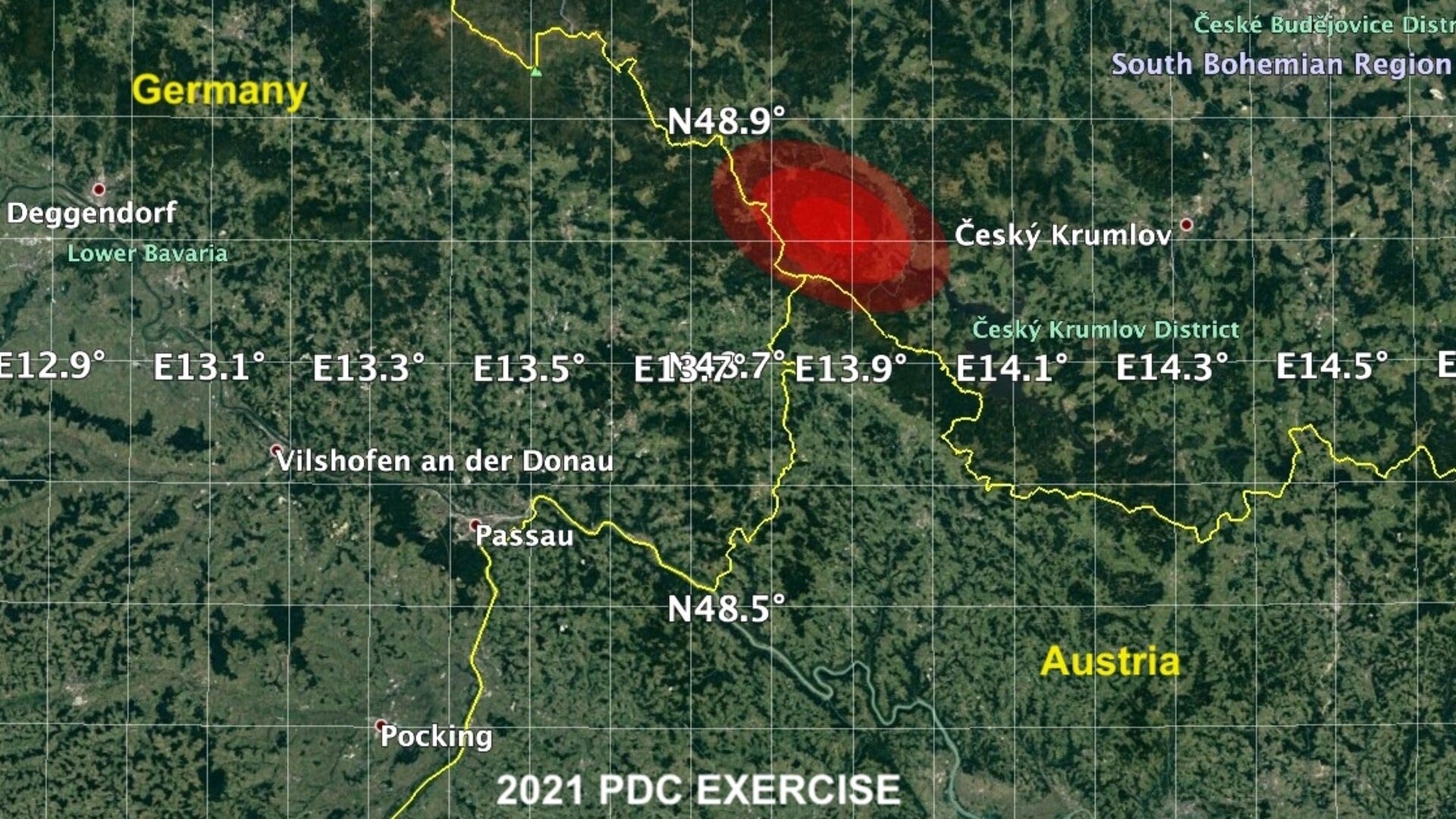
In an alternate reality playing out at this year’s International Planetary Defense Conference, a fictional asteroid crashes over Europe, ‘destroying’ a region about 100 km wide near the Czech Republic and German border. The scenario was imagined, but the people who took part are very real, and the lessons learned will shape our ability to respond to dangerous asteroids for years to come.
Asteroid Impact: The Only Natural Disaster We Might Prevent
Natural hazards come in a range of forms and occur with varying frequency. Some are relatively frequent events with localized impacts such as flooding and wildfires. Others occur just once in a blue moon but can impact the entire planet, such as global pandemics and asteroid impacts.
The threat from asteroids however is unique: an asteroid impact is the most predictable natural disaster we face, and given enough warning we have the technology, in principle, to entirely prevent it.
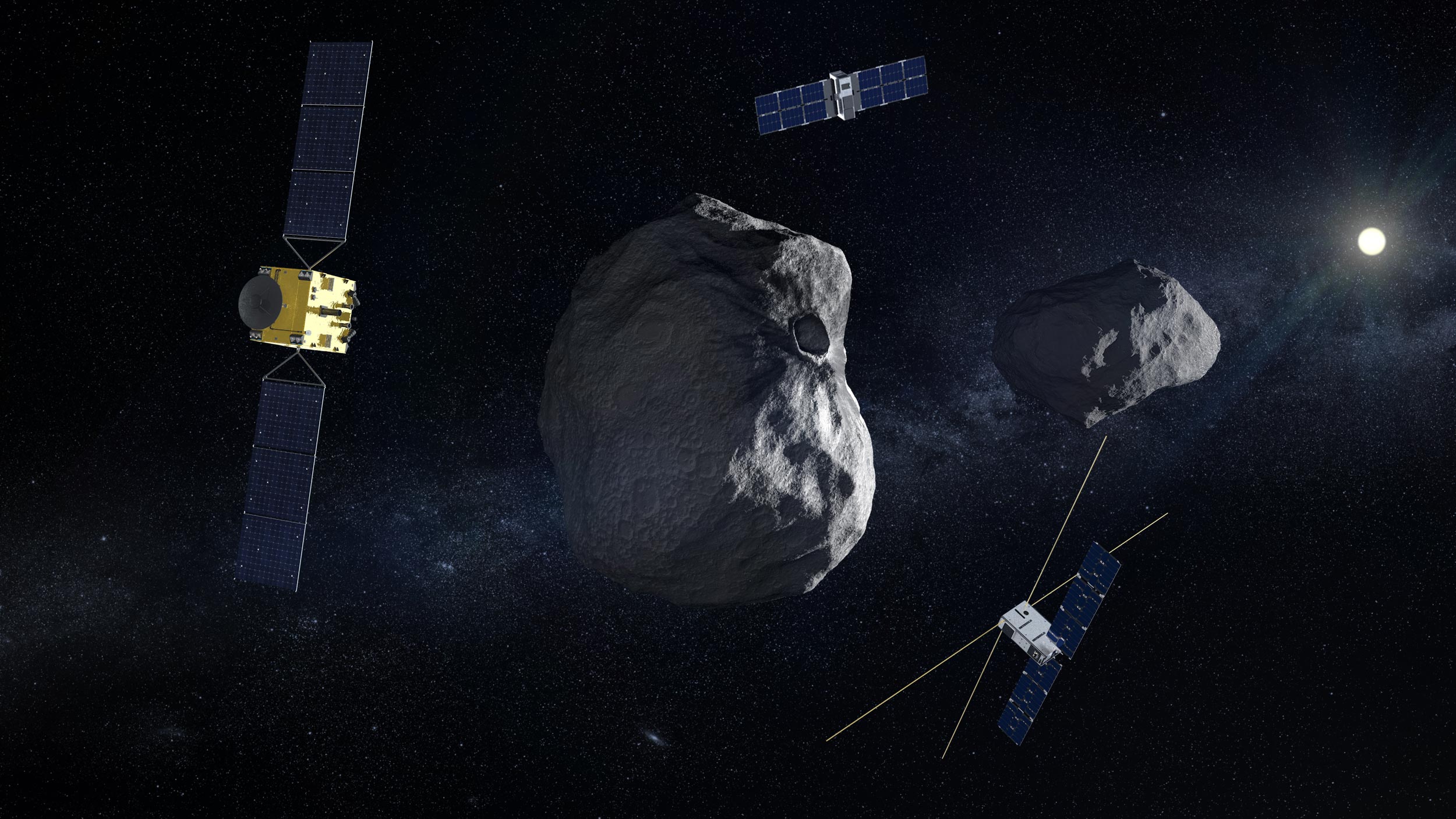
In the last few decades, the field of planetary defense has made remarkable progress – humankind now has telescopes dotted across the planet seeking out hazardous space rocks, the largest of which have all been discovered, and this year we launch a mission that will for the first time put asteroid deflection to the test.
The good news is, when it comes to giant, dinosaur-extinction-sized asteroids, we are pretty sure we’ve found everyone out there. Because of their sheer size, they are easy to detect. But the smaller they get, the more we still have to find, which is why the impact of this year’s asteroid, 2021 PDC, provided such an important lesson: we can only prevent what we can predict.
This Year’s Scenario: Mission Impossible
Although this scenario is realistic in many ways, it is completely fictional and
does NOT describe an actual asteroid impact.
It all began on April 19, 2021, when a new asteroid was discovered by the Pan-STARRS near-Earth object survey project. It soon became clear that this asteroid was worryingly likely to strike Earth in just six months.
Further observations confirmed what the international community had feared, an impact was certain. However, the size of the object remained unclear, ranging anywhere from 35 to 700 meters (115 to 2,300 feet) in diameter.
As would be the case if a real asteroid were on collision course, the International Asteroid Warning Network (IAWN) – a network of organizations that detect, track and characterize potentially hazardous asteroids – publicly disseminated weekly updates on the impact probability as the situation progressed.
At the same time, the Space Missions Planning Advisory Group (SMPAG) began to consider our options to prevent the impact. However, time is short and we are still uncertain about the size of the object. Most options to deflect an asteroid – such as deflection via a high-energy impact, ‘gravity tractor’, or ‘ion beam shepherd’ – work by only slightly nudging the targeted space rock. However, if performed far enough in advance that small initial nudge builds up to become a large shift in position by the time the asteroid gets close to Earth.
By day three of the conference, the scenario jumps ahead two months to 30 June, less than four months until the imaginary asteroid would strike. At this point, SMPAG concludes that no space missions can be launched in time to deflect or disrupt 2021 PDC from its collision course.
Lessons Learned: We Can’t Prevent What We Can’t Predict
A scenario like this, in which an asteroid impact is predicted with short warning of just a few months, poses challenges for in-space prevention.
Asteroids in our Solar System do not appear out of nowhere, they travel in orbits around the Sun for thousands, millions of years. Like annual meteor showers, we can calculate with great certainty when an asteroid will be back.
Had a more sensitive asteroid survey such as NEOSM or the Rubin Observatory (LSST) been in place in 2014, they would almost certainly have detected 2021 PDC on a previous journey round the Sun, and this seven-year warning would have opened up a host of different possible outcomes. In particular, space missions would have been feasible for a reconnaissance mission to find out more about the asteroid’s size and composition, or a simple ‘kinetic-impactor’ deflection mission could have nudged it out the way.
Investing on Eyes on the Sky
Telescopes and sky surveys such as the PanSTARRS or Catalina sky survey and many more are discovering new near-Earth objects (NEOs) every day. ESA is adding to this global network with its upcoming network of high-tech ‘Flyeyes’.
ESA’s Test-Bed Telescope, the second of which was recently installed at La Silla, in South America, is a collaborative project with ESO that will efficiently perform follow-up observations of NEOs, and the first Flyeye telescope is currently under construction to be installed on a mountain top in Sicily, Italy, with an insect-inspired design that will allow it to cover large regions of the sky much quicker than traditional designs.
Investments such as these, as well as those under way across the globe, are fundamental to protecting us from dangerous asteroids. We have to find them before we can do anything about them.
Lessons From COVID-19
“Simply thinking in annual or bi-annual planning cycles, which is how many budgets at public institutions are set, is not good enough to address a risk that has been hundreds of millions of years in the making.”
This year’s conference, like the majority of events in the last months, took place entirely online. As many participants noted, preparing for one disaster while in the midst of another had a unique poignancy, a not-so-subtle reminder that unlikely but catastrophic events are very real, and must be prepared for.
Disaster management experts, local governments, mission planners, and policy experts regularly look to past events to see what worked, and what went wrong. On the fourth day of the conference, lessons from past disasters such as hurricanes, floods, and earthquakes were discussed, along with lessons from the COVID-19 pandemic.
Of vital importance is the need to invest in research and technology, prepare governments and local authorities with realistic exercise scenarios, understand how to protect diverse populations with varying needs including the most vulnerable in society, and provide clear and transparent information and advice to the public.
“A big lesson was that we need more long-term planning on how we can spot, track, and ultimately mitigate potentially dangerous asteroids,” says Detlef Koschny, Head of ESA’s Planetary Defence Office.
“Simply thinking in annual or bi-annual planning cycles, which is how many budgets at public institutions are set, is not good enough to address a risk that has been hundreds of millions of years in the making.”
Finally, one thing is clear: an asteroid impact, although unlikely, is probably going to happen sooner or later – so it is best to be prepared.
Never miss a breakthrough: Join the SciTechDaily newsletter.
Follow us on Google and Google News.
5 Comments
That’s fairly mountainous country. Did they extend the simulation to blast effects in such terrain ? Mass ejection and its effect on global weather/climate ? As reported the whole thing seems.. an inconvenience.
It sounds like a two-foot-tall interstellar Beavis with three eyes could annihilate all life on Earth just by giving a big rock a little push…Just for giggles.
Very informative article. Fascinating from my 78 year old eyes. If this had been written when I was a kid, the author would have been run out of town for being insane! Congratulations on expanding knowledge!!
n/a
Get a clue. You think people need more to worry about with the current crisis the world is in. Change your headline. Don’t be another dbag.