
Close Menu
    Facebook X (Twitter) Instagram
    SciTechDaily
    • Biology
    • Chemistry
    • Earth
    • Health
    • Physics
    • Science
    • Space
    • Technology
    Facebook X (Twitter) Pinterest YouTube RSS
    SciTechDaily
    Home»Science»How Touching Is Perceived in the Brain – Investigated With Two-Person MRI Scans on Couples
    Science

    How Touching Is Perceived in the Brain – Investigated With Two-Person MRI Scans on Couples

    By Aalto UniversityMay 24, 2020No Comments3 Mins Read
    Facebook Twitter Pinterest Telegram LinkedIn WhatsApp Email Reddit
    Share
    Facebook Twitter LinkedIn Pinterest Telegram Email Reddit
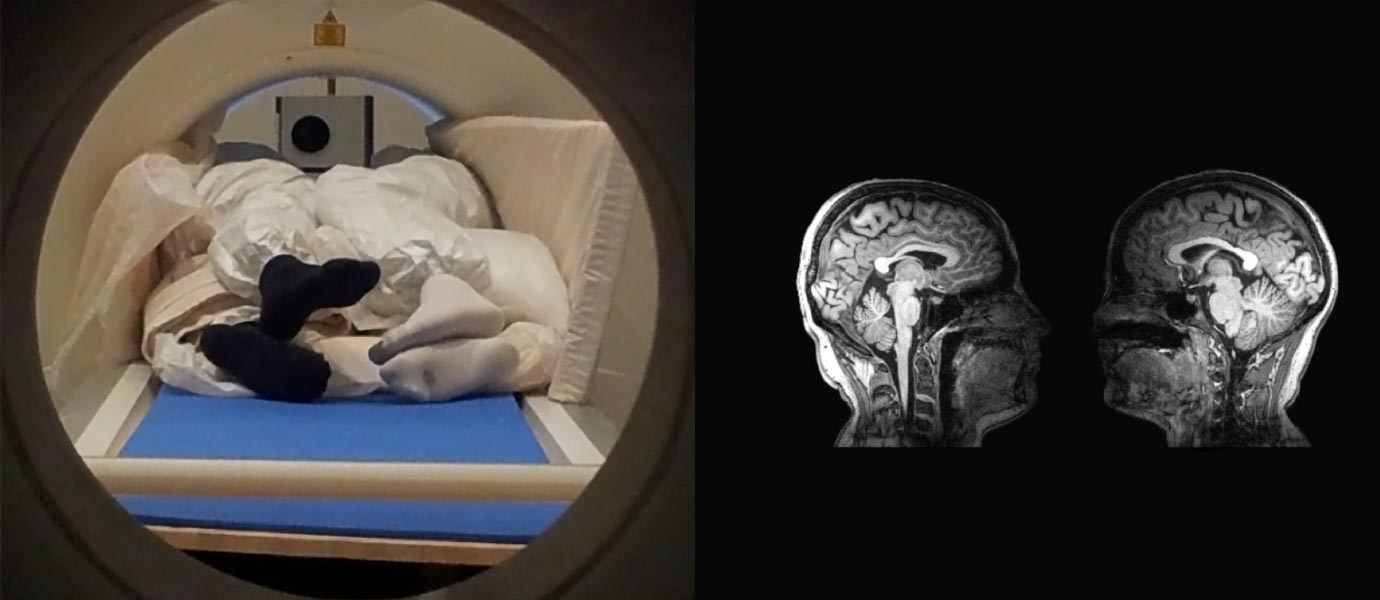
    Two Person MRI Scan
    Two people together in an MRI Scanner along with the accompanying image of their brains. Credit: Ville Renvall/ Aalto University

    An MRI in each other’s arms shows how physical contact alters the brains of couples.

    Researchers at Aalto University and Turku PET Centre have developed a new method for simultaneous imaging brain activity from two people, allowing them to study social interaction.

    In a recent study, the researchers scanned brain activity from 10 couples. Each couple spent 45 minutes inside the MRI scanner in physical contact with each other. The objective of the study was to examine how social contact activates the brain. The results were published in the theme issue Social Interaction in Neuropsychiatry of the journal Frontiers in Psychiatry.

    “This is an excellent start for the study of natural interaction. People don’t just react to external stimuli, but adjust their actions moment-by-moment based on what they expect to happen next,” says Riitta Hari, emerita Professor at Aalto University.

    Ordinary magnetic resonance imaging is used to scan one person at a time. In the device developed at Aalto University, the head coil used for regular brain scans was divided into two separate coils. This new design allows for simultaneous scanning of two brains, when the individuals are positioned close enough to each other inside the scanner. During scanning, the participants were face-to-face, almost hugging each other.

    When instructed by the researchers, the subjects took turns in tapping each other’s lips. Looking at the brain scans, the researchers could see that the motor and sensory areas of the couples’ brains were activated.

    Studying the fundamentals of human interaction

    “During social interaction, people’s brains are literally synchronized. The associated mental imitation of other people’s movements is probably one of the basic mechanisms of social interaction. The new technology now developed will provide totally new opportunities for studying the brain mechanisms of social interaction,” says Professor Lauri Nummenmaa from Turku PET Centre.

    “For example, during a conversation or problem solving, people’s brain functions become flexibly linked with each other. However, we cannot understand the brain basis of real-time social interaction if we cannot simultaneously scan the brain functions of both persons involved in social interaction,” Riitta Hari says.

    Reference: “Imaging Real-Time Tactile Interaction With Two-Person Dual-Coil fMRI” by Ville Renvall, Jaakko Kauramäki, Sanna Malinen, Riitta Hari and Lauri Nummenmaaal, 28 April 2020, Frontiers in Psychiatry.
    DOI: 10.3389/fpsyt.2020.00279

    The study was funded by the European Research Council (ERC) and the Academy of Finland.

    Never miss a breakthrough: Join the SciTechDaily newsletter.
    Follow us on Google and Google News.

    Aalto University Behavioral Science Brain Neuroscience Popular Psychiatry
    Share. Facebook Twitter Pinterest LinkedIn Email Reddit

    Related Articles

    Harvard Psychiatrist Says Mental Illness Starts in Your Cells

    What’s Missing in the Psychopathic Brain? Scientists Find Startling Clues

    In the Amygdala, Clues to Anxiety’s Origins — and a Potential Cure

    Neuroscience Surprise: Different Types of Love Light Up Different Parts of the Brain

    Brain’s Hidden Highway: Neural Pathway Linking Motivation, Addiction and Disease

    How the Brain Changes During Depression Treatment

    MIT Neuroscientists Demonstrate Controlling Attention With Brain Waves

    Dreams May Serve a Real Purpose: Preparing Us to Face Our Fears

    Be Like Neo and Learn New Skills Matrix-Style

    Leave A Reply Cancel Reply

    • Facebook
    • Twitter
    • Pinterest
    • YouTube

    Don't Miss a Discovery

    Subscribe for the Latest in Science & Tech!

    Trending News

    Researchers Discover a Hidden Vitamin D Problem That Persists Year-Round

    Interstellar Comet 3I/ATLAS Reveals Strange Chemistry Beyond Our Solar System

    A Newly Found Cellular Shift May Explain Why Aging Leads to Disease

    Scientists Discover Gut Signal That Turns Off Sugar Cravings

    Scientists Discover Rogue Gene That Could Unlock New Cancer Treatments

    Constantly Tired? Scientists Say These Vitamin Deficiencies May Be Why

    A Surprising Discovery Inside Fish Could Change What We Know About the Ocean

    Scientists May Have Finally Solved the Mystery of the Strange Hum Heard Around the World

    Follow SciTechDaily
    • Facebook
    • Twitter
    • YouTube
    • Pinterest
    • Newsletter
    • RSS
    SciTech News
    • Biology News
    • Chemistry News
    • Earth News
    • Health News
    • Physics News
    • Science News
    • Space News
    • Technology News
    Recent Posts
    • Hidden Solar Storms May Be Lighting Japan’s Skies With Massive Red Auroras
    • UCLA Scientists Uncover a “Hidden Weakness” in Some of the World’s Deadliest Cancers
    • Oak Trees Outsmart Caterpillars With a Brilliant Spring Trick
    • Scientists Discover a Hidden Disease Crisis Spreading Through Wild Snakes
    • Humpback Whale Stuns Scientists With 15,000 Kilometer Journey Across Oceans
    Copyright © 1998 - 2026 SciTechDaily. All Rights Reserved.
    • Science News
    • About
    • Contact
    • Editorial Board
    • Privacy Policy
    • Terms of Use

    Type above and press Enter to search. Press Esc to cancel.