
Close Menu
    Facebook X (Twitter) Instagram
    SciTechDaily
    • Biology
    • Chemistry
    • Earth
    • Health
    • Physics
    • Science
    • Space
    • Technology
    Facebook X (Twitter) Pinterest YouTube RSS
    SciTechDaily
    Home»Health»What’s Missing in the Psychopathic Brain? Scientists Find Startling Clues
    Health

    What’s Missing in the Psychopathic Brain? Scientists Find Startling Clues

    By EBRAINSJuly 13, 2025No Comments3 Mins Read
    Facebook Twitter Pinterest Telegram LinkedIn WhatsApp Email Reddit
    Share
    Facebook Twitter LinkedIn Pinterest Telegram Email Reddit
    Brain MRI Scans
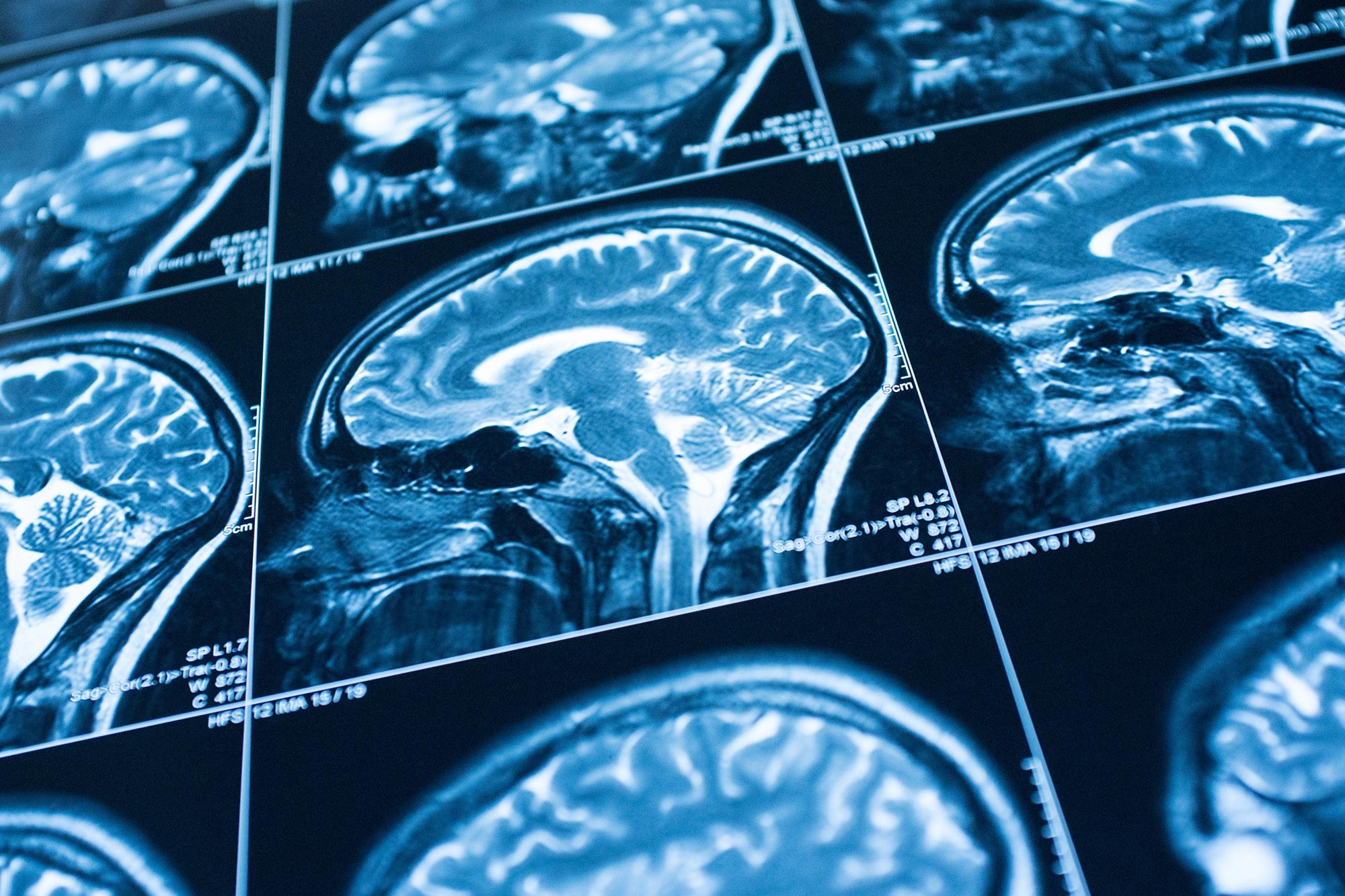
    Advanced MRI analyses uncover widespread volume reductions in emotion- and control-related brain regions in psychopathy, pointing to a strong biological basis for antisocial behaviour and opening new avenues for understanding its neural roots. Credit: Stock

    A research team has used the Julich-Brain Atlas to identify specific brain structures linked to antisocial behavior.

    A recent publication in the European Archives of Psychiatry and Clinical Neuroscience provides new insights into structural brain differences linked to psychopathy, a condition strongly associated with chronic violent behavior.

    By applying advanced neuroimaging techniques in combination with the Julich-Brain Atlas, scientists from Forschungszentrum Jülich, RWTH Aachen University, Heinrich-Heine-University Düsseldorf, Georg August University (Germany), and the University of Pennsylvania (USA) identified distinct neural networks that show structural alterations in people with psychopathic traits. The Julich-Brain Atlas is openly available through the EBRAINS Research Infrastructure.

    MRI confirms reduced brain volume in psychopathy

    The researchers analyzed structural MRI scans from 39 adult men diagnosed with psychopathy and compared them to a control group matched on key characteristics. Psychopathic traits were measured using the Psychopathy Check-List (PCL-R), a widely recognized tool that distinguishes between two primary components: interpersonal-affective traits (factor 1) and lifestyle-antisocial behavior (factor 2).
    Associations of Brain Structure With Psychopathy
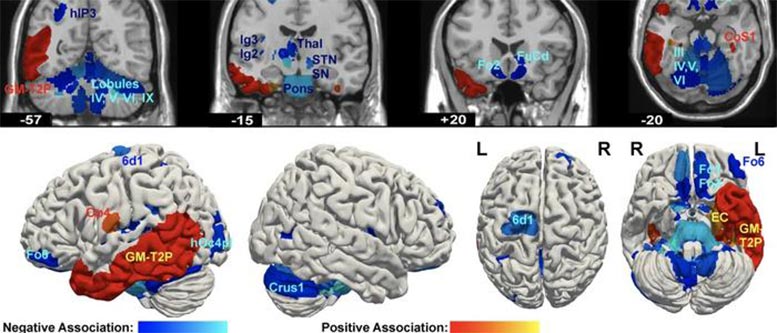
    Coloured regions show where brain volume was associated with deviant lifestyle and antisocial behavior in individuals with psychopathic traits. Credit: Pieperhoff, P., Hofhansel, L., Schneider, F. et al. Eur Arch Psychiatry Clin Neurosci (2025)

    Findings showed that individuals with higher scores on factor 2, which reflects antisocial tendencies, had reduced volumes in several brain regions. Affected areas included subcortical structures like the basal ganglia, thalamus, and basal forebrain, as well as sections of the brainstem (pons), cerebellum, and cortical regions such as the orbitofrontal and insular cortices.

    These brain regions are associated with functions including emotional regulation, decision-making, impulse control, and social behavior.

    Inconsistent links for interpersonal traits

    In contrast, associations with factor 1 traits, such as pathological lying and lack of empathy, were weaker and more variable. Some volume differences were noted in the orbitofrontal, dorsolateral-frontal, and left hippocampal areas, but the patterns were less consistent across individuals.

    Group comparisons also revealed a significant reduction in total brain volume in the psychopathy group, with the most notable localized difference in the right subiculum, a part of the hippocampus involved in memory.

    The study’s authors highlight that the findings suggest a particularly strong neurobiological link between antisocial behavior and reduced brain volume across widespread regions.

    The study advances research on the neuropsychobiological correlates of aggression, which will be intensively investigated in the next years at RWTH Aachen together with the universities in Heidelberg and Frankfurt, the Central Institute in Mannheim, as well as Forschungszentrum Jülich within the research initiative SFB TRR 379 (Neuropsychobiology of Aggression: A Transdiagnostic Approach in Mental Disorders.)

    Reference: “Associations of brain structure with psychopathy” by Peter Pieperhoff, Lena Hofhansel, Frank Schneider, Jürgen Müller, Katrin Amunts, Sabrina Weber-Papen, Carmen Weidler, Benjamin Clemens, Adrian Raine and Ute Habel, 29 May 2025, European Archives of Psychiatry and Clinical Neuroscience.
    DOI: 10.1007/s00406-025-02028-6

    Never miss a breakthrough: Join the SciTechDaily newsletter.
    Follow us on Google and Google News.

    Behavioral Science Brain Mental Health Neuroscience Popular Psychiatry
    Share. Facebook Twitter Pinterest LinkedIn Email Reddit

    Related Articles

    Scientists Discover Neural Basis of Schizophrenia and Bipolar Disorder

    Psychedelic Drug Psilocybin “Magic Mushrooms” Spurs Growth of Neural Connections Lost in Depression

    Can Omega-3 Fatty Acids – Fish Oil Supplements – Prevent Psychotic Disorder?

    Antidepressant Power of Lactate Revealed in New Research

    Non-hallucinogenic Psychedelic Analog Rapidly Reverses Effects of Stress on the Brain

    Brain Ion Channel Identified As New Approach to Treating Depression – Scientists “Surprised” by Significant Improvements in Depressive Symptoms

    Study Links Brain Cells to Depression – Brings Hope for Targeted Treatment Options

    Awakening After a Sleeping Pill: Man With Serious Brain Injury Temporarily Recovered After 8 Years

    How Touching Is Perceived in the Brain – Investigated With Two-Person MRI Scans on Couples

    Leave A Reply Cancel Reply

    • Facebook
    • Twitter
    • Pinterest
    • YouTube

    Don't Miss a Discovery

    Subscribe for the Latest in Science & Tech!

    Trending News

    Breakthrough Bowel Cancer Trial Leaves Patients Cancer-Free for Nearly 3 Years

    Natural Compound Shows Powerful Potential Against Rheumatoid Arthritis

    100,000-Year-Old Neanderthal Fossils in Poland Reveal Unexpected Genetic Connections

    Simple “Gut Reset” May Prevent Weight Gain After Ozempic or Wegovy

    2.8 Days to Disaster: Scientists Warn Low Earth Orbit Could Suddenly Collapse

    Common Food Compound Shows Surprising Power Against Superbugs

    5 Simple Ways To Remember More and Forget Less

    The Atomic Gap That Could Cost the Semiconductor Industry Billions

    Follow SciTechDaily
    • Facebook
    • Twitter
    • YouTube
    • Pinterest
    • Newsletter
    • RSS
    SciTech News
    • Biology News
    • Chemistry News
    • Earth News
    • Health News
    • Physics News
    • Science News
    • Space News
    • Technology News
    Recent Posts
    • Scientists Discover Stem Cells That Could Regrow Teeth and Bone
    • Scientists Discover Natural Molecule That Stops Alzheimer’s Protein Clumps From Forming
    • Early Cannabis Use May Stall Key Brain Skills in Teens
    • Popular Vitamin D Supplement Has “Previously Unknown” Negative Effect, Study Finds
    • Powerful Antioxidant Found To Play a Key Role in Proper Protein Folding
    Copyright © 1998 - 2026 SciTechDaily. All Rights Reserved.
    • Science News
    • About
    • Contact
    • Editorial Board
    • Privacy Policy
    • Terms of Use

    Type above and press Enter to search. Press Esc to cancel.