
Close Menu
    Facebook X (Twitter) Instagram
    SciTechDaily
    • Biology
    • Chemistry
    • Earth
    • Health
    • Physics
    • Science
    • Space
    • Technology
    Facebook X (Twitter) Pinterest YouTube RSS
    SciTechDaily
    Home»Technology»“Elastic Cloaking” – New Flexible Material Designed to Protect Buildings, Military Personnel
    Technology

    “Elastic Cloaking” – New Flexible Material Designed to Protect Buildings, Military Personnel

    By University of Missouri-ColumbiaMay 31, 20204 Comments3 Mins Read
    Facebook Twitter Pinterest Telegram LinkedIn WhatsApp Email Reddit
    Share
    Facebook Twitter LinkedIn Pinterest Telegram Email Reddit
    Earthquake Damage
    A team of engineers at the University of Missouri has designed a flexible material that can help buildings withstand multiple waves of energy traveling through a solid material, including the ground motions found in earthquakes. Credit: University of Missouri

    University of Missouri engineers said their material has both civilian and military applications.

    Shake, rattle, and roll.

    Even though they are miles from the epicenter of an earthquake, buildings can collapse due to how an earthquake’s energy makes the ground shake and rattle. Now, a team of engineers led by Guoliang Huang, a James C. Dowell Professor in the Mechanical and Aerospace Engineering Department at the University of Missouri College of Engineering, has designed a flexible material that can help buildings withstand multiple waves of energy traveling through a solid material, including the simultaneous forward and backward and side-to-side motions found in earthquakes.

    Lattice Type Material
    This structured lattice-type material protects against both types of energy waves — longitudinal and sheer — that can travel through the ground. Credit: University of Missouri

    “Our elastic material can stretch and form to a particular surface, similar to a wrap on a vehicle,” Huang said. “It can be applied to the surface of an existing building to allow it to flex in an earthquake. What is unique about the structured lattice-type material is that it protects against both types of energy waves — longitudinal and sheer — that can travel through the ground.”

    Guoliang Huang
    Guoliang Huang is a James C. Dowell Professor in the Mechanical and Aerospace Engineering Department at the University of Missouri. Credit: University of Missouri

    Huang said the material also can be used by the defense industry to protect against vibration in mechanical parts, such as aircraft or submarine engines.

    “For over 20 years, no one had a natural solution for this issue in a solid material,” Huang said. “Now, we’ve designed, modeled, and fabricated a new material with properties that do not exist naturally for what we believe is a nearly perfect protective device.”

    The Army Research Office, which provided funding for the basic research effort at the University of Missouri associated with this project, is encouraged by the results from Huang’s team.

    “The results that the University of Missouri team has recently published are encouraging,” said Dan Cole, the program manager at the Army Research Office, a part of the U.S. Army Combat Capabilities Development Command’s Army Research Laboratory. “This research could lead to new strategies for steering mechanical waves away from critical regions in solid objects, which could enable novel capabilities in soldier protection and maneuvering.”
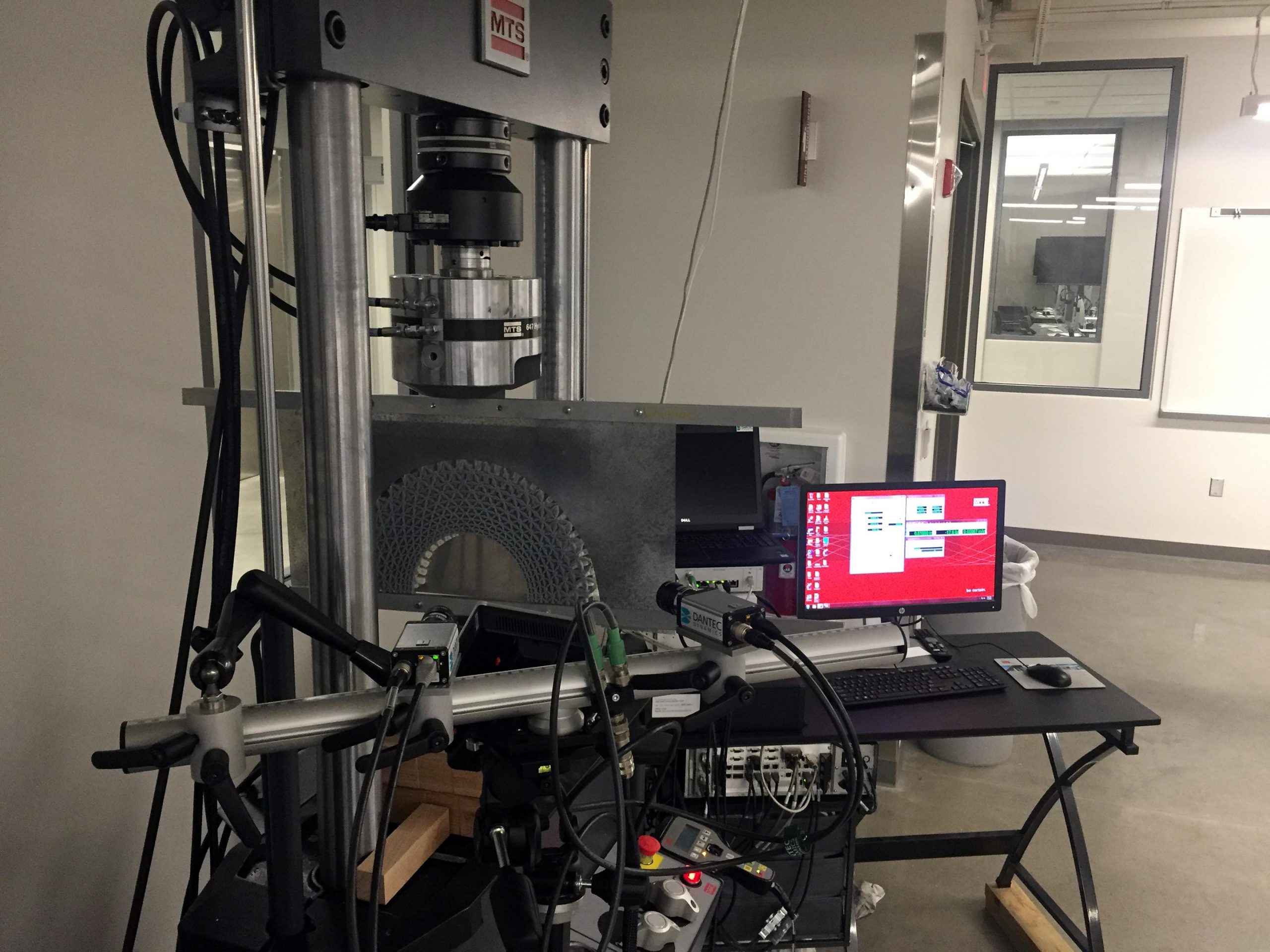
    Lattice Type Material Lab Equipment
    Lab equipment used to conduct experiments in the study. Credit: University of Missouri

    The studies, “Polar Metamaterials: A New Outlook on Resonance for Cloaking Applications” and “Physical Realization of Elastic Cloaking with a Polar Material,” were published in Physical Review Letters, a journal of the American Physical Society.

    Reference: “Physical Realization of Elastic Cloaking with a Polar Material’ by Xianchen Xu, Chen Wang, Wan Shou, Zongliang Du, Yangyang Chen, Beichen Li, Wojciech Matusik, Nassar Hussein and Guoliang Huang, 19 March 2020, Physical Review Letters.
    DOI: 10.1103/PhysRevLett.124.114301

    Other authors on the studies include Nassar Hussein, Yangyang Chen, Xianchen Xu and Chen Wangat at MU; Wan Shou, Beichen Li and Wojciech Matusik at the Massachusetts Institute of Technology; and Zongliang Du at MU and the Dalian University of Technology in China. The content is solely the responsibility of the authors and does not necessarily represent the official views of the funding agencies.

    Never miss a breakthrough: Join the SciTechDaily newsletter.
    Follow us on Google and Google News.

    Civil Engineering Earthquakes Mechanical Engineering University of Missouri-Columbia
    Share. Facebook Twitter Pinterest LinkedIn Email Reddit

    Related Articles

    Starfish-Inspired Wearable Tracks Your Heart – Even When You’re on the Move

    Bigon Rings: Technique Inspired by Lace Making Could Someday Weave Structures in Space

    Hopping Robots Could Use Stutter Jump to Conserve Energy

    Graphene Membranes May be Used to Filter Water & Biological Samples

    Light Activated Muscle Cells May Advance Biorobotics

    Self-Driving Audi TTS Hits Track Speeds of 120 MPH

    Meshworm, A Soft Autonomous Robot That Moves Like an Earthworm

    Semiautonomous “Intelligent Co-Pilot” Helps Vehicles Avoid Collisions

    Researchers Study Butterfly Flight Dynamics to Create Small Airborne Robots

    4 Comments

    1. Ron McCune on May 31, 2020 8:46 pm

      You can take this material and put bullet proof or shatter proof material in the stuff’s structure somehow. Then take that bullet proof material and put it all bullet proof vest, pants, boots, helmets and coats used by all military and police personnel and vehicles.

      Reply
    2. Tcdoe on May 31, 2020 11:48 pm

      This is kind of nonsense. It’s just a tweak of a standard lattice.

      Reply
    3. John-Paul on June 2, 2020 11:44 am

      Speeds off leaving Bree and Crowder in the dust since 1987.

      Reply
    4. Bruce on August 29, 2020 11:10 am

      Instead of rebar use this in contrete…

      Reply
    Leave A Reply Cancel Reply

    • Facebook
    • Twitter
    • Pinterest
    • YouTube

    Don't Miss a Discovery

    Subscribe for the Latest in Science & Tech!

    Trending News

    Breakthrough Bowel Cancer Trial Leaves Patients Cancer-Free for Nearly 3 Years

    Natural Compound Shows Powerful Potential Against Rheumatoid Arthritis

    100,000-Year-Old Neanderthal Fossils in Poland Reveal Unexpected Genetic Connections

    Simple “Gut Reset” May Prevent Weight Gain After Ozempic or Wegovy

    2.8 Days to Disaster: Scientists Warn Low Earth Orbit Could Suddenly Collapse

    Common Food Compound Shows Surprising Power Against Superbugs

    5 Simple Ways To Remember More and Forget Less

    The Atomic Gap That Could Cost the Semiconductor Industry Billions

    Follow SciTechDaily
    • Facebook
    • Twitter
    • YouTube
    • Pinterest
    • Newsletter
    • RSS
    SciTech News
    • Biology News
    • Chemistry News
    • Earth News
    • Health News
    • Physics News
    • Science News
    • Space News
    • Technology News
    Recent Posts
    • After 37 Years, the World’s Longest-Running Soil Warming Experiment Uncovers a Startling Climate Secret
    • NASA Satellite Captures First-Ever High-Res View of Massive Pacific Tsunami
    • ADHD Isn’t Just a Deficit: Study Reveals Powerful Hidden Strengths
    • Scientists Uncover “Astonishing” Hidden Property of Light
    • Scientists Discover Stem Cells That Could Regrow Teeth and Bone
    Copyright © 1998 - 2026 SciTechDaily. All Rights Reserved.
    • Science News
    • About
    • Contact
    • Editorial Board
    • Privacy Policy
    • Terms of Use

    Type above and press Enter to search. Press Esc to cancel.