
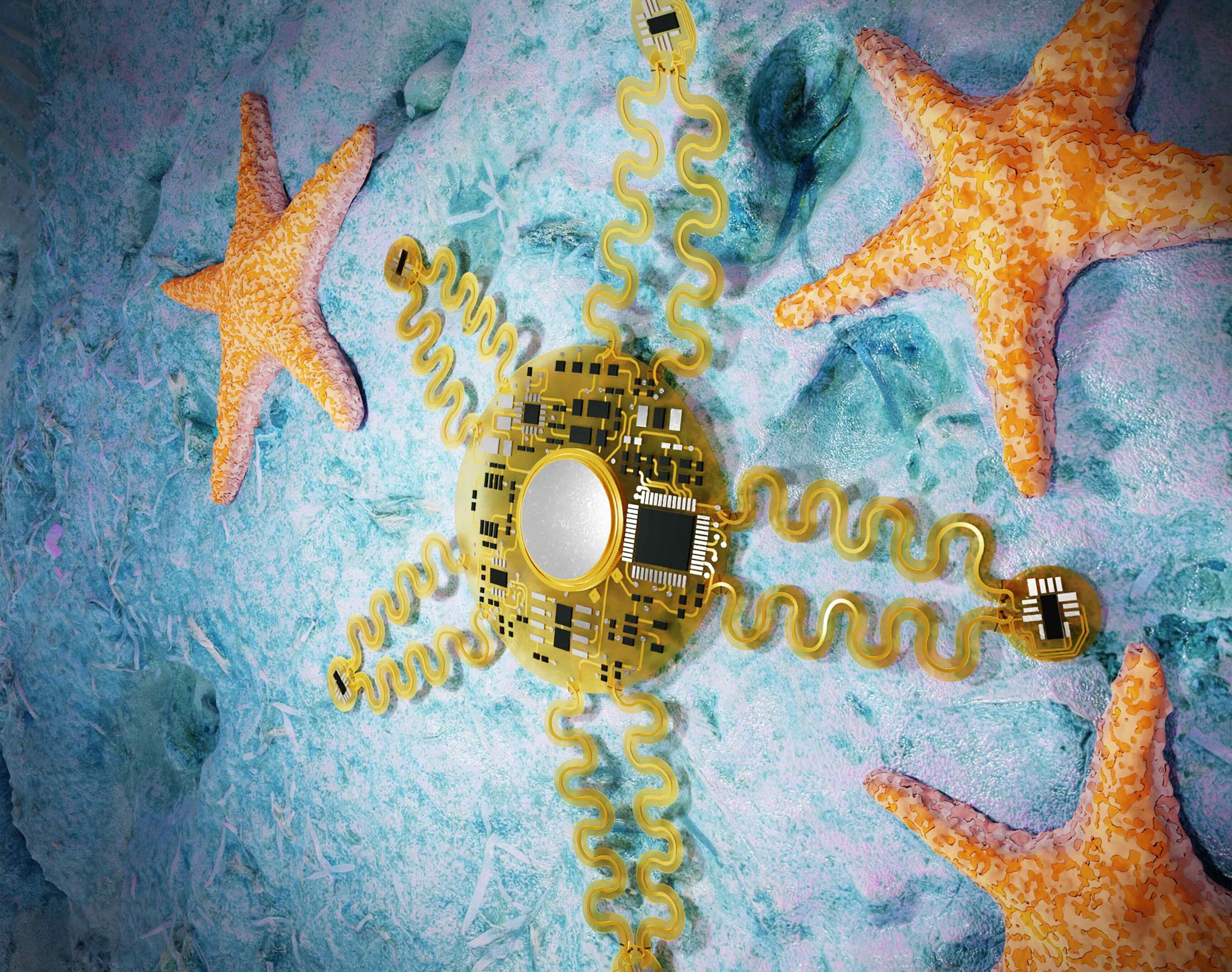
Inspired by how starfish flip themselves over, researchers have developed a unique wearable heart monitor with five flexible arms that stay in better contact with the skin, even during movement.
This biomimetic device tracks both electrical and mechanical heart signals simultaneously and uses AI to detect potential heart issues with over 90% accuracy. It syncs with a smartphone app, can be monitored remotely by doctors, and is being redesigned for greater comfort and long-term use. The goal? A more reliable, user-friendly way to track heart health in real-time.
How Starfish Inspired a Smarter Wearable
Tracking heart activity becomes more difficult when we move, a common limitation of many current wearable devices. But researchers at the University of Missouri have found inspiration in an unlikely source: the starfish.
Studying how starfish flip themselves over by coordinating their five arms, researchers Sicheng Chen and Zheng Yan from Mizzou’s College of Engineering developed a wearable device that mimics this structure. Their starfish-shaped monitor can track heart health in real-time, even during movement.
More Stable, More Accurate Tracking
Unlike traditional wearables like smartwatches, which rely on a single contact point, this device uses five flexible arms that make multiple contact points with the skin near the heart. This design keeps it more stable, allowing it to collect clearer, more reliable heart data while the wearer is active.
The device connects to a smartphone app, giving users real-time health insights and helping to detect potential heart issues early on.

“Similar to a starfish, our device has five arms, each equipped with sensors that simultaneously capture both electrical and mechanical heart activity,” Chen, a postdoctoral fellow and lead author, said. “Most current devices focus on capturing only one signal or require separate devices to track multiple signals at the same time. This allows us to provide a more complete picture of someone’s heart health.”
AI for Smarter Heart Monitoring
The team developed an artificial intelligence-powered system that learned from a large collection of heart data, including signals from both healthy individuals and people with heart disease. Using smart technology, the system filters out movement-related disruptions and analyzes heart signals to determine if someone’s heart is healthy or showing signs of trouble. The findings are shown on the smartphone app.
This AI-based approach correctly identifies heart conditions more than 90% of the time. Because the device has Bluetooth capability, doctors can review the data remotely, making it a convenient option for at-home monitoring between medical visits.
“This is also a benefit over traditional clinical heart tests such as the Doppler ultrasound, which usually requires patients to stay still to get accurate results,” Chen said.
Making Wearable Tech More Wearable
The team is also improving the long-term wearability of these devices.
“A big challenge with wearable devices is that they can cause skin irritation when worn for long periods,” Yan, an associate professor in Mizzou’s College of Engineering, said.
To address this, Yan’s team is working on making the device more comfortable and skin-friendly. Right now, the device sticks to the skin using a special gel, but future versions will use a breathable, skin-friendly material for more comfort. Yan’s team has been improving this material for the past few years.
Continuous Use, Minimal Disruption
The starfish-inspired device can also charge wirelessly while still being worn, ensuring continuous use without needing to remove it for charging.
While still in early development, the starfish-inspired innovation brings together nature, engineering and AI in a way that could change how we manage heart health — making it easier and more reliable for people to track their heart activity anytime, anywhere.
Reference: “Starfish-inspired wearable bioelectronic systems for physiological signal monitoring during motion and real-time heart disease diagnosis” by Sicheng Chen, Qunle Ouyang, Xianglin Meng, Yibo Yang, Can Li, Xuanbo Miao, Zehua Chen, Ganggang Zhao, Yaguo Lei, Bernard Ghanem, Sandeep Gautam, Jianlin Cheng and Zheng Yan, 2 April 2025, Science Advances.
DOI: 10.1126/sciadv.adv2406
Other co-authors are Qunle Ouyang, Xuanbo Miao Zehua Chen, and Ganggang Zhao at Mizzou.
Never miss a breakthrough: Join the SciTechDaily newsletter.
Follow us on Google and Google News.