
Close Menu
    Facebook X (Twitter) Instagram
    SciTechDaily
    • Biology
    • Chemistry
    • Earth
    • Health
    • Physics
    • Science
    • Space
    • Technology
    Facebook X (Twitter) Pinterest YouTube RSS
    SciTechDaily
    Home»Space»Scientists Set Fire Inside the NASA Cygnus Cargo Spacecraft
    Space

    Scientists Set Fire Inside the NASA Cygnus Cargo Spacecraft

    By Universities Space Research AssociationJune 4, 2020No Comments2 Mins Read
    Facebook Twitter Pinterest Telegram LinkedIn WhatsApp Email Reddit
    Share
    Facebook Twitter LinkedIn Pinterest Telegram Email Reddit
    Saffire Flame
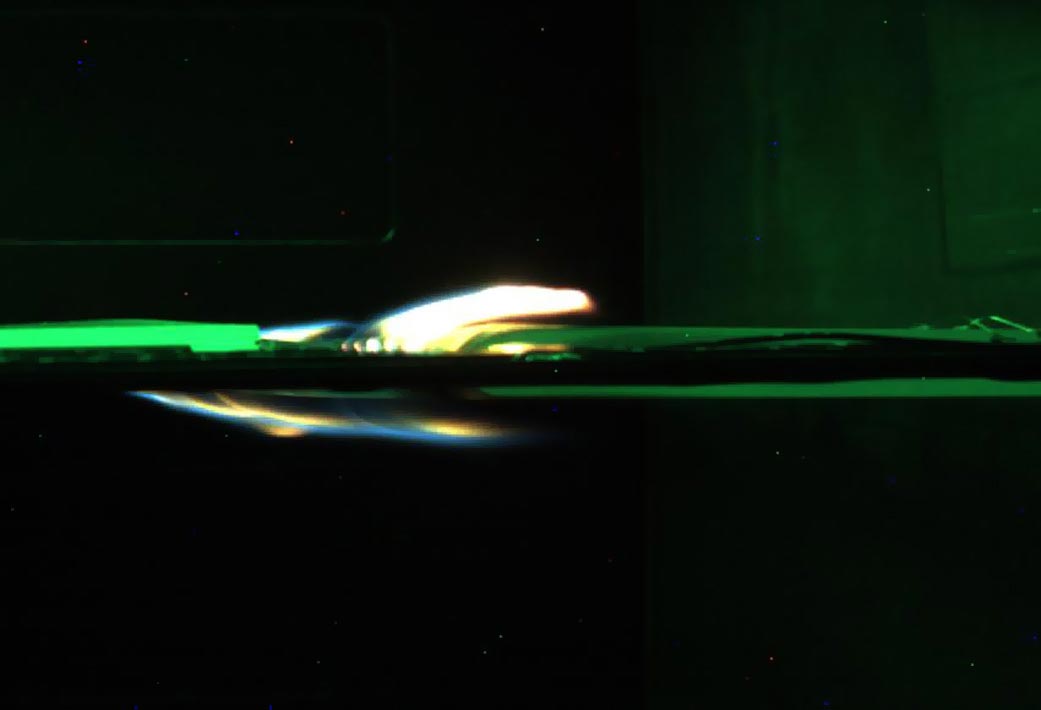
    This edge view of Saffire’s flame shows it developing over a one-centimeter thick sample of a plexiglass type material found on spacecraft. The blue color is typical of microgravity flames and moves from left to right at 20 cm per second. Credit: NASA

    NASA has been conducting a series of space fire experiments called Spacecraft Fire Safety (Saffire) Experiments that investigate how fires grow and spread in space, especially aboard future spacecraft bound for Moon and Mars. Recently, another set of experiments were conducted when Saffire IV lit longer and stronger flames inside Northrop Grumman’s Cygnus Cargo spacecraft.

    Just as in Saffire I, II, and III, the experiments were ignited in a Cygnus cargo vehicle after it had completed its primary International Space Station supply mission, departed the station, and before its planned destructive reentry to Earth.

    Understanding how fire behaves in microgravity, and how different materials propagate flames in space is immensely important for the development of future crew spacecraft. It also helps inform operational protocols for dealing with fire emergencies, particularly when astronauts do not have the ability to exit a spacecraft or quickly return to Earth.

    Several USRA scientists along with their NASA collaborators contributed to the success of this experiment. Dr. Carol Kory, USRA Director of the Glenn Engineering and Research Support (GEARS) program, at Glenn Research Center in Cleveland, Ohio, observed, “The contributions of these outstanding scientists are commendable. The success of this program is largely due to the efforts of USRA’s Jay Owens, Paul Ferkul, Rosa Padilla, Dan Gotti, Gordon Berger, and Claire Fortenberry along with John Easton from Case Western Reserve University.”

    Unique to Saffire IV was the carbon dioxide scrubber and smoke eater that were used to remove particulate and carbon monoxide after two material burns. The combustion gases monitor instrument and the smoke eater filter are prototypes of what will be used on the Orion spacecraft.

    The Saffire IV mission had more diagnostic equipment to see how effectively it can detect fires, measure combustion products, and evaluate future fire response and cleanup technologies. The experiment burned a sample of SIBAL cloth, which is a composite made up of 75% cotton and 25% fiberglass.

    Two additional Saffire experiments are scheduled for this October and March of 2021, as NASA continues to develop safer ways to operate future crewed exploration missions.

    Never miss a breakthrough: Join the SciTechDaily newsletter.
    Follow us on Google and Google News.

    NASA Universities Space Research Association
    Share. Facebook Twitter Pinterest LinkedIn Email Reddit

    Related Articles

    New Evidence Reveals that Venus has Active Volcanoes

    SOFIA Looking Deep Into the Orion Nebula

    NASA Probe Takes Close-Up Photos of Giant Vesta Asteroid

    Comet Survives after Close Brush With the Sun

    NASA’s Voyager 1 in “Cosmic Purgatory”

    Hubble Reaches New Milestone: 10,000th Scientific Paper Published

    NASA Confiscates Stolen Rocket Engine

    The Mars Rover Curiosity Planetary Protection Snafu

    NASA Curiosity Heads to Mars

    Leave A Reply Cancel Reply

    • Facebook
    • Twitter
    • Pinterest
    • YouTube

    Don't Miss a Discovery

    Subscribe for the Latest in Science & Tech!

    Trending News

    JWST Finds a “Star” 100 Billion Times Brighter Than Any Star Should Be

    Scientists Find a Hidden Biological Link Across Different Forms of Autism

    Astronomers Discover a Ghostly River of Stars That Could Reveal Dark Matter

    Why Is Colorectal Cancer Rising in People Under 50? New Clues Point to the Environment

    Quantum Fluctuations Break a Crystal’s Symmetry Rules

    Why Does an Irregular Heartbeat Strike 40 Years Early in Some People?

    Scientists Reveal How ADHD Could Fuel Creative Thinking

    Scientists Find Just 3 Minutes of Sprinting Can Transform Blood Chemistry

    Follow SciTechDaily
    • Facebook
    • Twitter
    • YouTube
    • Pinterest
    • Newsletter
    • RSS
    SciTech News
    • Biology News
    • Chemistry News
    • Earth News
    • Health News
    • Physics News
    • Science News
    • Space News
    • Technology News
    Recent Posts
    • Scientists Discover a Hidden Baobab Species in Madagascar
    • Dogs and Humans May Share a Surprising Biological Secret to Longevity
    • A 150-Million-Year-Old Dinosaur Flight Mystery May Finally Have an Answer
    • Giant Crocodylians Ruled South America’s Ancient Food Chain
    • 236-Million-Year-Old Fossil Reveals a Stunning Secret About the Origins of Mammal Birth
    Copyright © 1998 - 2026 SciTechDaily. All Rights Reserved.
    • Science News
    • About
    • Contact
    • Editorial Board
    • Privacy Policy
    • Terms of Use

    Type above and press Enter to search. Press Esc to cancel.