
Close Menu
    Facebook X (Twitter) Instagram
    SciTechDaily
    • Biology
    • Chemistry
    • Earth
    • Health
    • Physics
    • Science
    • Space
    • Technology
    Facebook X (Twitter) Pinterest YouTube RSS
    SciTechDaily
    Home»Space»New Evidence Reveals that Venus has Active Volcanoes
    Space

    New Evidence Reveals that Venus has Active Volcanoes

    By Universities Space Research AssociationJanuary 3, 2020No Comments3 Mins Read
    Facebook Twitter Pinterest Telegram LinkedIn WhatsApp Email Reddit
    Share
    Facebook Twitter LinkedIn Pinterest Telegram Email Reddit
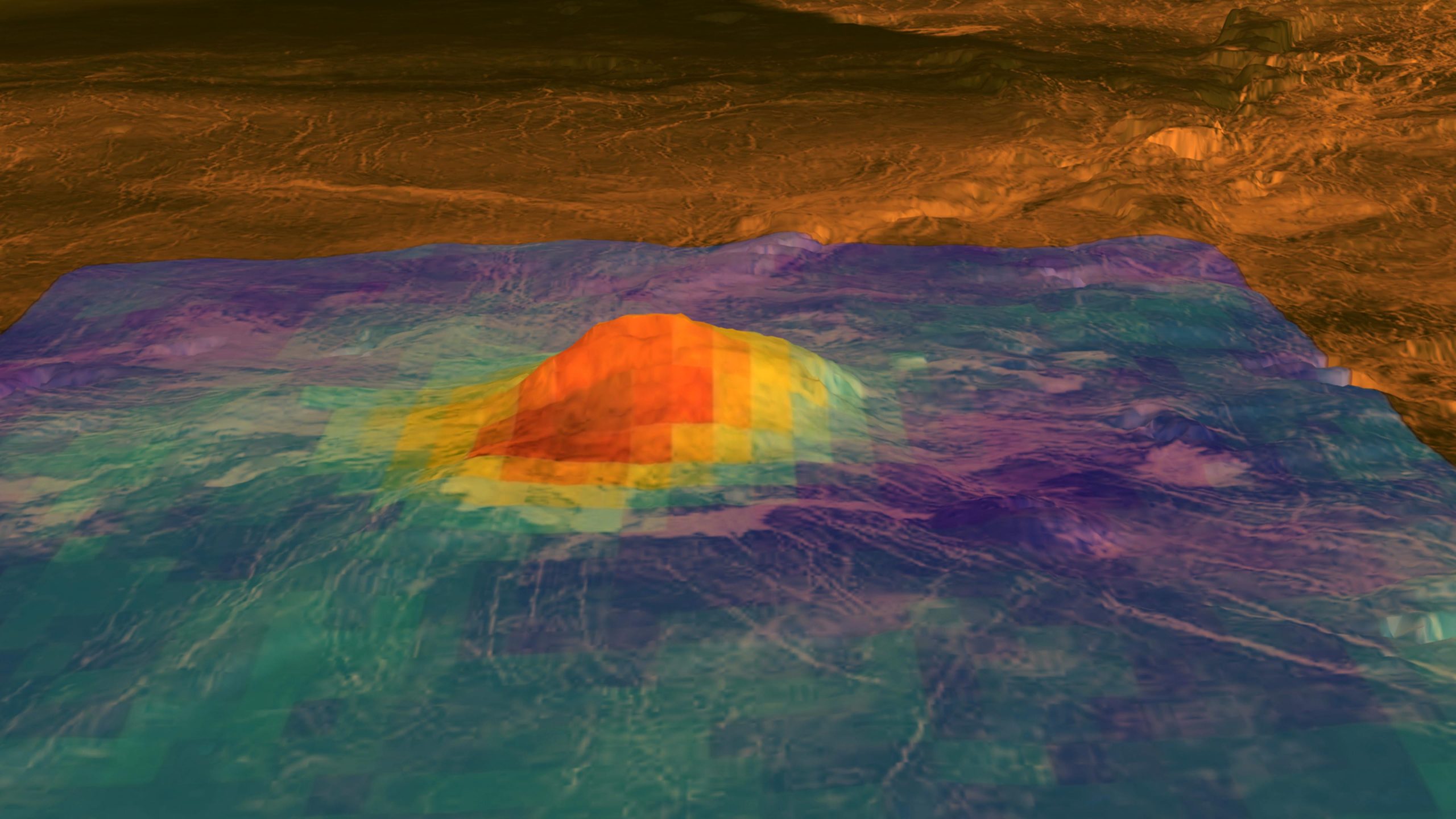
    Idunn Mons Volcanic Peak Venus
    This figure shows the volcanic peak Idunn Mons (at 46 degrees south latitude, 214.5 degrees east longitude) in the Imdr Regio area of Venus. The colored overlay shows the heat patterns derived from surface brightness data collected by the Visible and Infrared Thermal Imaging Spectrometer (VIRTIS), aboard the European Space Agency’s Venus Express spacecraft. Credit: NASA/ESA

    New research led by Universities Space Research Association (USRA) and published today (January 3, 2020) in Science Advances shows that lava flows on Venus may be only a few years old, suggesting that Venus could be volcanically active today — making it the only planet in our solar system, other than Earth, with recent eruptions.

    “If Venus is indeed active today, it would make a great place to visit to better understand the interiors of planets,” says Dr. Justin Filiberto, the study’s lead author and a Universities Space Research Association (USRA) staff scientist at the Lunar and Planetary Institute (LPI). “For example, we could study how planets cool and why the Earth and Venus have active volcanism, but Mars does not. Future missions should be able to see these flows and changes in the surface and provide concrete evidence of its activity.”

    Radar imaging from NASA’s Magellan spacecraft in the early 1990s revealed Venus, our neighboring planet, to be a world of volcanoes and extensive lava flows. In the 2000s, the European Space Agency’s (ESA’s) Venus Express orbiter shed new light on volcanism on Venus by measuring the amount of infrared light emitted from part of Venus’ surface (during its nighttime). These new data allowed scientists to identify fresh versus altered lava flows on the surface of Venus. However, until recently, the ages of lava eruptions and volcanoes on Venus were not well known because the alteration rate of fresh lava was not well constrained.

    Dr. Filiberto and his colleagues recreated Venus’ hot caustic atmosphere in the laboratory to investigate how the observed Venusian minerals react and change over time. Their experimental results showed that an abundant mineral in basalt — olivine — reacts rapidly with the atmosphere and within weeks becomes coated with the iron oxide minerals – magnetite and hematite. They further found that the Venus Express observations of this change in mineralogy would only take a few years to occur. Thus, the new results by Filiberto and coauthors suggest that these lava flows on Venus are very young, which in turn would imply that Venus does indeed have active volcanoes.

    Reference: “Present-day volcanism on Venus as evidenced from weathering rates of olivine” by Justin Filiberto, David Trang, Allan H. Treiman and Martha S. Gilmore, 3 January 2020, Science Advances.
    DOI: 10.1126/sciadv.aax7445

    Never miss a breakthrough: Join the SciTechDaily newsletter.
    Follow us on Google and Google News.

    NASA Popular Universities Space Research Association Venus Volcano
    Share. Facebook Twitter Pinterest LinkedIn Email Reddit

    Related Articles

    Venus Erupts: Fresh Volcanic Activity Revealed in NASA’s Magellan Data

    Planet Resurfacing: Venus Volcanism Could Have Been Fueled by Ancient, High-Energy Impacts

    Don’t Miss: “Peak Venus” and Jupiter Occultation

    Venus Is Alive!

    Volcanic Activity on Venus – Earth’s Evil Twin – Revealed in NASA’s Magellan Data

    NASA Prepares To “Take the Plunge” and Explore Venus With DAVINCI

    Bizarre Geologic Activity on Venus: “Squishy” Outer Shell May Be Resurfacing the Planet

    From Temperate World to Acidic Hothouse: How Massive Volcanism May Have Altered Venus’ Climate

    NASA’s DAVINCI Space Probe To Plunge Through Hellish Atmosphere of Venus

    Leave A Reply Cancel Reply

    • Facebook
    • Twitter
    • Pinterest
    • YouTube

    Don't Miss a Discovery

    Subscribe for the Latest in Science & Tech!

    Trending News

    The Universe Is Expanding Too Fast and Scientists Can’t Explain Why

    “Like Liquid Metal”: Scientists Create Strange Shape-Shifting Material

    Early Warning Signals of Esophageal Cancer May Be Hiding in Plain Sight

    Common Blood Pressure Drug Shows Surprising Power Against Deadly Antibiotic-Resistant Superbug

    Scientists Uncover Dangerous Connection Between Serotonin and Heart Valve Disease

    Scientists Discover a “Protector” Protein That Could Help Reverse Hair Loss

    Bone-Strengthening Discovery Could Reverse Osteoporosis

    Scientists Uncover Hidden Trigger Behind Stem Cell Aging

    Follow SciTechDaily
    • Facebook
    • Twitter
    • YouTube
    • Pinterest
    • Newsletter
    • RSS
    SciTech News
    • Biology News
    • Chemistry News
    • Earth News
    • Health News
    • Physics News
    • Science News
    • Space News
    • Technology News
    Recent Posts
    • Scientists Overcome Major Quantum Bottleneck, Potentially Transforming Teleportation and Computing
    • Quantum Physics’ Strangest Problem May Hold the Key to Time Itself
    • Scientists Create “Liquid Gears” That Spin Without Touching
    • The Simple Habit That Could Help Prevent Cancer
    • Forgotten Medicinal Plant Shows Promise in Fighting Dangerous Superbugs
    Copyright © 1998 - 2026 SciTechDaily. All Rights Reserved.
    • Science News
    • About
    • Contact
    • Editorial Board
    • Privacy Policy
    • Terms of Use

    Type above and press Enter to search. Press Esc to cancel.