
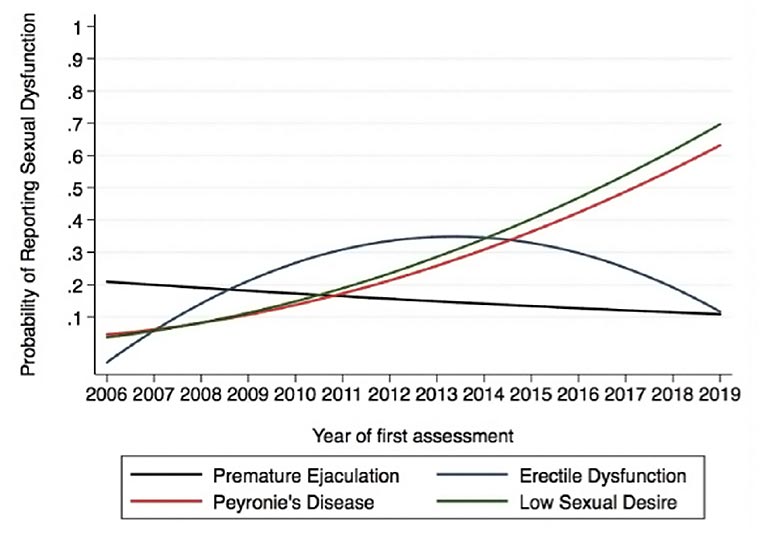
Scientists report a change in why men seek help for sexual problems, with fewer men complaining about impotence (erectile dysfunction) and premature ejaculation, and more men, especially younger men, complaining about low sexual desire and curvature of the penis (Peyronie’s disease).
Presenting the work at the European Association of Urology (virtual) Congress, after recent acceptance for publication, research leader Dr. Paolo Capogrosso (San Raffaele Hospital, Milan, Italy) said:
“Over a 10-year period, we have seen a real change in what concerns men when they attend sexual health clinics. This is probably driven by greater openness, and men now accepting that many sexual problems can be treated, rather than being something they don’t want to talk about.”
The success of erectile dysfunction treatments such as Viagra and Cialis, and the availability of new treatments, means that men facing sexual problems now have treatments for sexual problems which weren’t available a generation ago. Now researchers at San Raffaele Hospital in Milan have studied why men come to sexual health clinics, and how this has changed over a 10-year period.
In what is believed to be the first research of its kind, the scientists questioned 3244 male visitors to the San Raffaele Hospital Sexual Health Clinic in Milan over a 10-year period (2009 to 2019), and classified the main reason for the visit. They found that the number of patients visiting with erectile dysfunction problems increased from 2009 to 2013, then started to decrease.
There were comparatively few patients complaining of low sex drive or Peyronie’s disease in 2009, but complaints about both of these conditions grow from 2009 to the end of the study. In 2019 men were around 30% more likely to report Peyronie’s disease than in 2009, and around 32% more likely to report low sexual desire.
The number of men complaining of premature ejaculation dropped by around 6% over the 10-year period. The average age of first attendance at the clinical also dropped, from a mean of 61 to 53 years.
“Erectile dysfunction is still the main reason for attending the clinic, but this number is dropping, whereas around 35% of men attending the clinic now complain of Peyronie’s disease, and that number has shown steady growth,” said Paolo Capogrosso. “Our patients are also getting younger, which may reflect a generational change in attitude to sexual problems.”
Dr. Capogrosso continued “We need to be clear about what these figures mean. They do not indicate any change in the prevalence of these conditions, what they show is why men came to the clinic. In other words, it shows what they are concerned about. The changes probably also reflect the availability of treatments; as treatments for sexual conditions have become available over the last few years, men are less likely to suffer in silence.”
These are results from a single center, so they need to be confirmed by more inclusive studies. “Nevertheless there seems to be a growing awareness of conditions such as Peyronie’s disease, with articles appearing in the popular press*. In addition, we know that the awareness of this condition is increasing in the USA and elsewhere, so this may be a general trend,**” said Dr. Capogrosso.
Commenting, Dr Mikkel Fode (Associate Professor of Urology at University of Copenhagen), said:
“Although these data are somewhat preliminary as they stem from a single institution they are interesting because they allow us to formulate several hypotheses. For example, the drop in men presenting with erectile dysfunction may mean that family physicians are becoming more comfortable addressing this issue and that the patients are never referred to specialized centers. Likewise, the simultaneous drop in age at presentation and increase in Peyronie’s disease and low sex drive could indicate that both men and their partners are becoming more mindful to optimizing their sex lives. I will be very interesting to see if these trends are also present in other centers around the world.”
Dr. Fode was not involved in this work, this is an independent comment.
References:
* “Trends in reported male sexual dysfunction over the past decade: an evolving landscape” by Edoardo Pozzi, Paolo Capogrosso, Luca Boeri, Walter Cazzaniga, Rayan Matloob, Eugenio Ventimiglia, Davide Oreggia, Nicolò Schifano, Luigi Candela, Costantino Abbate, Francesco Montorsi and Andrea Salonia, 1 July 2020, International Journal of Impotence Research.
DOI: 10.1038/s41443-020-0324-7
** “The Prevalence of Peyronie’s Disease in the United States: A Population-Based Study” by Mark Stuntz, Anna Perlaky, Franka des Vignes, Tassos Kyriakides and Dan Glass, 23 February 2016, PLOS ONE.
DOI: 10.1371/journal.pone.0150157
PMCID: PMC4764365
Never miss a breakthrough: Join the SciTechDaily newsletter.
Follow us on Google and Google News.