
Close Menu
    Facebook X (Twitter) Instagram
    SciTechDaily
    • Biology
    • Chemistry
    • Earth
    • Health
    • Physics
    • Science
    • Space
    • Technology
    Facebook X (Twitter) Pinterest YouTube RSS
    SciTechDaily
    Home»Chemistry»Advance in Programmable Synthetic Materials: Artificial Molecules Could Power Future Computers
    Chemistry

    Advance in Programmable Synthetic Materials: Artificial Molecules Could Power Future Computers

    By SciTechDailyAugust 11, 2020No Comments3 Mins Read
    Facebook Twitter Pinterest Telegram LinkedIn WhatsApp Email Reddit
    Share
    Facebook Twitter LinkedIn Pinterest Telegram Email Reddit
    Encoding Information Multivariate MOF
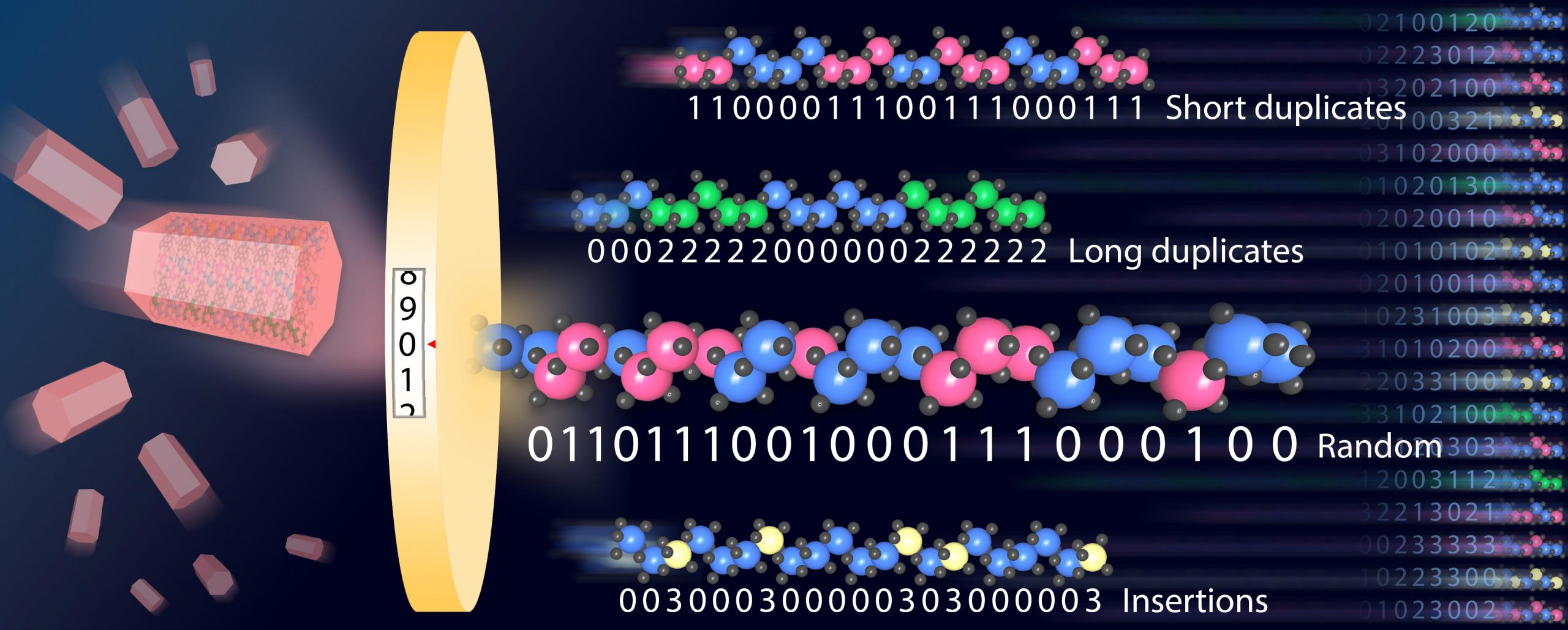
    Rods of multivariate MOFs (left) can be programmed with different metal atoms (colored balls) to do a series of chemical tasks, such as controlled drug release, or to encode information like the ones and zeros in a digital computer. Credit: UC Berkeley image by Omar Yaghi and Zhe Ji

    Reading sequence of metal atoms in MOFs allows encoding of multiple chemical functions.

    Artificial molecules could one day form the information unit of a new type of computer or be the basis for programmable substances. The information would be encoded in the spatial arrangement of the individual atoms – similar to how the sequence of base pairs determines the information content of DNA, or sequences of zeros and ones form the memory of computers.

    Researchers at the University of California, Berkeley, and Ruhr-Universität Bochum (RUB) have taken a step towards this vision. They showed that atom probe tomography can be used to read a complex spatial arrangement of metal ions in multivariate metal-organic frameworks.

    Metal-organic frameworks (MOFs) are crystalline porous networks of multi-metal nodes linked together by organic units to form a well-defined structure. To encode information using a sequence of metals, it is essential to be first able to read the metal arrangement. However, reading the arrangement was extremely challenging. Recently, the interest in characterizing metal sequences is growing because of the extensive information such multivariate structures would be able to offer.

    Fundamentally, there was no method to read the metal sequence in MOFs. In the current study, the research team has successfully done so by using atom probe tomography (APT), in which the Bochum-based materials scientist Tong Li is an expert. The researchers chose MOF-74, made by the Yaghi group in 2005, as an object of interest. They designed the MOFs with mixed combinations of cobalt, cadmium, lead, and manganese, and then decrypted their spatial structure using APT.

    Li, professor and head of the Atomic-Scale Characterisation research group at the Institute for Materials at RUB, describes the method together with Dr. Zhe Ji and chemistry professor Omar Yaghi from UC Berkeley in the journal Science, published online on August 7, 2020.

    Just as sophisticated as biology

    In the future, MOFs could form the basis of programmable chemical molecules: for instance, an MOF could be programmed to introduce an active pharmaceutical ingredient into the body to target infected cells and then break down the active ingredient into harmless substances once it is no longer needed. Or MOFs could be programmed to release different drugs at different times.

    “This is very powerful, because you are basically coding the behavior of molecules leaving the pores,” Yaghi said.

    They could also be used to capture CO2 and, at the same time, convert the CO2 into a useful raw material for the chemical industry.

    “In the long term, such structures with programmed atomic sequences can completely change our way of thinking about material synthesis,” write the authors. “The synthetic world could reach a whole new level of precision and sophistication that has previously been reserved for biology.”

    Reference: “Sequencing of metals in multivariate metal-organic frameworks” by Zhe Ji, Tong Li and Omar M. Yaghi, 7 August 2020, Science.
    DOI: 10.1126/science.aaz4304

    Never miss a breakthrough: Join the SciTechDaily newsletter.
    Follow us on Google and Google News.

    Materials Science Particle Physics UC Berkeley
    Share. Facebook Twitter Pinterest LinkedIn Email Reddit

    Related Articles

    Polymer-Eating Enzymes Make “Biodegradable” Plastics Truly Compostable

    Scientists Chemically Age Quantum Dots in a Test Tube

    Discovery of “Magic” Chemical That Makes Perfect Edges in 2D-Materials

    “Black Nitrogen” – Scientists Solve a Puzzle of the Periodic Table

    Fundamental Property of Halide Perovskites May Open Up a Whole New World of Applications

    New Technology Can Instantly Identify Airborne Chemicals – Down to Parts-Per-Billion

    Computer Model Helps Remove Greenhouse Gases From Power Plants

    Scientists Examine Platinum-Based Catalyst Design

    Using X-Ray Imaging to Help Improve Lithium-Sulfur Battery Technology

    Leave A Reply Cancel Reply

    • Facebook
    • Twitter
    • Pinterest
    • YouTube

    Don't Miss a Discovery

    Subscribe for the Latest in Science & Tech!

    Trending News

    Scientists Warn That This Common Pet Fish Can Wreck Entire Ecosystems

    Scientists Make Breakthrough in Turning Plastic Trash Into Clean Fuel Using Sunlight

    This Popular Supplement May Interfere With Cancer Treatment, Scientists Warn

    Scientists Finally Solved One of Water’s Biggest Mysteries

    Could This New Weight-Loss Pill Disrupt the Entire Market? Here’s What You Should Know About Orforglipron

    Earth’s Crust Is Tearing Open in Africa, and It Could Form a New Ocean

    Breakthrough Bowel Cancer Trial Leaves Patients Cancer-Free for Nearly 3 Years

    Natural Compound Shows Powerful Potential Against Rheumatoid Arthritis

    Follow SciTechDaily
    • Facebook
    • Twitter
    • YouTube
    • Pinterest
    • Newsletter
    • RSS
    SciTech News
    • Biology News
    • Chemistry News
    • Earth News
    • Health News
    • Physics News
    • Science News
    • Space News
    • Technology News
    Recent Posts
    • Researchers Discover Boosting a Single Protein Helps the Brain Fight Alzheimer’s
    • AI Detects “Invisible” Signs of Pancreatic Cancer Years Before Diagnosis
    • Kratom Use Explodes in the US, With Life-Changing Consequences
    • Scientists Uncover Fatal Weakness in “Zombie Cells” Linked to Cancer
    • World-First Study Reveals Human Hearts Can Regenerate After a Heart Attack
    Copyright © 1998 - 2026 SciTechDaily. All Rights Reserved.
    • Science News
    • About
    • Contact
    • Editorial Board
    • Privacy Policy
    • Terms of Use

    Type above and press Enter to search. Press Esc to cancel.