
Close Menu
    Facebook X (Twitter) Instagram
    SciTechDaily
    • Biology
    • Chemistry
    • Earth
    • Health
    • Physics
    • Science
    • Space
    • Technology
    Facebook X (Twitter) Pinterest YouTube RSS
    SciTechDaily
    Home»Chemistry»Discovery of “Magic” Chemical That Makes Perfect Edges in 2D-Materials
    Chemistry

    Discovery of “Magic” Chemical That Makes Perfect Edges in 2D-Materials

    By Chalmers University of TechnologyOctober 19, 2020No Comments4 Mins Read
    Facebook Twitter Pinterest Telegram LinkedIn WhatsApp Email Reddit
    Share
    Facebook Twitter LinkedIn Pinterest Telegram Email Reddit
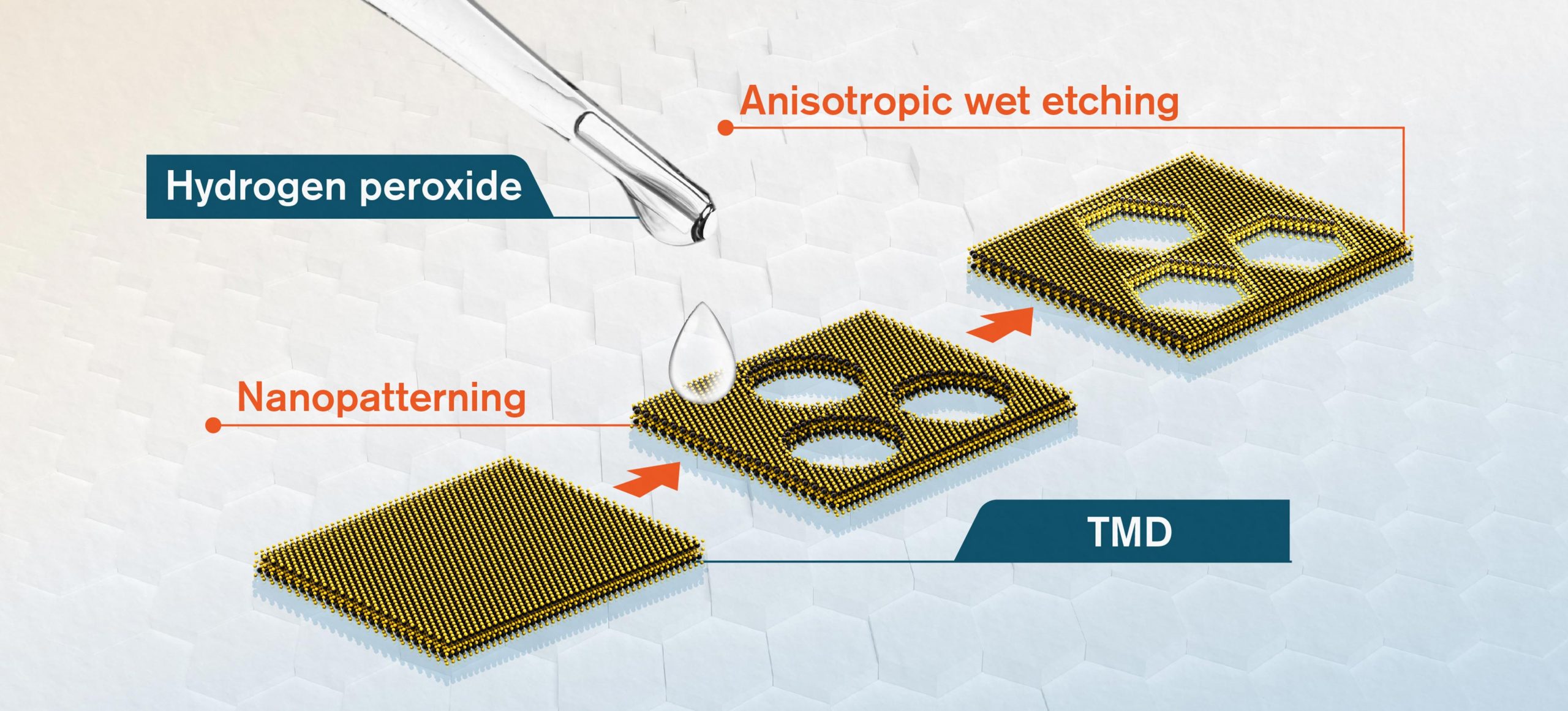
    Perfect Edges in 2D-Materials
    Researchers at Chalmers University of Technology present a method to finely control the edges of two-dimensional materials, by using a ‘magic’ chemical — hydrogen peroxide. Credit: Alexander Ericson/Yen Strandqvist/Chalmers University of Technology

    Ultrathin materials such as graphene promise a revolution in nanoscience and technology. Researchers at Chalmers University of Technology, Sweden, have now made an important advance within the field. In a recent paper in Nature Communications they present a method for controlling the edges of two-dimensional materials using a ‘magic’ chemical.

    “Our method makes it possible to control the edges — atom by atom — in a way that is both easy and scalable, using only mild heating together with abundant, environmentally friendly chemicals, such as hydrogen peroxide,” says Battulga Munkhbat, a postdoctoral researcher at the Department of Physics at Chalmers University of Technology, and first author of the paper.

    Materials as thin as just a single atomic layer are known as two-dimensional, or 2D, materials. The most well-known example is graphene, as well as molybdenum disulfide, its semiconductor analog. Future developments within the field could benefit from studying one particular characteristic inherent to such materials — their edges. Controlling the edges is a challenging scientific problem, because they are very different in comparison to the main body of a 2D material. For example, a specific type of edge found in transition metal dichalcogenides (known as TMD’s, such as the aforementioned molybdenum disulfide), can have magnetic and catalytic properties.

    Battulga Munkhbat
    “Our method makes it possible to control the edges — atom by atom — in a way that is both easy and scalable, using only mild heating together with abundant, environmentally friendly chemicals, such as hydrogen peroxide,” says Battulga Munkhbat, a postdoctoral researcher at the Department of Physics at Chalmers University of Technology, and first author of the paper. Credit: Anna Lena Lundqvist/Chalmers University of Technology

    Typical TMD materials have edges which can exist in two distinct variants, known as zigzag or armchair. These alternatives are so different that their physical and chemical properties are not at all alike. For instance, calculations predict that zigzag edges are metallic and ferromagnetic, whereas armchair edges are semiconducting and non-magnetic. Similar to these remarkable variations in physical properties, one could expect that chemical properties of zigzag and armchair edges are also very different. If so, it could be possible that certain chemicals might ‘dissolve’ armchair edges, while leaving zigzag ones unaffected.

    Now, such a ‘magic’ chemical is exactly what the Chalmers researchers have found — in the form of ordinary hydrogen peroxide. At first, the researchers were completely surprised by the new results.

    Timur Shegai
    “This method opens up new and unprecedented possibilities for van der Waals materials (layered 2D materials). We can now combine edge physics with 2D physics in one single material. It is an extremely fascinating development,” says Timur Shegai, Associate Professor at the Department of Physics at Chalmers and leader of the research project. Credit: Anna Lena Lundqvist/Chalmers University of Technology

    “It was not only that one type of edge was dominant over the others, but also that the resulting edges were extremely sharp — nearly atomically sharp. This indicates that the ‘magic’ chemical operates in a so-called self-limiting manner, removing unwanted material atom-by-atom, eventually resulting in edges at the atomically sharp limit. The resulting patterns followed the crystallographic orientation of the original TMD material, producing beautiful, atomically sharp hexagonal nanostructures,” says Battulga Munkhbat.

    “An extremely fascinating development”

    The new method, which includes a combination of standard top-down lithographic methods with a new anisotropic wet etching process, therefore makes it possible to create perfect edges in two-dimensional materials.

    “This method opens up new and unprecedented possibilities for van der Waals materials (layered 2D materials). We can now combine edge physics with 2D physics in one single material. It is an extremely fascinating development,” says Timur Shegai, Associate Professor at the Department of Physics at Chalmers and leader of the research project.

    These and other related materials often attract significant research attention, as they enable crucial advances within in nanoscience and technology, with potential applications ranging from quantum electronics to new types of nano-devices. These hopes are manifested in the Graphene Flagship, Europe’s biggest ever research initiative, which is coordinated by Chalmers University of Technology.

    To make the new technology available to research laboratories and high-tech companies, the researchers have founded a start-up company that offers high quality atomically sharp TMD materials. The researchers also plan to further develop applications for these atomically sharp metamaterials.

    Reference: “Transition metal dichalcogenide metamaterials with atomic precision” by Battulga Munkhbat, Andrew B. Yankovich, Denis G. Baranov, Ruggero Verre, Eva Olsson and Timur O. Shegai, 14 September 2020, Nature Communications.
    DOI: 10.1038/s41467-020-18428-2

    Never miss a breakthrough: Join the SciTechDaily newsletter.
    Follow us on Google and Google News.

    2D Materials Chalmers University of Technology Materials Science Nanotechnology Particle Physics
    Share. Facebook Twitter Pinterest LinkedIn Email Reddit

    Related Articles

    Revolutionary Solid Lubricant Slashes Friction With Nanoscale Precision

    Nano-Chainmail Unveiled: Revolutionary Material for Lightweight, Tough Protection

    White Graphene: The One-Atom Wonder Driving Greener Energy and Faster Tech

    Measuring the “Wettability” of Graphene and Other 2D Materials at the Molecular Level

    Findings to Help Achieve Holy Grail of 2D Materials – Superfast Electronic Devices

    Physicists Play With the Laws of Nature: Controlling Ultrastrong Light-Matter Coupling at Room Temperature

    Chemists Achieve Breakthrough in the Synthesis of Graphene Nanoribbons

    A Profound Leap Forward: Pushing the Limits of 2D Supramolecules

    New Technology Can Instantly Identify Airborne Chemicals – Down to Parts-Per-Billion

    Leave A Reply Cancel Reply

    • Facebook
    • Twitter
    • Pinterest
    • YouTube

    Don't Miss a Discovery

    Subscribe for the Latest in Science & Tech!

    Trending News

    New Study Reveals Why Ozempic Works Better for Some People Than Others

    Climate Change Is Altering a Key Greenhouse Gas in a Way Scientists Didn’t Expect

    New Study Suggests Gravitational Waves May Have Created Dark Matter

    Scientists Discover Why the Brain Gets Stuck in Schizophrenia

    Scientists Engineer “Tumor-Eating” Bacteria That Devour Cancer From Within

    Even “Failed” Diets May Deliver Long-Term Health Gains, Study Finds

    NIH Scientists Discover Powerful New Opioid That Relieves Pain Without Dangerous Side Effects

    Collapsing Plasma May Hold the Key to Cosmic Magnetism

    Follow SciTechDaily
    • Facebook
    • Twitter
    • YouTube
    • Pinterest
    • Newsletter
    • RSS
    SciTech News
    • Biology News
    • Chemistry News
    • Earth News
    • Health News
    • Physics News
    • Science News
    • Space News
    • Technology News
    Recent Posts
    • This 15,000-Year-Old Discovery Changes What We Know About Early Human Creativity
    • 35-Million-Year-Old Mystery: Strange Arachnid Discovered Preserved in Amber
    • Revolutionary Gas Turbine Generates Power Without Air Compression
    • Is AI Really Just a Tool? It Could Be Altering How You See Reality
    • JWST Reveals a “Forbidden” Planet With a Baffling Composition
    Copyright © 1998 - 2026 SciTechDaily. All Rights Reserved.
    • Science News
    • About
    • Contact
    • Editorial Board
    • Privacy Policy
    • Terms of Use

    Type above and press Enter to search. Press Esc to cancel.