
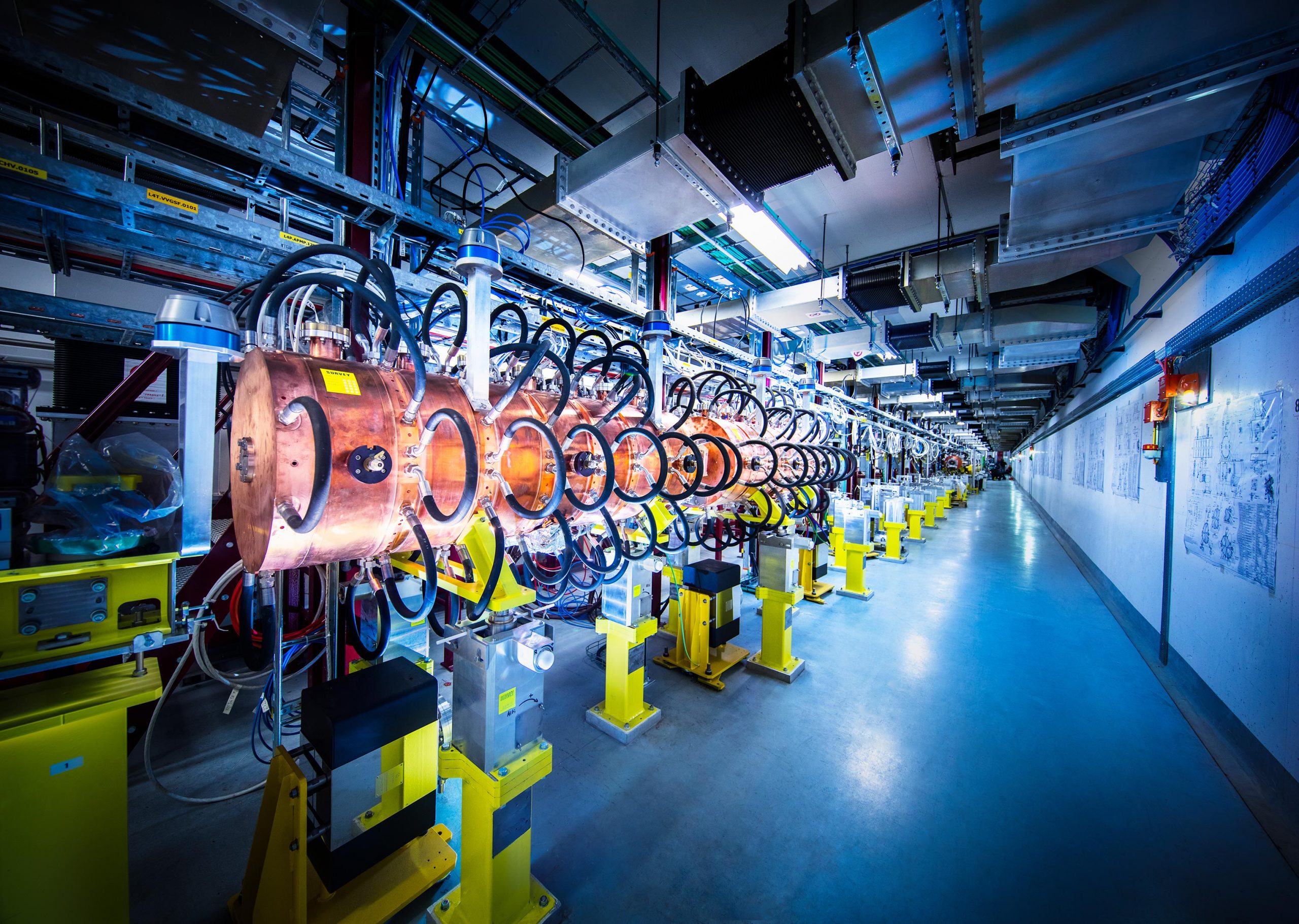
The CERN Control Centre (CCC) is abuzz once again. The second long shutdown (LS2) has come to an end for CERN’s newest accelerator – Linac 4 – and the accelerator complex’s slow awakening from a two-year repair-and-recuperation hibernation has begun. The three-week machine-development run until mid-August saw low-energy beams of negative hydrogen ions (H−) fly through the first part of the accelerator for the first time since it was connected to the PS Booster. On August 20, the first beams at the nominal energy of 160 MeV were accelerated through the entire machine and into a dedicated beam dump located at the end of the linac. Over the coming months, the brand-new accelerator will finish being commissioned and will be made ready to deliver various beams to the PS Booster in December.
CERN is famous for its circular accelerators, in particular the 27-kilometer-circumference (17-mile-circumference) Large Hadron Collider. But the protons that circulate in these bigger machines first undergo acceleration in a humble and relatively small linear accelerator, or linac. In 2018, Linac 2, which had fed protons to CERN’s accelerator complex since 1978, was finally retired, with the 86-meter-long (282-foot-long) Linac 4 ready to take its place. But a new machine comes with new challenges for the team operating it.
The machine-development phase from late July was handled by the Accelerators and Beam Physics group (ABP) team responsible for the proton sources, who previously also ran the Linac 2 operations. “ABP made sure that we could send beam through the first structure in Linac 4, the so-called radio-frequency quadrupole or RFQ, with low beam losses,” notes Bettina Mikulec, who is leading the team from the Operations group (OP) who are responsible not only for Linac 4 but for the PS Booster as well. Over the three weeks, ABP also worked on optimizing the proton source and realigning it to get a better angle for the particles entering the RFQ. ABP then handed over the accelerator for commissioning to the team from OP.
Linac 4 differs significantly in behavior from its predecessor, in terms of shaping the profile of the proton beams that are fired downstream. “With Linac 4, we can adjust additional parameters of the beam so we can feed the Booster in a loss-free process,” adds Mikulec. “We can also adapt the energy spread of the beams to match the Booster’s acceptance, whereas with Linac 2 one practically only adjusted the length of the beam before injection.” The newer accelerator will inject particles into the PS Booster at an energy of 160 MeV, significantly higher than the 50-MeV operation of Linac 2. This enables the Booster, in turn, to inject beams at an energy of 2 GeV into the Proton Synchrotron (PS), higher than the previous value of 1.4 GeV.
The commissioning phase is crucial for long-term operation of Linac 4. Qualifying the equipment, optimizing beam instrumentation and much more can only be done with beam in the accelerator. This week, Linac 4 was phased in for operation at its maximum energy. “Among other things, we are working with ABP to verify the optics of the machine to provide the optimum conditions for the PS Booster’s injection point,” Mikulec points out.
The beams are now being sent to Linac 4’s dedicated beam dump, and from September onwards will be sent down the injection line toward the PS Booster before slamming into the beam dump located just upstream of the Booster. The Linac 4 team is back in full operation and looking forward to delivering beam into the PS Booster on December 7.
Never miss a breakthrough: Join the SciTechDaily newsletter.
Follow us on Google and Google News.