
Close Menu
    Facebook X (Twitter) Instagram
    SciTechDaily
    • Biology
    • Chemistry
    • Earth
    • Health
    • Physics
    • Science
    • Space
    • Technology
    Facebook X (Twitter) Pinterest YouTube RSS
    SciTechDaily
    Home»Earth»A 1,000 km Long River May Be Flowing Deep Below Greenland’s Ice Sheet
    Earth

    A 1,000 km Long River May Be Flowing Deep Below Greenland’s Ice Sheet

    By Hokkaido UniversityNovember 12, 2020No Comments4 Mins Read
    Facebook Twitter Pinterest Telegram LinkedIn WhatsApp Email Reddit
    Share
    Facebook Twitter LinkedIn Pinterest Telegram Email Reddit
    Possible River Flowing Greenland
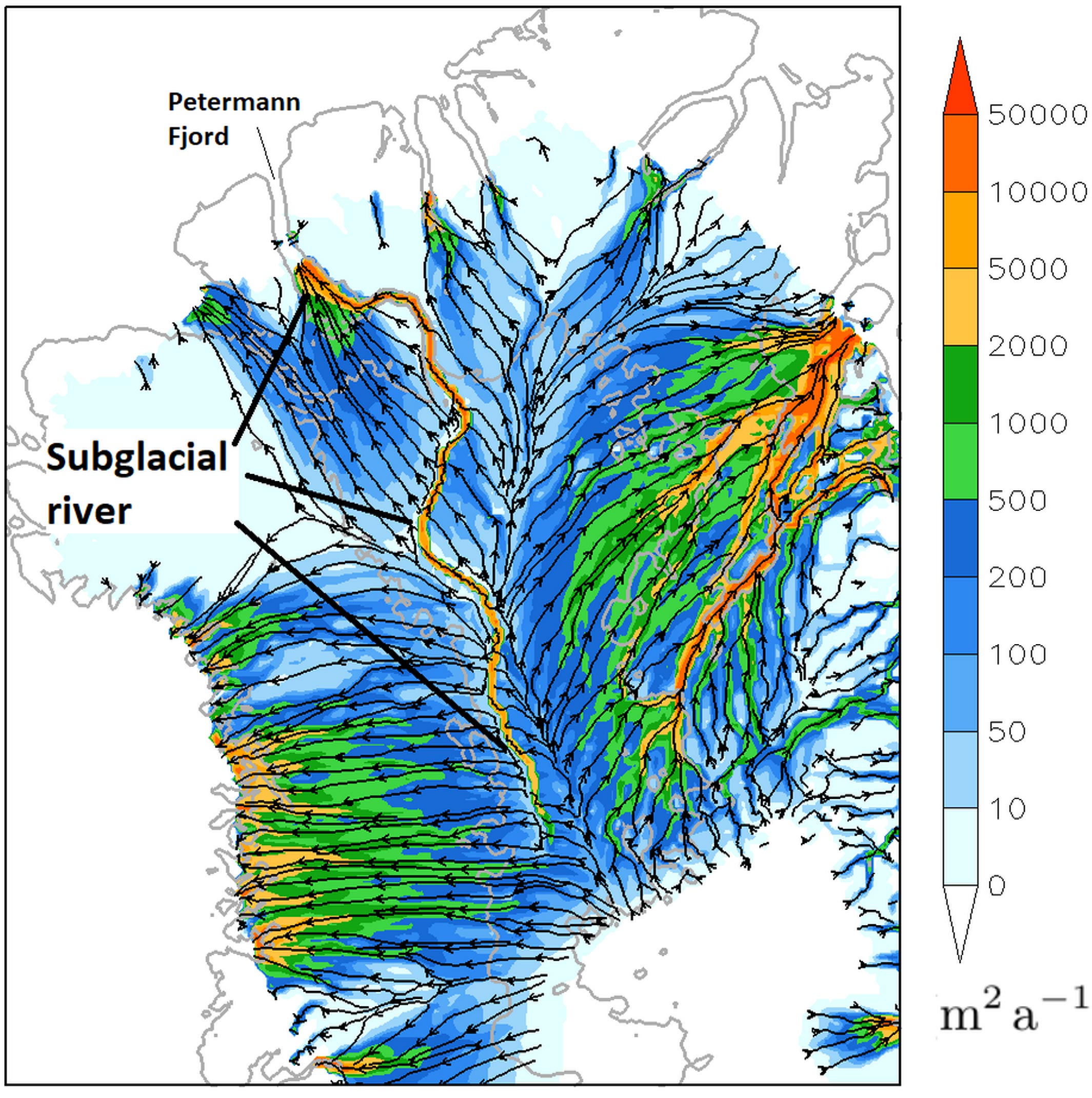
    The suggested valley and possible river flowing from the deep interior of Greenland to Petermann Fjord deep below Greenland’s ice sheet (500 meters below sea level). Credit: Christopher Chambers et al, The Cryosphere, November 12, 2020

    Computational models suggest that melting water originating in the deep interior of Greenland could flow the entire length of a subglacial valley and exit at Petermann Fjord, along the northern coast of the island. Updating ice sheet models with this open valley could provide additional insight for future climate change predictions.

    Radar surveys have previously mapped Greenland’s bedrock buried beneath two to three thousand meters of ice. Mathematical models were used to fill in the gaps in survey data and infer bedrock depths. The surveys revealed the long valley, but suggested it was segmented, preventing water from flowing freely through it. However, the peaks breaking the valley into segments only show up in areas where the mathematical modeling was used to fill in missing data, so could not be real.

    Christopher Chambers and Ralf Greve, scientists at Hokkaido University’s Institute of Low Temperature Science, wanted to explore what might happen if the valley is open and melting increases at an area deep in Greenland’s interior known for melting. Collaborating with researchers at the University of Oslo, they ran numerous simulations to compare water dynamics in northern Greenland with and without valley segmentation.

    Christopher Chambers and Ralf Greve
    Christopher Chambers (left) and Ralf Greve (right). Credit: Ralf Greve

    The results, recently published in The Cryosphere, show a dramatic change in how water melting at the base of the ice sheet would flow, if the valley is indeed open. A distinct subglacial watercourse runs all the way from the melting site to Petermann Fjord, which is located more than 1,000 kilometers (62 miles) away on the northern coast of Greenland. The watercourse only appears when valley segmentation is removed; there are no other major changes to the landscape or water dynamics.

    “The results are consistent with a long subglacial river,” Chambers says, “but considerable uncertainty remains. For example, we don’t know how much water, if any, is available to flow along the valley, and if it does indeed exit at Petermann Fjord or is refrozen, or escapes the valley, along the way.”

    If water is flowing, the model suggests it could traverse the whole length of the valley because the valley is relatively flat, similar to a riverbed. This suggests no parts of the ice sheet form a physical blockade. The simulations also suggested that there was more water flow towards the fjord with a level valley base set at 500 meters (1,640 feet) below sea level than when set at 100 meters (330 feet) below. In addition, when melting is increased only in the deep interior at a known region of basal melting, the simulated discharge is increased down the entire length of the valley only when the valley is unblocked. This suggests that a quite finely tuned relationship between the valley form and overlying ice can allow a very long down-valley water pathway to develop.

    “Additional radar surveys are needed to confirm the simulations are accurate,” says Greve, who has been developing the model used in the study, called Simulation Code for Polythermal Ice Sheets (SICOPOLIS). “This could introduce a fundamentally different hydrological system for the Greenland ice sheet. The correct simulation of such a long subglacial hydrological system could be important for accurate future ice sheet simulations under a changing climate.”

    Reference: “Possible impacts of a 1000 km long hypothetical subglacial river valley towards Petermann Glacier in northern Greenland” by Christopher Chambers, Ralf Greve, Bas Altena and Pierre-Marie Lefeuvre, 12 November 2020, The Cryosphere.
    DOI: 10.5194/tc-14-3747-2020

    Never miss a breakthrough: Join the SciTechDaily newsletter.
    Follow us on Google and Google News.

    Climate Change Greenland Hokkaido University Popular
    Share. Facebook Twitter Pinterest LinkedIn Email Reddit

    Related Articles

    Secrets of the Past: Huge Ancient Lake Bed Discovered Deep Beneath the Greenland Ice Sheet

    “Worst-Case Climate Scenario” – Ice Sheets in Greenland and Antarctica Loss Rates Rapidly Increasing

    Greenland Ice Sheet Already Reached Tipping Point 20 Years Ago

    Grim Global Warming Milestone: Record Loss of Greenland Ice in 2019 – 532 Billion Tons

    Worst-Case Climate Change Scenario: Greenland and Antarctica Losing Ice 6x Faster Than Expected

    Greenland Losing Ice 7 Times Faster Than in 1990s – Lost 3.8 Trillion Metric Tons of Ice Since 1992

    World’s Second-Largest Ice Sheet Becoming More Unstable As It Fractures in Shock Drone Images

    Satellites Confirm Extensive Ice Sheet Melt in Greenland

    1930s Photos Reveal History of Greenland Glaciers

    Leave A Reply Cancel Reply

    • Facebook
    • Twitter
    • Pinterest
    • YouTube

    Don't Miss a Discovery

    Subscribe for the Latest in Science & Tech!

    Trending News

    Millions Take These IBS Drugs, But a New Study Finds Serious Risks

    Scientists Unlock Hidden Secrets of 2,300-Year-Old Mummies Using Cutting-Edge CT Scanner

    Bread Might Be Making You Gain Weight Even Without Eating More Calories

    Scientists Discover Massive Magma Reservoir Beneath Tuscany

    Europe’s Most Active Volcano Just Got Stranger – Here’s Why Scientists Are Rethinking It

    Alzheimer’s Symptoms May Start Outside the Brain, Study Finds

    Millions Take This Popular Supplement – Scientists Discover a Concerning Link to Heart Failure

    The Universe Is Expanding Too Fast and Scientists Can’t Explain Why

    Follow SciTechDaily
    • Facebook
    • Twitter
    • YouTube
    • Pinterest
    • Newsletter
    • RSS
    SciTech News
    • Biology News
    • Chemistry News
    • Earth News
    • Health News
    • Physics News
    • Science News
    • Space News
    • Technology News
    Recent Posts
    • Doctors Surprised by the Power of a Simple Drug Against Colon Cancer
    • Why Popular Diabetes Drugs Like Ozempic Don’t Work for Everyone: The “Genetic Glitch”
    • Scientists Create Improved Insulin Cells That Reverse Diabetes in Mice
    • Scientists Stunned After Finding Plant Thought Extinct for 60 Years
    • A Common Diabetes Drug May Hold the Key to Stopping HIV From Coming Back
    Copyright © 1998 - 2026 SciTechDaily. All Rights Reserved.
    • Science News
    • About
    • Contact
    • Editorial Board
    • Privacy Policy
    • Terms of Use

    Type above and press Enter to search. Press Esc to cancel.