
Steven Burrows/JILA, edited
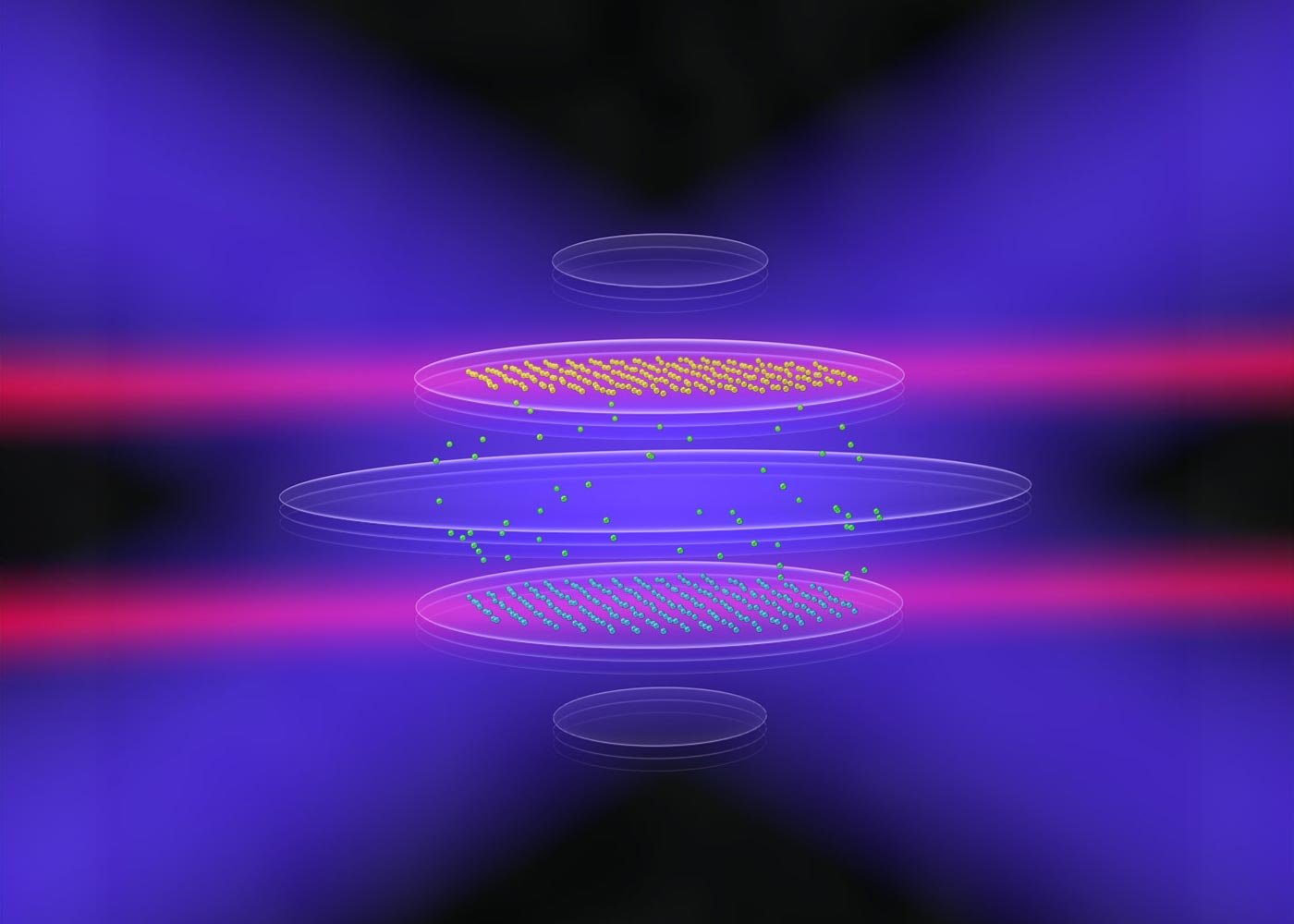
Researchers have engineered a new technique to trap ions in 3D structures using modified electric fields in Penning traps, forming stable bilayer crystals.
This innovation paves the way for more complex quantum devices and could revolutionize quantum computing and sensing by utilizing space more efficiently.
Quantum Device Challenges
Many quantum devices, from quantum sensors to quantum computers, use ions or charged atoms trapped with electric and magnetic fields as a hardware platform to process information.
However, current trapped-ion systems face important challenges. Most experiments are limited to one-dimensional chains or two-dimensional planes of ions, which constrain the scalability and functionality of quantum devices. Scientists have long dreamed of stacking these ions into three-dimensional structures, but this has been very difficult because it’s hard to keep the ions stable and well-controlled when arranged in more complex ways.
Breakthrough in Ion Trapping Technology
To address these challenges, an international collaboration of physicists from India, Austria, and the USA—including JILA and NIST Fellow Ana Maria Rey, along with NIST scientists Allison Carter and John Bollinger—proposed that tweaking the electric fields that trap the ions can create stable, multilayered structures, opening up exciting new possibilities for future quantum technologies. The researchers published their findings in Physical Review X.
“The capability to trap large ensembles of ions in two or more spatially separated layers under fully controllable conditions opens exciting opportunities to explore new regimes and phenomena not easily accessible in purely 2D crystals, such as topological chiral modes, teleportation and precision measurements of spatially varying fields all relevant for quantum information science,” says Rey.
Enhancing Quantum Computing With Penning Traps
Among the various platforms being explored for quantum computing, trapped ions have emerged as a leading candidate due to their high degree of controllability and the ability to perform precise quantum operations. These ions can be manipulated with laser or microwave pulses, which change their quantum states, allowing them to be “coded” with specific information. These coded ions are often called quantum bits or “qubits.”
During this process, ions also experience the Coulomb force or interactions with other ions, which physicists can use to entangle them, reducing the system’s overall noise and enhancing its measurements.
“Previous work has shown that ion crystals can form 3D spheroidal structures, but what we were looking for was a way to realize a stacked array of 2D layers,” Samarth Hawaldar, the paper’s first author and a researcher at the Indian Institute of Science, explained in a recent write up about the paper. “We started to explore ways to realize such structures in a specific type of ion trap called a Penning trap, because these traps are good at storing large numbers of ions, typically many hundreds to thousands.”
In a Penning trap, ions can be forced to self-ensemble into crystalline structures generated by the competition between repulsive Coulomb interactions and the confinement potential—the combined electric and magnetic force that keeps ions securely trapped in a specific region of space.
“Confinement is achieved via electromagnetic forces created by a stack of electrodes and by making the ions rotate in a powerful magnetic field,” explains Carter.
For physicists, Penning traps are particularly useful because they can store a large number of ions, making them a good option for experimenting with more complex, three-dimensional structures. Penning traps have been used to arrange ions into a single, two-dimensional layer or more rounded, three-dimensional shapes. The rounded, three-dimensional shape happens because the confining electric field in these traps usually increases linearly with distance from the trap’s center, like that of an ideal spring, naturally guiding the ions into these simpler, rounded formations.
However, the researchers, including Prakriti Shahi of the Indian Institute of Technology Bombay, tried modifying the trap’s electric field to be more nuanced and dependent on the distance from the center of the trap. This subtle change allowed them to coax the ions into forming a new kind of structure—a bilayer crystal, where two flat layers of ions were stacked one above the other.
The team conducted extensive numerical simulations to validate their new approach, showing that this bilayer configuration could be stabilized under certain conditions and even suggesting the potential to extend the method to create crystals with more than two layers.
“We’re excited to try forming bi-layer crystals in the lab with our current Penning trap set-up,” says John Bollinger, an experimental physicist and co-author of the publication. “In the longer term I think this idea will motivate a redesign of the detailed electrode structure of our traps.”
A New Frontier for Ion Trapping
Shifting ion trapping from 2D to 3D has significant implications for the future of quantum devices such as sensors or quantum computers.
“Bilayer crystals open up several new capabilities for quantum information processing that are not straightforward with 1D chains or 2D planes,” Dr. Athreya Shankar, a postdoctoral researcher at the Indian Institute of Science, said in a recent statement about the study. “For instance, the generation of quantum entanglement between large sub-systems separated by a distance, such as the two layers in this system, is a sought-after capability across all quantum hardware.”
The team is eager to test these findings experimentally in their Penning traps. If successful, this could lead to new quantum hardware architectures that make more efficient use of 3D space, thus increasing the scalability and robustness of quantum technologies.
Besides hardware opportunities, the bilayers open new quantum simulations and sensing possibilities.
“For example, the normal modes of the ions in a bilayer can couple both vertical and radial degrees of freedom, favoring the clock over anti-clockwise circulation or vice versa,” Rey elaborates. “This could be used to imitate rich behaviors experienced by electrons in strong magnetic fields but under fully controllable settings. Moreover, having more ions can enhance signal-to-noise in measurement and thus enable more precise estimation of quantities such as time, electric fields, or accelerations, which can be very important for discovering new physics.”
This partnership between researchers in India, Austria, and the USA is critical as the field of quantum technology continues to evolve. Innovations like these will be vital in realizing the full potential of quantum computing, sensing, and beyond.
Reference: “Bilayer Crystals of Trapped Ions for Quantum Information Processing” by Samarth Hawaldar, Prakriti Shahi, Allison L. Carter, Ana Maria Rey, John J. Bollinger and Athreya Shankar, 16 August 2024, Physical Review X.
DOI: 10.1103/PhysRevX.14.031030
This work was supported by the U.S. Department of Energy’s Office of Science, The National Quantum Initiative (NQI) Science Research Centers, and the Quantum Systems Accelerator (QSA).
Never miss a breakthrough: Join the SciTechDaily newsletter.
Follow us on Google and Google News.
1 Comment
“Previous work has shown that ion crystals can form 3D spheroidal structures, but what we were looking for was a way to realize a stacked array of 2D layers,” Samarth Hawaldar explained.
VERY GOOD!
Please ask researchers to think deeply:
1. How do you understand 2D and 3D in physics?
2. Is 2D in physics related to 2D in mathematics?
3. How do you understand topological vortex gravitational fields?
and so on.
Scientific research guided by correct theories can help humanity avoid detours, failures, and pomposity. Please witness the exemplary collaboration between theoretical physicists and experimentalists (https://scitechdaily.com/microscope-spacecrafts-most-precise-test-of-key-component-of-the-theory-of-general-relativity/#comment-854286). Some people in contemporary physics has always lived in a self righteous children’s story world. Whose values have been overturned by such a comical and ridiculous reality?
From Physical Review Letters (PRL), to Nature, and Science, even the Proceedings of the National Academy of Sciences (PNAS), the so-called academic journals firmly believe that two high-dimensional spacetime objects (such as two sets of cobalt-60) rotating in opposite directions can be transformed into two objects that mirror each other, and that the asymmetry between the amount of created matter and antimatter led to the matter-dominated Universe as we know it today.
Does the facts tell the so-called academic journals that two sets of cobalt-60 rotating in opposite directions can be transformed into two objects that mirror each other? Does mathematics tell the so-called academic journals that matter and antimatter are asymmetric? When physics no longer believes in facts and mathematics, it is no different from theology.
Naked walkers never consider themselves ugly, but rather consider themselves cool.
The physical phenomena observed in scientific experiments are always just appearances, not the natural essence of things. The natural essence of things needs to be extracted and sublimated based on natural phenomena via mathematical theories. After understanding and mastering the natural essence of things, humans can predict more possible natural phenomena, and even manipulate and implement them.