
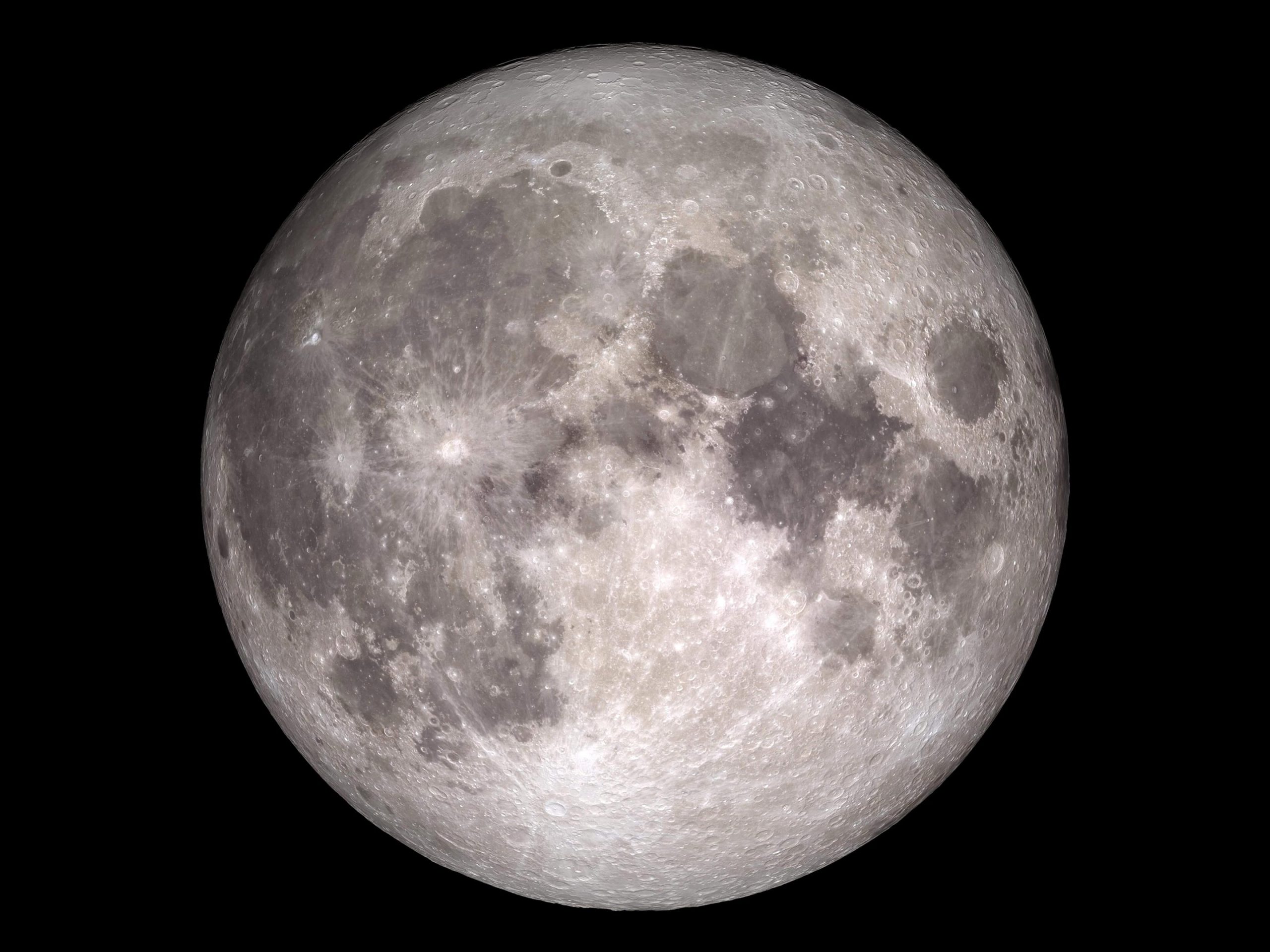
Radar Points to Moon Being More Metallic Than Previously Thought
What started out as a hunt for ice lurking in polar lunar craters turned into an unexpected finding that could help clear some muddy history about the Moon’s formation.
Team members of the Miniature Radio Frequency (Mini-RF) instrument on NASA’s Lunar Reconnaissance Orbiter (LRO) spacecraft found new evidence that the Moon’s subsurface might be richer in metals, like iron and titanium, than researchers thought. That finding, published July 1 in Earth and Planetary Science Letters, could aid in drawing a clearer connection between Earth and the Moon.
“The LRO mission and its radar instrument continue to surprise us with new insights about the origins and complexity of our nearest neighbor,” said Wes Patterson, Mini-RF principal investigator from the Johns Hopkins Applied Physics Laboratory (APL) in Laurel, Maryland, and a study coauthor.
Substantial evidence points to the Moon as the product of a collision between a Mars-sized protoplanet and young Earth, forming from the gravitational collapse of the remaining cloud of debris. Consequently, the Moon’s bulk chemical composition closely resembles that of Earth.
Look in detail at the Moon’s chemical composition, however, and that story turns murky. For example, in the bright plains of the Moon’s surface, called the lunar highlands, rocks contain smaller amounts of metal-bearing minerals relative to Earth. That finding might be explained if Earth had fully differentiated into a core, mantle, and crust before the impact, leaving the Moon largely metal-poor. But turn to the Moon’s maria — the large, darker plains — and the metal abundance becomes richer than that of many rocks on Earth.
This discrepancy has puzzled scientists, leading to numerous questions and hypotheses regarding how much the impacting protoplanet may have contributed to the differences. The Mini-RF team found a curious pattern that could lead to an answer.
Using Mini-RF, the researchers sought to measure an electrical property within lunar soil piled on crater floors in the Moon’s northern hemisphere. This electrical property is known as the dielectric constant, a number that compares the relative abilities of a material and the vacuum of space to transmit electric fields, and could help locate ice lurking in the crater shadows. The team, however, noticed this property increasing with crater size.
For craters approximately 1 to 3 miles (2 to 5 kilometers) wide, the dielectric constant of the material steadily increased as the craters grew larger, but for craters 3 to 12 miles (5 to 20 kilometers) wide, the property remained constant.
“It was a surprising relationship that we had no reason to believe would exist,” said Essam Heggy, coinvestigator of the Mini-RF experiments from the University of Southern California in Los Angeles and lead author of the published paper.
Discovery of this pattern opened a door to a new possibility. Because meteors that form larger craters also dig deeper into the Moon’s subsurface, the team reasoned that the increasing dielectric constant of the dust in larger craters could be the result of meteors excavating iron and titanium oxides that lie below the surface. Dielectric properties are directly linked to the concentration of these metal minerals.
If their hypothesis were true, it would mean only the first few hundred meters of the Moon’s surface is scant in iron and titanium oxides, but below the surface, there’s a steady increase to a rich and unexpected bonanza.
Comparing crater floor radar images from Mini-RF with metal oxide maps from the LRO Wide-Angle Camera, Japan’s Kaguya mission and NASA’s Lunar Prospector spacecraft, the team found exactly what it had suspected. The larger craters, with their increased dielectric material, were also richer in metals, suggesting that more iron and titanium oxides had been excavated from the depths of 0.3 to 1 mile (0.5 to 2 kilometers) than from the upper 0.1 to 0.3 miles (0.2 to 0.5 kilometers) of the lunar subsurface.
“This exciting result from Mini-RF shows that even after 11 years in operation at the Moon, we are still making new discoveries about the ancient history of our nearest neighbor,” said Noah Petro, the LRO project scientist at NASA’s Goddard Space Flight Center in Greenbelt, Maryland. “The MINI-RF data is incredibly valuable for telling us about the properties of the lunar surface, but we use that data to infer what was happening over 4.5 billion years ago!”
These results follow recent evidence from NASA’s Gravity Recovery and Interior Laboratory (GRAIL) mission that suggests a significant mass of dense material exists just a few tens to hundreds of kilometers beneath the Moon’s enormous South Pole-Aitken basin, indicating that dense materials aren’t uniformly distributed in the Moon’s subsurface.
The team emphasizes that the new study can’t directly answer the outstanding questions about the Moon’s formation, but it does reduce the uncertainty in the distribution of iron and titanium oxides in the lunar subsurface and provide critical evidence needed to better understand the Moon’s formation and its connection to Earth.
“It really raises the question of what this means for our previous formation hypotheses,” Heggy said.
Anxious to uncover more, the researchers have already started examining crater floors in the Moon’s southern hemisphere to see if the same trends exist there.
Read Surprising Find at the Bottom of Moon’s Craters Provides New Insights to Its Origin for more on this research.
Reference: “Bulk composition of regolith fines on lunar crater floors: Initial investigation by LRO/Mini-RF” by E. Heggy, E. M. Palmer, T. W. Thompson, B. J. Thomson and G. W. Patterson, 12 May 2020, Earth and Planetary Science Letters.
DOI: 10.1016/j.epsl.2020.116274
LRO is managed by NASA’s Goddard Space Flight Center in Greenbelt, Maryland for the Science Mission Directorate at NASA Headquarters in Washington. Mini-RF was designed, built and tested by a team led by APL, Naval Air Warfare Center, Sandia National Laboratories, Raytheon and Northrop Grumman.
Never miss a breakthrough: Join the SciTechDaily newsletter.
Follow us on Google and Google News.
113 Comments
It’s made of green cheese, of course.
That’s no moon. It’s a space station.
Supposed image of the dark side of the moon:
https://images.app.goo.gl/3Etpt94JQMeWtuov8
“Supposed”? “Dark side”?
The far side of the moon gets as much sunlight as the nearside, 50 % or two weeks out of a month, as it is tidal locked to Earth during its month long orbit. [ https://en.wikipedia.org/wiki/Far_side_of_the_Moon ]
Question: Data shows the core structure of all the planets, with that in mind how accurate are those if we are just now learning the core of the moon?
We don’t know the inner structure of planets very well, especially for gas giants:
“The surviving core of a gas giant has been discovered orbiting a distant star by University of Warwick astronomers, offering an unprecedented glimpse into the interior of a planet. … We have the opportunity to look at the core of a planet in a way that we can’t do in our own solar system. There are still big open questions about the nature of Jupiter’s core, for example, so strange and unusual exoplanets like this give us a window into planet formation that we have no other way to explore.”
[ https://phys.org/news/2020-07-exposed-planetary-core-glimpse-worlds.html ]
Seismology has allowed to learn more of Earth inside, as well as Moon [Apollo seismometers] and now lately Mars [InSight seismometer]. I see some work at times, there is a lot of data, but also lots of uncertainties in models yet.
The Armenians came from the moon.
The best answer you would get is if you find a read a recent review of work on the topic.
Can’t we use seismic waves as a method for gaining further insight on the moon’s interior? For instance, an elaborate setup of multiple detonaters and receivers scattered accross the lunar surface.
What about the water?
Alien lives matter
Alien lives matter 😘
Brilliant!
Yes every life matters and we are all aliens.
You’re both clueless
Nerds are the worst racists!
Not if there is a race to the moon.
How long until we had a space war over the control of the mineral deposits on the Moon?
The moon should be off limits to any mining efforts. It is of greatest value in tact.
I believe Mankind will find a way to mine the bejesus out of the moon until it is gone or loses the gravitational symbiotic relationship it has with Earth. The predictable tides will be gone, life will perish as we know it and we will perish along with it. Man always finds a way to destroy everything they touch for their own greedy purpose.
Absolite truth. A sad truth, but truth all the same
…
The moon is hollow and made of ti, al and f. The aliens covered it with a thin crust of cyber dirt in our universe simulation.
You shouldn’t smoke that pipe.
Maybe you should leave the moon as is .Humans are too smart for their own good.Your answers are here on this planet .If it were anywhere else you wouldn’t be here .
These guys have no idea what they’re talking about. My Mother told me the moon is made of cheese 😉
If we’re talking about the Collision of two protoplanets that are mostly formed then The cores would formed. The smaller planet colliding with the larger planet would likely eject the core to become the new moon. The core being the densest part of the entire planet would retain the most inertia and rip its way out of the other planet being slowed down by the Collision. The remains of that core would set itself up in orbit around the debris field slowly coalescing some of the debris. While the newly forming Earth would absorb the majority. I would postulate that there is in fact a solid metal core in the Moon. Evidence has shown that the moon had a magnetic field in the past.
The rest seems good, but dunno about the core – simulations show that the impactor is thoroughly fragmented.
An interesting perspective to the article is that they now have found impactor oxygen isotopes, more the deeper the sample [ https://www.sciencedaily.com/releases/2020/03/200310164742.htm ].
This article was clearly written to keep the lie going. Iron and titanium oxides? How about manufactured steel and titanium alloys. The only way the craters could have the one-sided pattern and markings is through hyper-sonic movements through a debris field in space, not impacts while stationary. Did I mention the measurable / measured ringing out effect that happens when an object impacts the moon? It is a non-natural satellite that was placed in orbit by intention. Their are no cave paintings older than 17,000 years old that depict the moon, only stars and planets (wandering stars). Within .25% the size and distance needed to provide total solar eclipses. 1/400th the diameter of the Sun, but 400X closer. Not to mention the fact id you ask 5 planetary scientists / geologists wher the Moon came from you’ll likely get at least 3 different answers. Moonbase Alpha is real but who’s running it?
The “lie” – which we don’t know what you mean – imply a conspiracy theory. Why would anyone else care for such fantasies?
It is more than just chance, or coincidence that causes the moon’s rotation to match its orbit to such a degree of accuracy, that the same side always faces earth! The best explanation is that the side facing earth is made up of somewhat lighter materials than the other (denser)side, thus, it is merely a matter of centrifugal force that keeps the outer, side always facing outward.
The Moon is tidally locked, yes.
But your model of tides is common, yet erroneous – your physics would mean any glass of liquid would see tides as large as the oceans.
In reality, there is no mass differences between near and far sides of tidal objects, and for Earth oceans small force differences adds up for large effects. Here is a thorough explanation: https://www.youtube.com/watch?v=pwChk4S99i4 .
To late to do us any good, China is already building bases there and moving there 9dash line to 109 dash line.
Claim to be supported with data.
The moon is pale, therefore it’s racist.
Your comment text is black on white, therefore racist.
The man on the moons home
So, they really found more of what they expected to find. I wasn’t aware that the collision theory required further proof. That’s how natural satellites are formed.
You can always test, and more data may mean better understanding.
What suffice for evidence (not “proof”, that’s math) is context dependent. In this case, the Moon impactor has been the main hypothesis for many decades and there is no good alternative.
That’s Mars covered in strip malls and shopping centers.
How can this be a surprising discovery, when it was taught as likely more than 20 years ago??
The putative [a bit shaky proxy for “metal”, IMO] find of different materials in crater bottoms is new.
We will mine the moon…and crack it.
Earth’s water will rise and sink everything.
Profits. For those precious metals.
No way! It’s the other half of a clickity clacker he he.
I wonder if they are considering that the meteors might be bringing the metals with them and the bigger crators/impacts would have higher concentrations of metals.
This material difference presumably also apply to volcanic craters.
but what is on the dark side of the moon is the question to find the answer to.
( )nothing just like between these two brackets…nothing we know of…
Do you mean far side, since there is no “dark side”? The tidal lock means the far side is exposed 50 % of the time to sunlight, as much as the nearside, as the Moon rotates in its month long orbit around the Earth. Sunlight photo of farside taken from Apollo here: https://en.wikipedia.org/wiki/Far_side_of_the_Moon .
The nearside/farside difference seems to have an interesting local explanation: https://www.sciencealert.com/there-s-a-new-explanation-for-why-the-moon-is-so-lopsided . “Researchers have proposed a possible new explanation, backed by experimental evidence. The Moon’s asymmetry, a recent paper lays out, could be down to an asymmetrical distribution of radioactive elements.” TL;DR: A local lump of radioactive metals would continue to create a larger melt, eventually the seen mares. The data match is really good!
Why are they acting surprised. I thought they already went to the moon and took all the samples they needed in 69. Come on guys you know we never lo et low earth orbit.
No one has ever been there or can ever be on it………..
I can’t read this? Are you suggesting we never visited Moon?
[If so, it is a conspiracy theory. Why would anyone else be interested in your fantasies?]
The Moon stuff isn’t crazy. What’s crazy is NASA’s idea to bring an asteroid into a high orbit of Earth and mine the thing. THAT’S crazy. Can’t just send missions TO the asteroid belt to do this unless it is just to check feasibility. To make it financially effective, you would have to bring one CLOSER.
That idea is history.
hey Joe, the earth contains no gold whatsoever. I thoroughly examined my backyard 10 years ago, and no gold was present. The earth is only made up of dirt and tomato plants. Nothing more to learn, and no need to look any further.
I need to talk to the Moon when it’s Full, and make a Wish! Moon are also like Stars, 🎶 When you wish upon the Moon🎶…”😁
Boy howdy, these comments. In all seriousness, perhaps this means the moon potentially has enough of it’s own material there? We could actually build a base on the moon. Probably not a good idea stripping it for resources entirely, though..
Hear Hear!! Mr. Phillip O’Bannon has reminded us all about the original News info!???
What about the WATER people??
A News report isn’t Rocket SCIENCE y’all! Finish the report at sometime, this week would be nice.
I may not quit picking on you folk’s. Nothing bad or socially unacceptable. Just point out your flaws in communication with your fellow human’s . In other words whenever you folks blow it.
Bulls#!t : Stop wasting money on moon and universal stuff…
On Earth lakhs of people are dying due to Corona…invent some Medicine which is Urgently required !!!
Never mind that GPS and satellite comms is used to deliver Ebola vaccines, then!?
Yes, we cracked one epidemic during the pandemic! The 2 year old ebola epidemic is gone (and the local outbreak is a new jump from an animal reservoir 🙁 ).
Don’t ask us not to use money on stuff that is highly useful and essential, even for health! It’s such a self defeating suggestion. Humanity can walk and chew gum at the same time, and in science any of it makes positive feedback on the rest.
There is no dark side of the moon…as a matter of fact, it’s all dark
blue cheese of course.
The moon was like the sun earlier, check it out. This is mentioned in the Qur’an 1400 before, according one of interpretation of this verse ’12-17: ‘We have made the Night and the Day as two (of Our) Signs: the Sign of the Night have We obscured, while the Sign of the Day We have made to enlighten you; that ye may seek bounty from your Lord, and that ye may know the number and count of the years: all things have We explained in detail’
@Hamdy: Keep that `voodoo` to yourself, Dumbledore!
You’re welcome!
Superstition evangelization. And explicitly without relevance to nature, which was the topic of the article.
Will the dark side of the moon want reparations if we mine for metals?
You guys are just wasting your energy and wasting time and money to explore the moon. I think its better to focus our energy and redirect all those strategies and fund to develop our planet earth.
“Dark side”?
The far side of the moon gets as much sunlight as the nearside, 50 % or two weeks out of a month, as it is tidal locked to Earth during its month long orbit. [ https://en.wikipedia.org/wiki/Far_side_of_the_Moon ]
The moon is in an ice age,thawing as we speak.we have rainbows,it’s 50 shades of Gray.Earths twin.
The moon was toad in, it’s by design.
Funny how you smart guys keep changing your hypothesis, when the Bible has remained constant since the cery beginning. FYI…God made them all. That’s what you will learn someday!
@Ron White: Keep that `voodoo` to yourself, Dumbledore!
You’re welcome!
Superstition evangelization. And explicitly without relevance to nature, which was the topic of the article.
That science can learn is a strength. C.f. how superstition still claims there is magic in nature!
I AGREE WITH WATSON..
WHEN IS THE WAR. ON MINERAL RIGHTS. GOING. TO START?
Love your. Website!
Why is no one asking the real question? Is any if that metal vibranium?
And what would it matter if there’s ice on it or anywhere else anyway…let’s figure out how this planet works how to take care of it before we start thinking about stripping the other planets of resources that we can’t possibly return to Earth with
I just came here to see if anyone knows if they found adamantium or vibranium yet. Or possibly if e.t. was spotted. Since its easier to find him than that damn Waldo. Or maybe that’s where carmen Sandiego is cuz growing up we could never find that bitch anywhere in the world…..hmmmm
It saddens me for people to show how ignorant and uneducated they are by leaving comments so lacking in intelligence. God bless them and help mankind.
Spot on
I would fully agree if you not had ended with a superstitous terminology.
“Superstitous” = superstitious.
Dumbest thing I’ve ever heard of. Who gives a crap about the surface of the moon? Nobody! Spending money on this is REDICULOUS! Get lives and quit trying to cover for the government. WE ALL KNOW THE TRUTH!
Nunya business has the correct answer.
Don’t ask the rest of us not to use money on stuff that is highly useful and essential, especially for an implied conspiracy theory that no one else would care about.
It’s such a self defeating suggestion. Humanity can walk and chew gum at the same time, and in science any of it makes positive feedback on the rest.
Thanks neda, if only all of us were as smart and perfect as you are lol. Give me a break lol, Mrs. Genius has entered the arena.
The moon is actually the command terraforming ship that brought humans to the Earth.
The moon is a machine for the soul to be recarnated. The moon came from a 5th dimensional being planted that was between Jupiter and Mars. Look up Indigo Child from Mars. He lives in Russia. He is a grown man now but he knew about this a age of 4. He also new about Lumeria million if years ago. Russia knows the truth.
This most resonates with me. I have had dreams about it along with many past life memories.
Also when we get out of line our guardians stop us. They will allow us to create havoc though interfere if we create something that will undo this entire solar system as a whole till it is time.
Superstition, with conspiracy theory thrown in at the end. And explicitly without relevance to nature, which was the topic of the article.
The moon is what collided with mars and created the valles mariners
Our earth naturally magnetic pull keeps it clinched like a magnetic. Haha!!!
The Hebrews of old testament new when God created this planet, they wrote about it. God told them so that they would share this with those who are there descendents. This planet is not even 10,000 yrs old. So how can things be millions of years? You know nothing & your ways of calculating are obviously wrong. You claim to be so wise, yet you are no more than fools.
Seek after God & get real wisdom. You’re waisting your time if you don’t. Everything you see is going to be thrown into the lake of fire and burned up.it’s in the prophecy in the Bible. By seeking after God everything makes sense. If not, you will come up with all kinds of wrong answers and you will constantly keep changing your mind and theory, until you finally conclude, God created all of this.
Superstition evangelization. And explicitly without relevance to nature, which was the topic of the article.
At least if you are going to propose your outlandish views use the correct words. In “share this with those who are THERE descendants” the word you wanted was “THEIR”. And you’re “WASTING” your time on your position if you think it’s “You’re WAISTING your time if you don’t.”
What would happen if an asteroid hit the moon?
Maybe the moon is made out of metal and the protective coating of soil and rocks the aliens put there is wearing away and the metal magnetice tide pulling center is more exposed in spots?🤔🤔🤔🤔🤔
A geode.
Sumerians were right
It’s funny how no one brings up there fact that all the creators on the moon, regardless of the diameter, are all roughly the same depth. Hum… And that after Armstrong and them left the moon the booster that they dropped back onto the moon made the moon ring like a bell…. Which made NASA drop off a bigger booster the second time to record the ringing of the moon using sysmic equipment and the moon rung for hours!!!
Superstition, with conspiracy theory thrown in at the end. And explicitly without relevance to nature, which was the topic of the article.
If a proto planet did impact earth in its early stages of formation (which is reasonable) than where is the proof of such impact on earth and where does this event fit in with the formation of our solar system?
Good questions!
An interesting perspective to the article is that they now have found impactor oxygen isotopes, more the deeper the sample [ https://www.sciencedaily.com/releases/2020/03/200310164742.htm ].
Reversely I’m not sure experts expect to find any impact or impactor evidence, aside from the fact that our supply of rare earth elements (at ~ 0.5 % of Earth mass) fits with a late veneer from after the impact. But there are volatiles with primordial (chondrite) isotope ratios leaking up at superplumes and deep kimberlites volcanic material from under the continental plates.
From here on, mostly cherry picked articles and hand waving, so YMMV:
Superplumes and deep kimberlites can in turn be traced to ultralow-velocity zones (ULVZs), who lie bunched up against two fuzzy mantle zones at opposite sides of the equator, the Large Low-Shear Velocity provinces [ https://phys.org/news/2020-06-scientists-unexpected-widespread-earth-core.html ] . The Large Low-Shear Velocity provinces are roughly crust mass, and my hope is that they are the primordial crust that turned over as the Moon forming impactor made a new magma ocean [ https://en.wikipedia.org/wiki/Large_low-shear-velocity_provinces ].
So maybe the ULVZs are impactor material!?
Speaking of turnover, the newest observations says that Earth may have formed within 5 million years [ https://www.sciencedaily.com/releases/2020/02/200220130509.htm ], which is consistent with current models and data [ https://www.sciencemag.org/news/2020/01/cataclysmic-bashing-giant-planets-occurred-early-our-solar-systems-history ]. Perhaps already within 1 million years, if formation of other systems is any clue [ https://www.sciencemag.org/news/2020/06/missing-mass-planet-formation-found-young-disks-gas-and-dust ].
And indeed the Moon formation impact is dated to 50 million years after system formation, with the putative impactor material implying an origin in the outer system [1st link]. Perhaps the later Jupiter/Saturn resonance that pushed Jupiter in but the other gas giants out resulted in the impactor eventually making its way towards Sun and a meeting with its destiny.
Good questions!
Seems I’m allowed one link before comments go into moderation. So to speed things up, I cut up my response, even if it means it is harder to read.
An interesting perspective to the article is that they now have found impactor oxygen isotopes, more the deeper the sample [ https://www.sciencedaily.com/releases/2020/03/200310164742.htm ].
Reversely I’m not sure experts expect to find any impact or impactor evidence, aside from the fact that our supply of rare earth elements (at ~ 0.5 % of Earth mass) fits with a late veneer from after the impact. But there are volatiles with primordial (chondrite) isotope ratios leaking up at superplumes and deep kimberlites volcanic material from under the continental plates.
– tbctd –
– ctd –
From here on, mostly cherry picked articles and armaving, so YMMV:
Superplumes and deep kimberlites can in turn be traced to ultralow-velocity zones (ULVZs), who lie bunched up against two fuzzy mantle zones at opposite sides of the equator, the Large Low-Shear Velocity provinces [ https://phys.org/news/2020-06-scientists-unexpected-widespread-earth-core.html ] .
– tbctd –
– ctd –
The Large Low-Shear Velocity provinces are roughly crust mass, and my hope is that they are the primordial crust that turned over as the Moon forming impactor made a new magma ocean [ https://en.wikipedia.org/wiki/Large_low-shear-velocity_provinces ].
So maybe the ULVZs are impactor material!?
– tbctd –
– ctd –
Speaking of turnover, the newest observations says that Earth formed within 5 million years [ https://www.sciencedaily.com/releases/2020/02/200220130509.htm ],
– tbctd –
– ctd –
which is consistent with current models and data [ https://www.sciencemag.org/news/2020/01/cataclysmic-bashing-giant-planets-occurred-early-our-solar-systems-history ].
– tbctd –
– ctd –
Perhaps already within 1 million years, if formation of other systems is any clue [ https://www.sciencemag.org/news/2020/06/missing-mass-planet-formation-found-young-disks-gas-and-dust ].
And indeed the Moon formation impact is dated to 50 million years after system formation, with the putative impactor material implying an origin in the outer system [1st link]. Perhaps the later Jupiter/Saturn resonance that pushed Jupiter in but the other gas giants out resulted in the impactor eventually making its way towards Sun and a meeting with its destiny.
With the J/S resonance I’m referring to the main model of what sculpted lots of our system, the Nice model [ https://en.wikipedia.org/wiki/Nice_model ].
That too is a bit fuzzy, see the link to “cataclysmic bashing” which propose changes to not only the time but to some of the sculpting. (And there are more changes proposed outside of those links and models, even up to having the putative 9th planet tilting the system 6 degrees relative to Sun over billions of years, as well as what is seen in other systems making suggestions. Fun times! 😉 )
Thank you for your insightful articles. Comic-ly this leaves more even more questions than answers! I do agree ULVZ’s being primordial crust would be exciting especially if it correlates with samples of the homogenization lunar layer. How Fantastic! Thanks again 😁👍
Ok, so we have had enough of drilling into the earth and depleting its resources, now we are going to excavate the moon because we are not rich enough..
Well lunatics must be gamers man on macs. mmm. Bad joke.
Dont you think theres been enough samples taken from the moon?Keep it up there wont been one.Youve got the United states Kearian,Russians did I miss any one ,Egyptians. THATS BEEN TO THE MOON YOU HAVE ALOT OF SATALITES UP THE space stations trying to measure,detect space as livable and for what other reason you have.Science is good granted and theres alot yet and younger generation to learn or to put in perspective life in space expectitivcy or on earth.By the way if that big metor hits like it did done around New orleans and fla it dug a deep hole in a angle under the and would divers check it out after its be stable enough to.Depending how deep and wide and if any pieces flew off while falling to earth account of difference in tempertures.Mary D Kinney 1235 elm st Meadville pa 16335.
When titanium oxide is given the energy of iron, and recombobulated into element of reduced space, superconducting Hull plating
First off, think of the term “dark side of the moon” like the “dark ages”. A lack of knowledge and meaningful understanding concerning the far side, not a lack of sunlight.
Why are we driven to go to the moon? Just like the answer given by Sir Edmund Hillary on climbing Mount Everest, because it is there. We humans are naturally curious creatures, we are natural born explorers; so it is the next step in our evolutionary chain. The exploration and creation of a lunar way station, a much needed step for the colonization of Mars and the asteroid belt.
Science fiction writers have given us a glimmer of truth in the science involved. Heinlein wrote about using the craters of the moon for our outposts, half of the labor to excavate and quickly build domed structures has already been done for us. All we need to do is stretch a large inflatable cover, just like the Sun-dome at the University of South Florida. We would need to use a material that would repel any Solar radiation.
The rockets and landers we use to get there need to be built with a dual purpose in mind, transportation to the moon and then as recycled materials needed in the construction of our base of operations. (More on this later)
Will it be hard? Yes.
Will it be dangerous? Most certainly.
So why should we do it? Because it is there, a bright shiny destination in our sight. The next step in our destiny.