
Close Menu
    Facebook X (Twitter) Instagram
    SciTechDaily
    • Biology
    • Chemistry
    • Earth
    • Health
    • Physics
    • Science
    • Space
    • Technology
    Facebook X (Twitter) Pinterest YouTube RSS
    SciTechDaily
    Home»Health»A New, High-Risk Subtype of Cancer Has Been Discovered
    Health

    A New, High-Risk Subtype of Cancer Has Been Discovered

    By Baylor College of MedicineJuly 15, 2022No Comments3 Mins Read
    Facebook Twitter Pinterest Telegram LinkedIn WhatsApp Email Reddit
    Share
    Facebook Twitter LinkedIn Pinterest Telegram Email Reddit
    Artists Illustration Cancer Cells
    The newly identified tumors, referred to as hepatoblastomas with hepatocellular carcinoma features, often resisted conventional treatment and had dismal prognoses in the absence of more aggressive surgical procedures.

    The new high-risk subtype of pediatric liver cancer was discovered using molecular profiling

    Up until recently, almost all pediatric liver cancers were classified as either hepatoblastoma or hepatocellular carcinoma. However, pediatric pathologists have noted that certain liver tumors have histological characteristics that do not readily match either of these two carcinoma models. The outcomes for patients with these tumors are poor and the tumors are less likely to respond to chemotherapy.

    Dr. Pavel Sumazin, an associate professor of pediatrics at Texas Children’s Cancer and Hematology Center and Baylor College of Medicine, sought to better understand this high-risk cancer. 
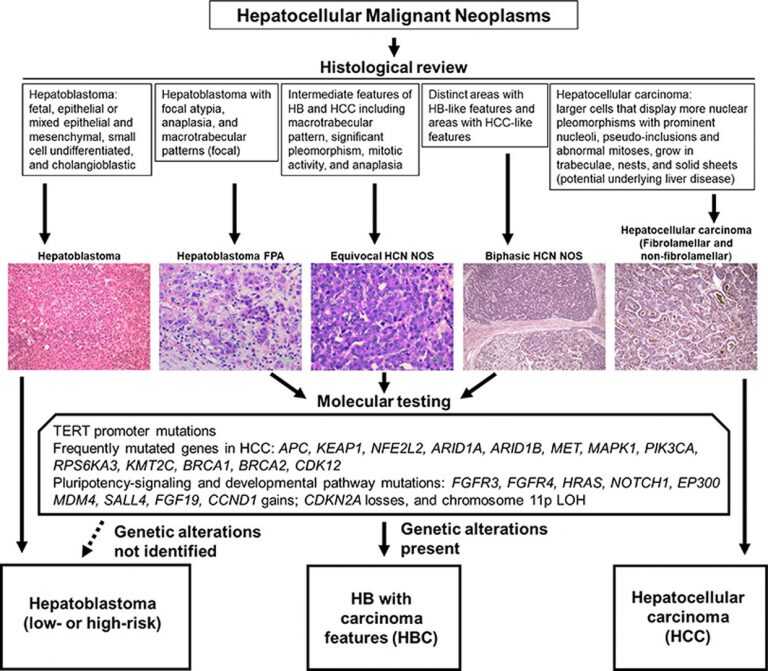
    Hepatocellular Malignant Neoplasms Testing Graphic
    Graphical abstract of the work. Credit: Image courtesy of the authors/Journal of Hepatology, 2022.

    The scientists examined the tumors’ molecular profiles, which included their gene expression and genetic makeup. The researchers discovered that these molecular profiles do not fall within the hepatoblastoma (HB) or hepatocellular carcinoma (HCC) classifications. These tumors, however, had recurrent molecular characteristics that have been reported in both HBs and HCCs. These tumors were classified as hepatoblastomas with hepatocellular carcinoma features (HBCs). The scientists’ research was published in the Journal of Hepatology.

    The team also examined HBC treatments and outcomes and found that they tended to be more resistant to standard chemotherapy and have poor outcomes when not treated with more aggressive surgical approaches, including transplantation. Based on their findings, the team proposed a diagnostic algorithm to stratify HBCs and guide specialized treatment.

    “Our findings highlight the importance of molecular testing to accurately classify these tumors to optimize treatment recommendations at the time of initial diagnosis,” said Dr. Dolores López-Terrada, corresponding author of the paper, professor of pathology, immunology, and pediatrics at Baylor and chief of the division of genomic medicine at Texas Children’s. “Our analysis suggested that children with HBCs may benefit from treatment strategies that differ from the guidelines for patients with hepatoblastoma and hepatocellular carcinoma.”

    The study was funded by the Cancer Prevention and Research Institute of Texas (RP180674), the European Union’s Horizon 2020 (826121), the Schindler Foundation, and the National Cancer Institute (R21CA223140).

    Reference: “Hepatoblastomas with carcinoma features represent a biological spectrum of aggressive neoplasms in children and young adults” by Pavel Sumazin and Tricia L. Peters, Stephen F. Sarabia, Hyunjae R. Kim, Martin Urbicain, Emporia Faith Hollingsworth, Karla R. Alvarez, Cintia R. Perez, Alice Pozza, Mohammad Javad Najaf Panah, Jessica L. Epps, Kathy Scorsone, Barry Zorman, Howard Katzenstein, Allison F. O’Neill, Rebecka Meyers, Greg Tiao, Jim Geller, Sarangarajan Ranganathan, Arun A. Rangaswami, Sarah E. Woodfield, John A. Goss, Sanjeev A. Vasudevan, Andras Heczey, Angshumoy Roy, Kevin E. Fisher, Rita Alaggio, Kalyani R. Patel, Milton J. Finegold, Dolores H. López-Terrada, 13 May 2022, Journal of Hepatology.
    DOI: 10.1016/j.jhep.2022.04.035

    Never miss a breakthrough: Join the SciTechDaily newsletter.
    Follow us on Google and Google News.

    Baylor College of Medicine Cancer Pediatrics Popular Tumor
    Share. Facebook Twitter Pinterest LinkedIn Email Reddit

    Related Articles

    Most Effective Treatment Yet: New Radioactive Tumor Implant Obliterates Pancreatic Cancer

    Cancer Weakness Discovered: New Method Pushes Cancer Cells Into Remission

    Mayo Clinic Researchers Reveal Critical New Insight Into Cancer

    A Stanford-Developed Device May Open Up Promising New Possibilities for the Treatment of Cancer

    Groundbreaking Method “Starves” Highly-Lethal Cancer Tumors of Energy, Eradicating Them

    Researchers Discover a Key Weak Spot in a Deadly Childhood Cancer

    New “Masked” Cancer Drug Kills Cancer Cells With Minimal Side Effects

    Scientists Have Created Worms That Can Kill Cancer Cells

    Mysterious Circular DNA Causes Cancer in Children – Surprising New Insights Into Cancer Genetics

    Leave A Reply Cancel Reply

    • Facebook
    • Twitter
    • Pinterest
    • YouTube

    Don't Miss a Discovery

    Subscribe for the Latest in Science & Tech!

    Trending News

    Bees Have a Hidden Nutritional Superpower, Oxford Study Reveals

    A Century-Old Belief About Diamond Has Just Been Overturned

    The Universe Can Expand Faster Than Light Without Breaking Physics

    The Exercise Paradox: Why Workouts Don’t Guarantee Weight Loss

    This Ancient Sea Animal Fights Viruses in the Opposite Way Humans Do

    39 Sweeteners Put to the Test Produced Surprising Gut Changes

    This Experimental Drug Repaired the Gut and Reversed Severe Fatty Liver Disease

    Physicists Just Turned a Black Hole Energy Theory Into Reality

    Follow SciTechDaily
    • Facebook
    • Twitter
    • YouTube
    • Pinterest
    • Newsletter
    • RSS
    SciTech News
    • Biology News
    • Chemistry News
    • Earth News
    • Health News
    • Physics News
    • Science News
    • Space News
    • Technology News
    Recent Posts
    • A Powerful Cosmic Accelerator Has Been Confirmed in the Milky Way
    • These Nearby Alien Planets Are Stranger – and More Hostile – Than Expected
    • Black Hole Collisions May Follow a Surprisingly Simple Rule
    • Could Young Stem Cells Be the Key to Healthier Aging?
    • Feeling Lonely May Take a Bigger Toll on Health Than Expected
    Copyright © 1998 - 2026 SciTechDaily. All Rights Reserved.
    • Science News
    • About
    • Contact
    • Editorial Board
    • Privacy Policy
    • Terms of Use

    Type above and press Enter to search. Press Esc to cancel.