
Close Menu
    Facebook X (Twitter) Instagram
    SciTechDaily
    • Biology
    • Chemistry
    • Earth
    • Health
    • Physics
    • Science
    • Space
    • Technology
    Facebook X (Twitter) Pinterest YouTube RSS
    SciTechDaily
    Home»Biology»Researchers Develop New Method to Identify Splicing-Based Biomarkers for Liver Cancer
    Biology

    Researchers Develop New Method to Identify Splicing-Based Biomarkers for Liver Cancer

    By Peter Tarr, Cold Spring Harbor LaboratoryMarch 2, 20181 Comment4 Mins Read
    Facebook Twitter Pinterest Telegram LinkedIn WhatsApp Email Reddit
    Share
    Facebook Twitter LinkedIn Pinterest Telegram Email Reddit
    Researchers Develop a Method for Identifying Splicing-Based Biomarkers for Liver Cancer
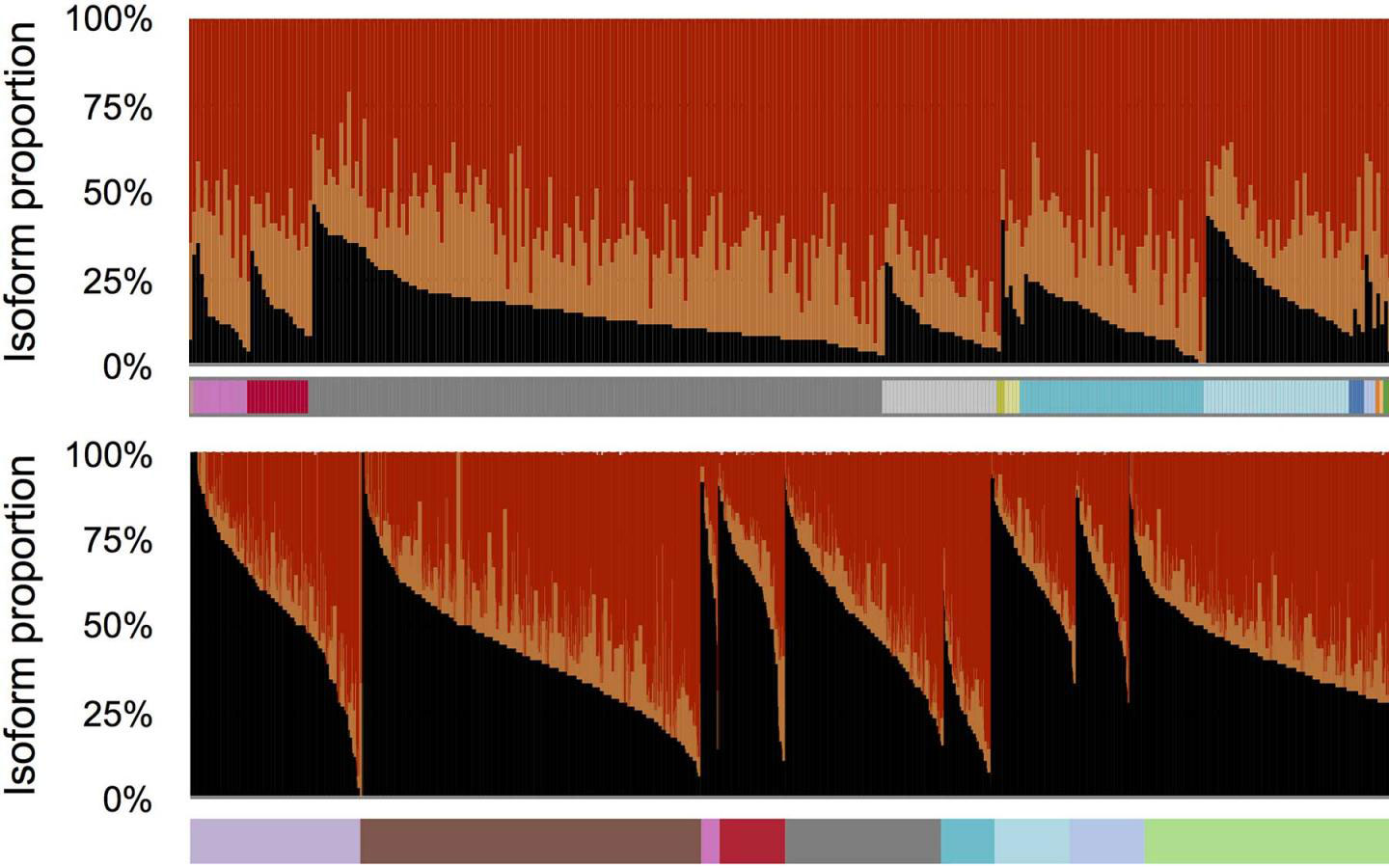
    Different versions, or isoforms, of messenger RNAs generated by the human AFMID gene, are represented, showing their relative prevalence in cancerous (top) and non-cancerous tissue (bottom), sampled from throughout the body. Black peaks, representing the normal variant found in adult cells, are much lower in cancerous tissue than in normal tissue. The reverse is true of variants color-coded orange and red, which serve as biomarkers in liver cancer. Credit: Krainer Lab, CSHL

    Because liver cancer is particularly diverse, genetically, and prone to relapse, identifying biomarkers that can predict disease progression is a critical goal in the fight against it.

    Researchers at Cold Spring Harbor Laboratory (CSHL), led by CSHL Professor Adrian Krainer, now report in Genome Research that they have developed a method for identifying splicing-based biomarkers for the most common form of liver cancer, hepatocellular carcinoma (HCC). They believe the method will be useful in other cancer types as well.

    “This study underscores the potential for learning how RNA splicing variants can contribute to cancer and points to these variants as potential biomarkers for cancer progression,” Krainer says.

    Splicing refers to a process in which an RNA message copied from information encoded in a gene is edited before it is able to serve as a blueprint for the manufacture of a specific protein. A gene can give rise to multiple RNA messages, each resulting in a different protein variant, or “isoform.” Many diseases have been associated with errors or variations in the way that RNA is spliced. Errors or variations in splicing can lead to non-functional proteins or proteins with distinct or aberrant functions.

    Researchers Develop a Method for Identifying Splicing-Based Biomarkers for Liver Cancer
    A gene can give rise to multiple RNA messages, each resulting in a different variant, or isoform. Here are the 4 messenger RNA isoforms generated by the human AFMID gene. From top: two isoforms normally found in adult cells. Lower two variants are missing some of the 11 segments, called exons, in the main isoform; these give rise to truncated proteins associated with liver cancer. Credit: Krainer Lab, CSHL

    Recent studies have identified splicing irregularities in liver cancer cells. Led by CSHL postdoctoral researcher Kuan-Ting Lin, Krainer’s team developed a method that comprehensively analyzes all RNA messages made from a given gene. The team tested their splicing-variant detection method in HCC, by analyzing RNA messages in HCC cells sampled from hundreds of patients.

    They found that particular splicing isoforms of the gene AFMID correlated with very poor patient survival. These variants lead cells to manufacture truncated versions of the AFMID protein. These unusual versions of the protein are associated in adult liver cancer cells with mutations in tumor-suppressor genes called TP53 and ARID1A.

    These mutations, the researchers hypothesize, are associated with low levels of a molecule called NAD+ that is involved in repairing damaged DNA. Restoring missing portions, called exons, to AFMID’s normal RNA message, they propose, might raise NAD+ to normal levels, avoiding mutations in TP53 and ARID1A. The team hopes to use small molecules called ASOs (antisense oligonucleotides) that can bind to RNA, to change the way AFMID’s RNA messages are spliced. Krainer’s team previously used this technique to correct errors in the splicing of the gene SMN2 as a way to treat spinal muscular atrophy (SMA).

    Fixing AFMID splicing could lead to enhanced production of NAD+ and an increase in DNA repair. “If we can do this, AFMID splicing can become a therapeutic target and the source of a new drug for liver cancer,” Lin says. Preliminary experiments suggest the team is on the right track. They demonstrated that coaxing cells to over-express AFMID spliced in the normal manner led to higher NAD+ levels and slower growth of liver cancer cells.

    Reference: “A human-specific switch of alternatively spliced AFMID isoforms contributes to TP53 mutations and tumor recurrence in hepatocellular carcinoma” by Kuan-Ting Lin, Wai Kit Ma, Juergen Scharner, Yun-Ru Liu and Adrian R. Krainer, 24 January 2018, Genome Research.
    DOI: 10.1101/gr.227181.117

    Never miss a breakthrough: Join the SciTechDaily newsletter.
    Follow us on Google and Google News.

    Biomarkers Cancer Cold Spring Harbor Laboratory Genome Medicine
    Share. Facebook Twitter Pinterest LinkedIn Email Reddit

    Related Articles

    Highly Recurrent Mutations Discovered in “Dark Matter” of the Cancer Genome

    Magnets Used to Eradicate Cancer Cells

    Genomic Analysis of Colon Cancer Reveals New Potential Drug Targets

    Cdt1 Protein Has a Role in DNA Replication and Mitosis

    New Drug CD47 Could Potentially Shrink and Cure All Tumors

    Researchers Use Bioinformatics and Epigenetics to Aid Cancer Research

    Zelboraf Nearly Doubles Median Survival Time for Patients with Metastatic Melanoma

    Cancer-Causing Mutations Disrupt Cells’ Ability to Differentiate

    Researchers Use Body’s Immune System to Fight Cancer

    1 Comment

    1. elizabeth on March 12, 2018 11:59 pm

      thank you so much for the sharing its nice to know about the new technology to cure cancer

      Reply
    Leave A Reply Cancel Reply

    • Facebook
    • Twitter
    • Pinterest
    • YouTube

    Don't Miss a Discovery

    Subscribe for the Latest in Science & Tech!

    Trending News

    Mezcal “Worm” in a Bottle Mystery: DNA Testing Reveals a Surprise

    New Research Reveals That Your Morning Coffee Activates an Ancient Longevity Switch

    This Is What Makes You Irresistible to Mosquitoes

    Shockingly Powerful Giant Octopuses Ruled the Seas 100 Million Years Ago

    Scientists Stunned by New Organic Molecules Found on Mars

    Rewriting Dinosaur Evolution: Scientists Unearth Remarkable 150-Million-Year-Old Stegosaur Skull

    Omega-3 Supplements Linked to Cognitive Decline in Surprising New Study

    First-of-Its-Kind Discovery: Homer’s Iliad Found Embedded in a 1,600-Year-Old Egyptian Mummy

    Follow SciTechDaily
    • Facebook
    • Twitter
    • YouTube
    • Pinterest
    • Newsletter
    • RSS
    SciTech News
    • Biology News
    • Chemistry News
    • Earth News
    • Health News
    • Physics News
    • Science News
    • Space News
    • Technology News
    Recent Posts
    • These Simple Daily Habits Can Quickly Improve Blood Pressure and Heart Risk Factors
    • A Common Nutrient May Play a Surprising Role in Anxiety
    • Doing This After 9 p.m. Could Double Your Risk of Gut Issues
    • New Research Challenges Long-Held Beliefs About How the Brain Makes Decisions
    • Breakthrough Technology Reveals New Treatment Targets for Cancer
    Copyright © 1998 - 2026 SciTechDaily. All Rights Reserved.
    • Science News
    • About
    • Contact
    • Editorial Board
    • Privacy Policy
    • Terms of Use

    Type above and press Enter to search. Press Esc to cancel.