
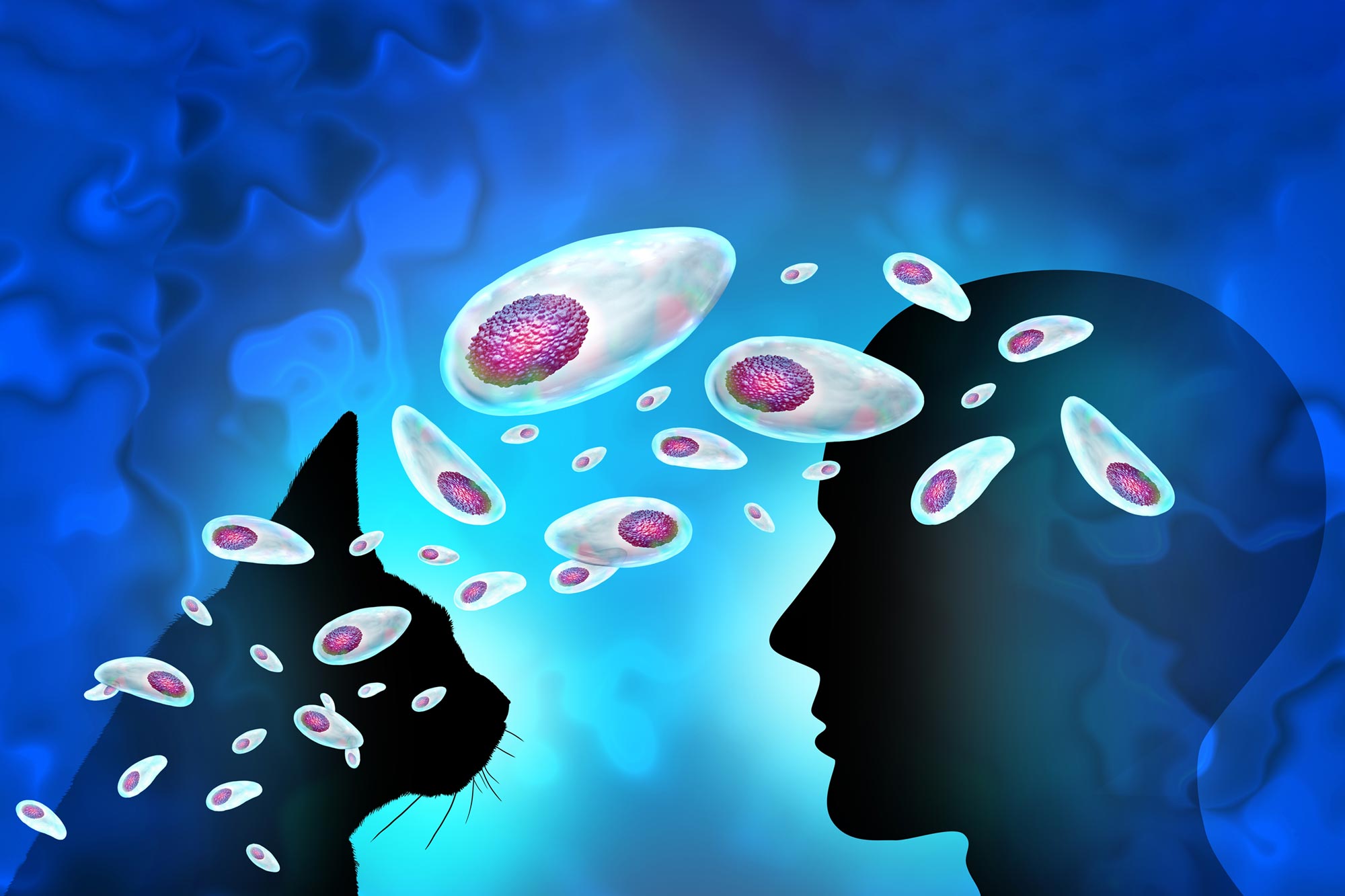
A common parasite hiding in the brain turns out to be far more active and organized than anyone realized.
A team of scientists at the University of California, Riverside, has discovered that Toxoplasma gondii, a parasite estimated to infect up to one-third of the world’s population, is far more biologically complex than previously understood. Their findings, published in Nature Communications, provide new insight into how the parasite causes disease and why it has proven so difficult to eliminate with current treatments.
How Toxoplasmosis Spreads in Humans
People typically become infected with toxoplasmosis by eating undercooked meat or through contact with contaminated soil or cat feces. Once inside the body, the parasite is known for its ability to evade the immune system by forming tiny cysts, most often in the brain and muscle tissue.
In most infected individuals, the parasite causes no noticeable symptoms. Even so, it remains in the body for life inside these cysts, which can hold hundreds of parasites. Under certain conditions, especially when the immune system is weakened, the parasites can become active again and may cause serious damage to the brain or eyes. Infection during pregnancy carries additional risks, as it can lead to severe complications in developing babies whose immune systems are not fully formed.
Rethinking What Happens Inside Parasite Cysts
For many years, scientists believed that each cyst contained a single, uniform type of parasite that stayed dormant until reactivation. Using advanced single-cell analysis methods, the UC Riverside researchers found that this long-held assumption was incorrect. Their work shows that each cyst contains multiple distinct parasite subtypes, each with its own biological role.
“We found the cyst is not just a quiet hiding place — it’s an active hub with different parasite types geared toward survival, spread, or reactivation,” said Emma Wilson, a professor of biomedical sciences in the UCR School of Medicine and the study’s lead author.
The Structure and Location of Toxoplasma Cysts
Wilson explained that cysts develop gradually as the parasite responds to pressure from the immune system. Each cyst is enclosed by a protective wall and contains hundreds of slow-growing parasites known as bradyzoites. While cysts are microscopic, they are relatively large compared to other intracellular pathogens, reaching up to 80 microns in diameter. Individual bradyzoites measure about five microns in length.
These cysts are most commonly found inside neurons, but they also frequently appear in skeletal and cardiac muscle. This is especially significant because humans are often infected by eating undercooked meat that contains these cysts.
Why Cysts Drive Disease and Persistence
According to Wilson, cysts play a critical role in both disease and transmission. Once established, they resist all existing therapies and remain in the body indefinitely. They also help the parasite spread between hosts.
When cysts reactivate, bradyzoites transform into fast-growing tachyzoites that spread throughout the body. This process can cause severe illnesses such as toxoplasmic encephalitis (neurological damage) or retinal toxoplasmosis (vision loss).
Challenging a Simplified Life Cycle Model
“For decades, the Toxoplasma life cycle was understood in overly simplistic terms, conceptualized as a linear transition between tachyzoite and bradyzoite stages,” Wilson said. “Our research challenges that model. By applying single-cell RNA sequencing to parasites isolated directly from cysts in vivo, we found unexpected complexity within the cyst itself. Rather than a uniform population, cysts contain at least five distinct subtypes of bradyzoites. Although all are classified as bradyzoites, they are functionally different, with specific subsets primed for reactivation and disease.”
Overcoming Longstanding Research Challenges
Wilson noted that cysts have been difficult to study for decades. They grow slowly, are buried deep within tissues such as the brain, and do not form efficiently in standard laboratory cultures. Because of these challenges, most genetic and molecular research on Toxoplasma has focused on tachyzoites grown in vitro, leaving cyst-dwelling bradyzoites poorly understood.
“Our work overcomes those limitations by using a mouse model that closely mirrors natural infection,” Wilson said. “Because mice are a natural intermediate host for Toxoplasma, their brains can harbor thousands of cysts. By isolating these cysts, digesting them enzymatically, and analyzing individual parasites, we were able to gain a view of chronic infection as it occurs in living tissue.”
What the Findings Mean for Future Treatments
Wilson explained that current treatments can control the rapidly replicating form of the parasite responsible for acute illness, but no available drugs can eliminate cysts.
“By identifying different parasite subtypes inside cysts, our study pinpoints which ones are most likely to reactivate and cause damage,” she said. “This helps explain why past drug development efforts have struggled and suggests new, more precise targets for future therapies.”
Ongoing Risks and a Shift in Scientific Focus
Congenital toxoplasmosis remains a serious concern when infection first occurs during pregnancy, as it can lead to severe outcomes for the fetus. While prior immunity usually protects the developing baby, routine screening is not available in some countries, highlighting the challenges of managing an infection that is widespread but often symptom-free.
Despite its prevalence, toxoplasmosis has received far less attention than many other infectious diseases. Wilson hopes the new findings will help change that.
“Our work changes how we think about the Toxoplasma cyst,” she said. “It reframes the cyst as the central control point of the parasite’s life cycle. It shows us where to aim new treatments. If we want to really treat toxoplasmosis, the cyst is the place to focus.”
Reference: “Bradyzoite subtypes rule the crossroads of Toxoplasma development” by Arzu Ulu, Sandeep Srivastava, Nala Kachour, Brandon H. Le, Michael W. White and Emma H. Wilson, 24 January 2026, Nature Communications.
DOI: 10.1038/s41467-026-68489-y
Wilson conducted the study alongside Arzu Ulu, Sandeep Srivastava, Nala Kachour, Brandon H. Le, and Michael W. White. Wilson and White are co-corresponding authors of the paper.
The research was supported by grants from the National Institute of Allergy and Infectious Diseases of the National Institutes of Health.
Never miss a breakthrough: Join the SciTechDaily newsletter.
Follow us on Google and Google News.
1 Comment
Essential study. Hope it will help to find treatment for the cysts.