
Close Menu
    Facebook X (Twitter) Instagram
    SciTechDaily
    • Biology
    • Chemistry
    • Earth
    • Health
    • Physics
    • Science
    • Space
    • Technology
    Facebook X (Twitter) Pinterest YouTube RSS
    SciTechDaily
    Home»Space»A Portal to the Past: Hubble Reveals an Ancient Witness to a Galactic Merger
    Space

    A Portal to the Past: Hubble Reveals an Ancient Witness to a Galactic Merger

    By ESA/HubbleJune 10, 2024No Comments3 Mins Read
    Facebook Twitter Pinterest Telegram LinkedIn WhatsApp Email Reddit
    Share
    Facebook Twitter LinkedIn Pinterest Telegram Email Reddit
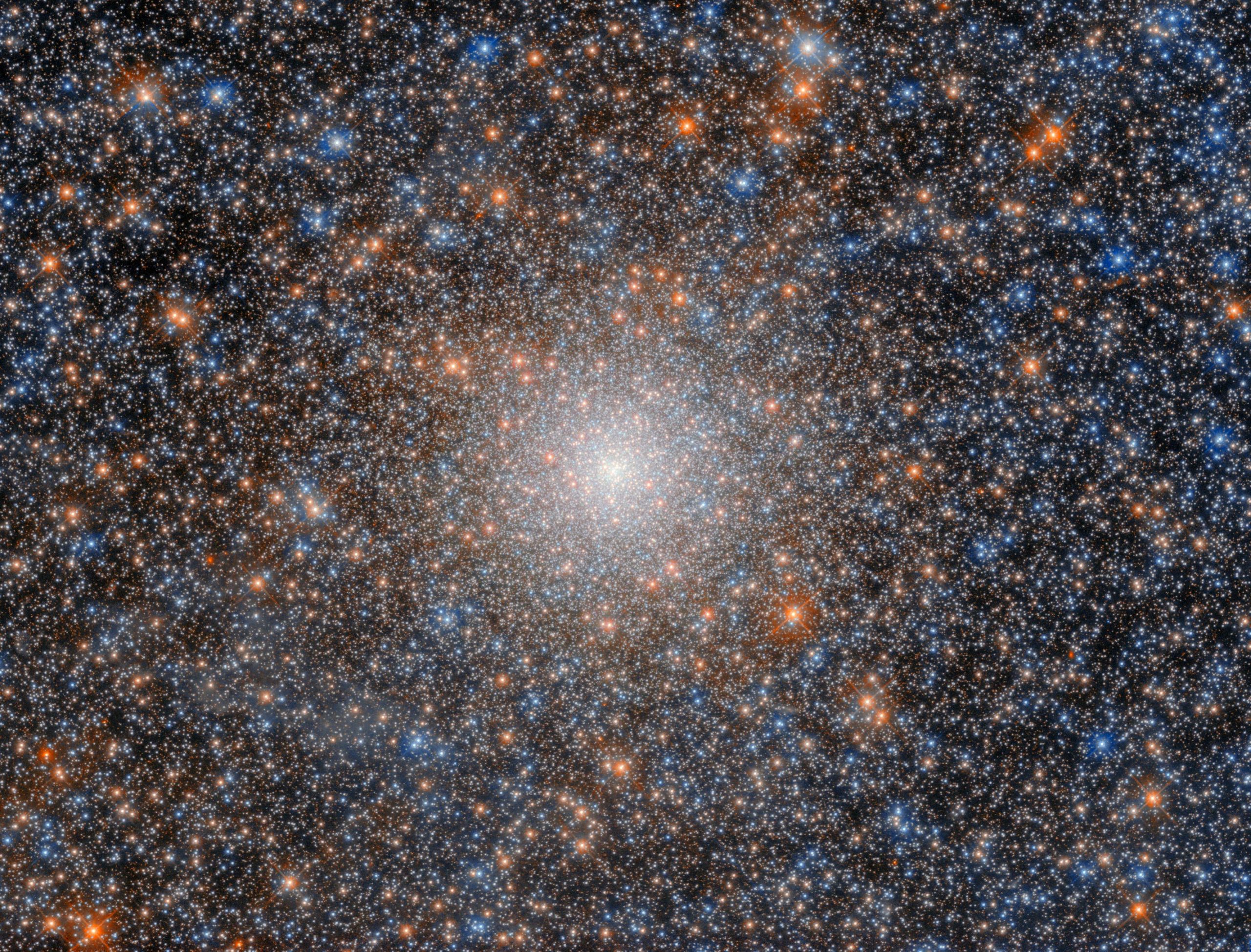
    Globular Cluster NGC 2005
    This Hubble Space Telescope image features the globular cluster NGC 2005. It is located about 750 light-years from the Large Magellanic Cloud’s center, and about 162,000 light-years from Earth. This cluster is an example of ancient cosmic structures, holding potentially millions of old stars that offer insights similar to fossils on Earth, revealing characteristics of ancient stars. Credit: ESA/Hubble & NASA, F. Niederhofer, L. Girardi

    NGC 2005, a globular cluster in the Large Magellanic Cloud, serves as a crucial piece of evidence supporting the theory of galaxies evolving through mergers.

    This mesmerizing image from the Hubble Space Telescope features the globular cluster NGC 2005. While it is not unusual in and of itself, it is a peculiarity in relation to its surroundings.

    NGC 2005 is located about 750 light-years from the heart of the Large Magellanic Cloud (LMC), which is the Milky Way’s largest satellite galaxy and which itself lies about 162,000 light-years from Earth. Globular clusters are densely packed clusters that can constitute tens of thousands or millions of stars. Their density means that they are tightly gravitationally bound and are therefore very stable. This stability contributes to their longevity: globular clusters can be billions of years old, and as such often comprise very old stars.

    Therefore, studying globular clusters in space can be a little like studying fossils on Earth: where fossils give insights into the characteristics of ancient plants and animals, globular clusters illuminate the characteristics of ancient stars.

    Current theories of galaxy evolution predict that galaxies merge with one another. It is widely thought that the relatively large galaxies that we observe in the modern Universe were formed via the merging of smaller galaxies. If this is correct, then astronomers would expect to see evidence that the most ancient stars in nearby galaxies originated in different galactic environments. As globular clusters are known to contain ancient stars, and because of their stability, they are an excellent laboratory to test this hypothesis.

    NGC 2005 is such a globular cluster, and its very existence has provided evidence to support the theory of galaxy evolution via mergers. Indeed, the stars in NGC 2005 have a chemical composition that is distinct from the stars in the LMC around it. This suggests that the LMC underwent a merger with another galaxy somewhere in its history. That other galaxy has long since merged and otherwise dispersed, but NGC 2005 remains behind as an ancient witness to the long-past merger.

    Never miss a breakthrough: Join the SciTechDaily newsletter.
    Follow us on Google and Google News.

    Astronomy European Space Agency Hubble Space Telescope
    Share. Facebook Twitter Pinterest LinkedIn Email Reddit

    Related Articles

    A Diamond Necklace of Cosmic Proportions

    Hubble Snaps a Stunning Close-Up of a Magnificent Spiral Galaxy

    Extraordinary Hubble Image: Light Bends From the Beyond

    Hubble Space Telescope Sees Volcanic Activity Reforming the Atmosphere on a Rocky Exoplanet

    Hubble Spies a Luminous Heart With Dark Tendrils

    Spectacular Return to the Veil Nebula

    Hubble Spots a Peculiar Sight: Unusual Spiral Galaxy With a Heavy Arm

    A Flash of Life: Hubble Spies an Unusual Planetary Nebula

    Through the Cosmic Clouds: Hubble Spots a Beautiful Stellar Nursery

    Leave A Reply Cancel Reply

    • Facebook
    • Twitter
    • Pinterest
    • YouTube

    Don't Miss a Discovery

    Subscribe for the Latest in Science & Tech!

    Trending News

    Your Blood Pressure Reading Could Be Wrong Because of One Simple Mistake

    Astronomers Stunned by Ancient Galaxy With No Spin

    Physicists May Be on the Verge of Discovering “New Physics” at CERN

    Scientists Solve 320-Million-Year Mystery of Reptile Skin Armor

    Scientists Say This Daily Walking Habit May Be the Secret to Keeping Weight Off After Dieting

    New Therapy Rewires the Brain To Restore Joy in Depression Patients

    Giant Squid Detected off Western Australia in Stunning Deep-Sea Discovery

    Popular Sugar-Free Sweetener Linked to Liver Disease, Study Warns

    Follow SciTechDaily
    • Facebook
    • Twitter
    • YouTube
    • Pinterest
    • Newsletter
    • RSS
    SciTech News
    • Biology News
    • Chemistry News
    • Earth News
    • Health News
    • Physics News
    • Science News
    • Space News
    • Technology News
    Recent Posts
    • Hidden Warm Water Beneath Antarctica Could Rapidly Raise Global Sea Levels
    • Scientists Revive Ancient Chemistry Trick To Engineer Next-Generation Glass
    • Scientists Use AI To Supercharge Ultrafast Laser Simulations by More Than 250x
    • Scientists Just Found a Surprising Way To Destroy “Forever Chemicals”
    • Popular Supplement Ingredient Linked to Shorter Lifespan in Men
    Copyright © 1998 - 2026 SciTechDaily. All Rights Reserved.
    • Science News
    • About
    • Contact
    • Editorial Board
    • Privacy Policy
    • Terms of Use

    Type above and press Enter to search. Press Esc to cancel.