
Close Menu
    Facebook X (Twitter) Instagram
    SciTechDaily
    • Biology
    • Chemistry
    • Earth
    • Health
    • Physics
    • Science
    • Space
    • Technology
    Facebook X (Twitter) Pinterest YouTube RSS
    SciTechDaily
    Home»Space»A Ring of Fire Sunrise Solar Eclipse
    Space

    A Ring of Fire Sunrise Solar Eclipse

    By NASAJune 9, 2021No Comments2 Mins Read
    Facebook Twitter Pinterest Telegram LinkedIn WhatsApp Email Reddit
    Share
    Facebook Twitter LinkedIn Pinterest Telegram Email Reddit
    A Ring of Fire Sunrise Solar Eclipse
    A ring of fire sunrise solar eclipse

    On Thursday, June 10, 2021, people across the northern hemisphere will have the chance to experience an annular or partial eclipse of the Sun. Learn more about that here, where you will find visualizations, maps, and information on viewing the “ring of fire” solar eclipse.

    The video below, which features a ring of fire solar eclipse from 2013, provides some stunning clips of what it may look like depending on your location.

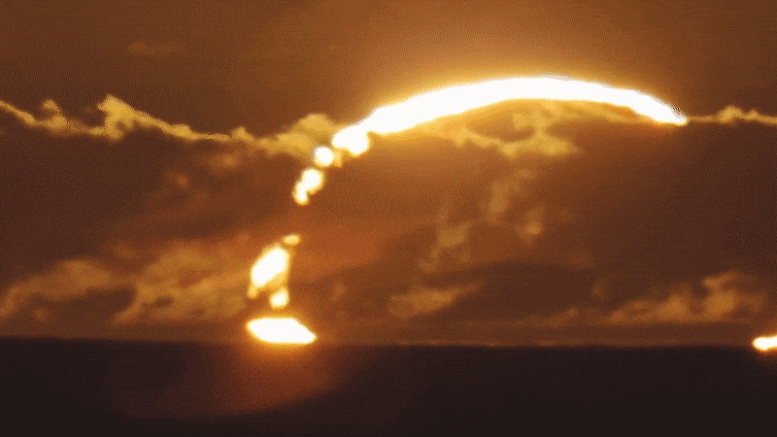
    What’s rising above the horizon behind those clouds? It’s the Sun. Most sunrises don’t look like this, though, because most sunrises don’t include the Moon.

    In the early morning of May 10, 2013, however, from Western Australia, the Moon was between the Earth and the rising Sun.

    At times, it would be hard for the uninformed to understand what was happening. In an annular eclipse, the Moon is too far from the Earth to block the entire Sun, and at most leaves a ring of fire where sunlight pours out around every edge of the Moon.

    The featured time-lapse video also recorded the eclipse through the high refraction of the Earth’s atmosphere just above the horizon, making the unusual rising Sun and Moon appear also flattened. As the video continues on, the Sun continues to rise, and the Sun and Moon begin to separate.

    Tomorrow, June 10, a new annular solar eclipse will occur, visible from parts of Canada, Greenland, and northern Russia. Viewers in parts of the eastern United States and northern Alaska will see a partial solar eclipse, along with much of Canada and parts of the Caribbean, Europe, Asia, and northern Africa.

    In the United States, the partial eclipse will be visible along parts of the Southeast, Northeast, Midwest, and in Northern Alaska. In many of these locations, the eclipse will occur before, during, and shortly after sunrise. This means that viewers will need to get a clear view of the horizon during sunrise in order to see the eclipse.

    Never miss a breakthrough: Join the SciTechDaily newsletter.
    Follow us on Google and Google News.

    Astronomy NASA Popular Solar Eclipse
    Share. Facebook Twitter Pinterest LinkedIn Email Reddit

    Related Articles

    Don’t Miss: Total Solar Eclipse, Mars and Saturn Rising, Slim Lunar Crescent, Comet 12P

    2024 Total Solar Eclipse: Broader Path, Longer Totality, and Increased Solar Activity

    Don’t Miss: A “Ring of Fire” in the Sky

    NASA Science in the Shadows: Five Exciting Experiments for 2024 Total Solar Eclipse

    Don’t Miss: April 2022 Solar Eclipse

    NASA’s ACE Mission: Total Solar Eclipses Shine a Light on the Solar Wind

    Don’t Miss the Breathtaking “Ring of Fire” Solar Eclipse

    Recently Discovered Comet Seen Flying Past the Sun During Total Solar Eclipse

    Moon Mountains Magnified During Ring of Fire Eclipse

    Leave A Reply Cancel Reply

    • Facebook
    • Twitter
    • Pinterest
    • YouTube

    Don't Miss a Discovery

    Subscribe for the Latest in Science & Tech!

    Trending News

    Scientists May Have Discovered How To Heal Damaged Kidneys

    Interstellar Visitor 3I/ATLAS Is Bursting With an Unexpected Chemical

    Scientists Just Found All 5 Genetic “Letters” of DNA and RNA on an Asteroid

    The 4,000-Year-Old City That Defied History’s Rules on Wealth and Power

    The World’s Biggest Population Fear Has Flipped – and It Could Change Everything

    This “Fake” Pill Improved Memory and Physical Performance in Just 3 Weeks

    Scientists Say Frequent Ejaculation May Improve Sperm Quality and Fertility

    Scientists Have Found “The Heaven Sword” After Years of Looking

    Follow SciTechDaily
    • Facebook
    • Twitter
    • YouTube
    • Pinterest
    • Newsletter
    • RSS
    SciTech News
    • Biology News
    • Chemistry News
    • Earth News
    • Health News
    • Physics News
    • Science News
    • Space News
    • Technology News
    Recent Posts
    • Science Debunks a Common Belief About Pets and Stress
    • The Surprising Reason Sugary Gum Helped Lower Blood Pressure
    • Hidden Virus May Have Infected 9.4 Million People – Scientists Say We’ve Missed Most Cases
    • NASA’s Lucy Uncovers Ancient Water Clues on a Weirdly Wobbling Asteroid
    • Could This Visitor From Another Star System Be Alien Technology? SETI Investigates
    Copyright © 1998 - 2026 SciTechDaily. All Rights Reserved.
    • Science News
    • About
    • Contact
    • Editorial Board
    • Privacy Policy
    • Terms of Use

    Type above and press Enter to search. Press Esc to cancel.