
Genomic Research Could Bolster Conservation Initiatives Aimed at Protecting the Endangered Species
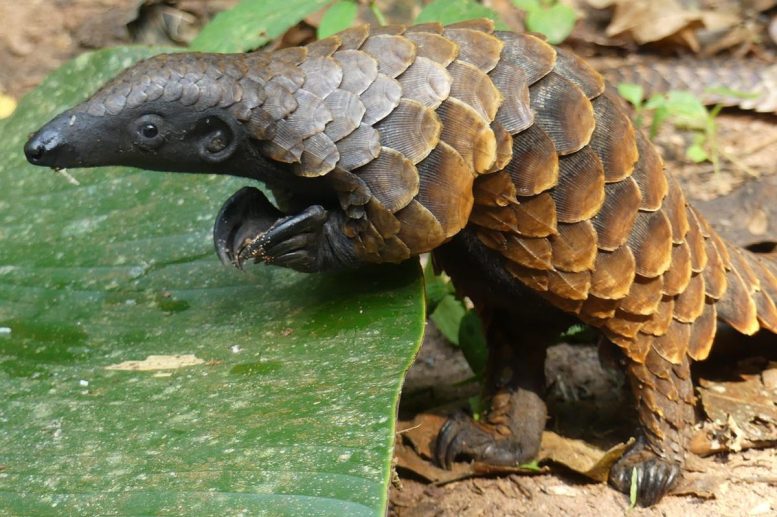
Scientists still have much to uncover about the unique, scaly mammal known as the pangolin, a creature that bears resemblance to an aardvark and an armadillo. A recent study, published in the journal Chromosome Research, reveals what UCLA researcher Jen Tinsman calls a “scientific surprise” that underscores how unusual the animal is..
The research team uncovered that the female white-bellied pangolin possesses 114 chromosomes, a count surpassed only by the Bolivian bamboo rat’s 118, significantly exceeding the human count of 46. The chromosome counts of other pangolin species align more with typical mammalian ranges, fluctuating between 36 to 42.
The scientists also identified another genetic quirk. Male white-bellied pangolins have a different number of chromosomes, 113, than their female counterparts; in most species, males and females have the same number.
“There’s nothing else like them on the planet; they’re in their own order, their own family,” said Tinsman, a UCLA research fellow, and co-author of the study, adding that pangolins’ closest relatives include cats and rhinoceroses.
Tinsman collaborated on the study with colleagues from UCLA and several other universities around the world, as well as zoos and research organizations. The research was undertaken to produce information about the pangolin’s genome in order to support conservation efforts — all four species of the pangolin are endangered.
One reason little is known about pangolins is that they are notoriously difficult to study. They fare poorly in captivity; only a few zoos have managed to house them successfully. In the wild, they are hard to locate, and the technology scientists use to monitor other species often fails when it comes to pangolins — the animals sometimes use trees to rub radio tags from their scales.
Adaptations and Behavior of Pangolins
What researchers do know about the animals is that they dig and use their long tongues to eat ants, termites, and other insects. Some species, including the white-bellied variety, live in trees, hanging from trunks and branches. Others live in burrows. When threatened, pangolins curl into a ball. (Lions have been known to bat them around, unsure what else to do with them.)
The white-bellied species is relatively small, weighing in at three or four pounds (1.4 or 1.8 kilograms) and measuring less than a foot long (30 centimeters), while some ground pangolins grow to 80 or 90 pounds (36 or 41 kilograms), about the size of a large dog.
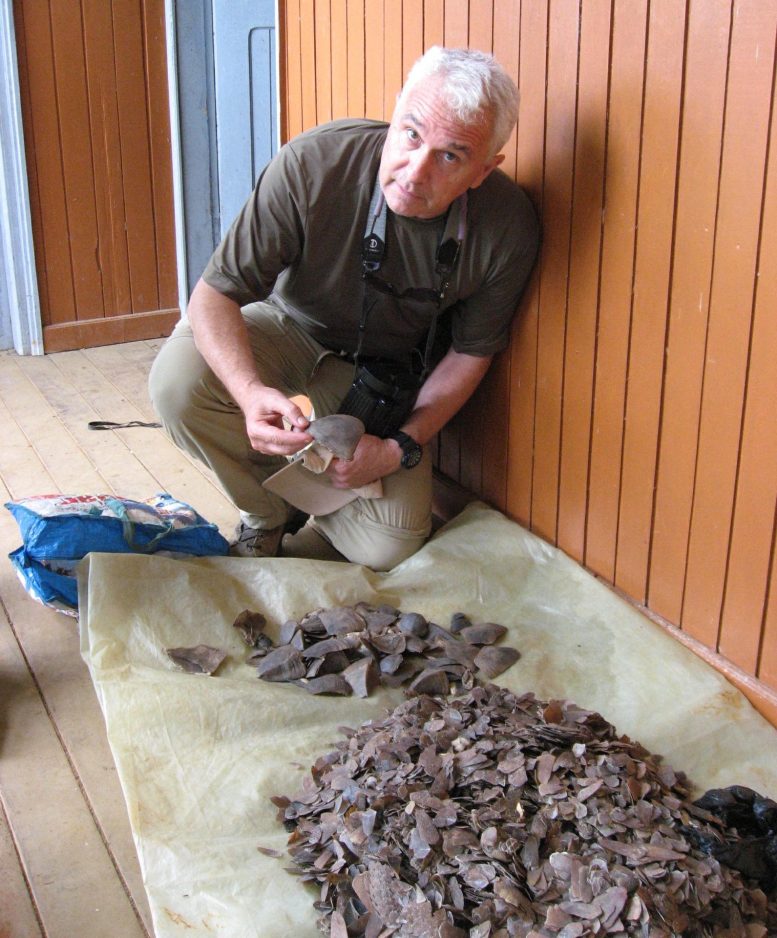
Aside from its scientific value, the research created a valuable genetic resource to support conservation efforts, especially attempts to control poaching, which is the primary reason the animals are endangered. Pangolins’ scales are sold illegally on international markets for use in traditional medicine from Nigeria to China. They’re also hunted as a food source — locally as bush meat, for which they sell for the equivalent of about $10 each, or for exotic meals in distant regions, for which they can fetch over $1,000 on international markets.
“I’ve seen pangolin scales trafficked alongside guns, fake IDs, and drugs,” Tinsman said. “The problem extends all the way up to major international crime syndicates.”
Using genomics could help identify which species of pangolin are the sources of products derived from the animals. And the information could help conservationists and researchers understand differences within a species whose habitats cover 6 million square kilometers (2.3 million square miles) and 23 countries.
“Understanding chromosomes and the structure of genes is important for conservation,” said Ryan Harrigan, an adjunct professor at the UCLA Center for Tropical Research and a co-author of the paper. “It can determine how we manage populations — if you found big genetic differences between two groups, you might manage them differently.”
Combining Science and Conservation
“This paper is a great example of how a study focused on saving a critically endangered species can also advance fundamental science,” said UCLA evolutionary biologist Tom Smith, a co-author of the study.
And vice versa. With conservation methods and technologies developing rapidly, research findings are increasingly likely to yield practical applications in the months and years following their discovery.
In this case, the new findings could be especially valuable as technologies like artificial intelligence and emerging conservation methods like environmental DNA, or eDNA, are developed and refined.
The study also supports a broader effort to track and map pangolin poaching by the Congo Basin Institute, a joint initiative of UCLA and the International Institute of Tropical Agriculture. The institute, of which Smith is a co-director, is based in Yaoundé, Cameroon, and includes two rainforest field stations.
“It’s this delightful creature that we’re hunting to extinction, which just makes me really sad,” said Smith, who said similar genomic research is planned to conserve other species of pangolins.
Reference: “Chromosome-length genome assemblies and cytogenomic analyses of pangolins reveal remarkable chromosome counts and plasticity” by Marlys L. Houck, Klaus-Peter Koepfli, Taylor Hains, Ruqayya Khan, Suellen J. Charter, Julie A. Fronczek, Ann C. Misuraca, Sergei Kliver, Polina L. Perelman, Violetta Beklemisheva, Alexander Graphodatsky, Shu-Jin Luo, Stephen J. O’Brien, Norman T.-L. Lim, Jason S. C. Chin, Vanessa Guerra, Gaik Tamazian, Arina Omer, David Weisz, Kenneth Kaemmerer, Ginger Sturgeon, Joseph Gaspard, Alicia Hahn, Mark McDonough, Isabel Garcia-Treviño, Jordan Gentry, Rob L. Coke, Jan E. Janecka, Ryan J. Harrigan, Jen Tinsman, Thomas B. Smith, Erez Lieberman Aiden and Olga Dudchenko, 12 April 2023, Chromosome Research.
DOI: 10.1007/s10577-023-09722-y
Never miss a breakthrough: Join the SciTechDaily newsletter.
Follow us on Google and Google News.
2 Comments
This is very valuable resource material for the STI Public Policy especially in the Developing Countries like Nigeria.
New rescue animal just dropped, this time with zoonotic antibody fun. Diamondplate fans just have to have them…