

Intriguing signs from CERN hint at a never-before-seen form of matter – one that could be the tiniest particle cluster ever detected.
Top quarks, typically too short-lived to pair up, may have briefly bonded into a mysterious object known as toponium. This unexpected observation challenges assumptions about particle behavior at the LHC and could reshape how physicists explore the quantum frontier.
Unexpected Particle Behavior Observed
Researchers with the CMS collaboration at CERN have detected an unexpected feature in data from the Large Hadron Collider (LHC) that could point to a new kind of particle – possibly the smallest composite particle ever observed.
The finding, presented last week at the Rencontres de Moriond conference in Italy, suggests that top quarks – the most massive and shortest-lived of the known elementary particles – may briefly form a bound state with their antimatter partners. This short-lived pairing, known as toponium, has long been considered too difficult to observe at the LHC. While the data hint at its possible existence, other explanations remain on the table, and confirmation will require further analysis from the LHC’s other major experiment, ATLAS.
Hunting for New Physics in Top Quark Data
At the LHC, high-energy proton collisions regularly produce pairs of top quarks and their antimatter counterparts (called tt-bar pairs). Measuring how often this happens—a quantity known as the cross section – is a crucial test of the Standard Model, the well-established but incomplete theory of particle physics. These measurements also offer a window into the search for unknown particles that might lie beyond the Standard Model. Many open questions in physics, including the mystery of dark matter, motivate the search for new particles that may be too massive to have appeared in past experiments.
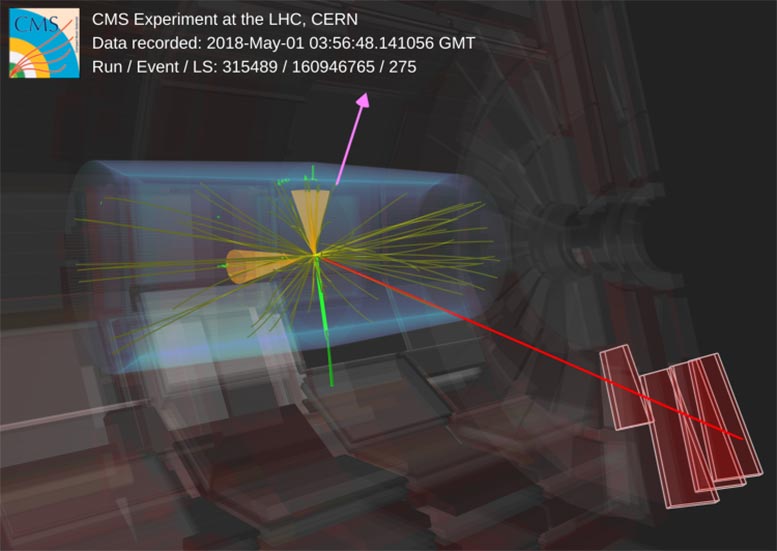
A Surprising Signal While Searching for Higgs Bosons
CMS researchers were analyzing a large sample of tt-bar production data collected in 2016–2018 to search for new types of Higgs bosons when they spotted something unusual. Additional Higgs-like particles are predicted in many extensions of the Standard Model. If they exist, such particles are expected to interact most strongly with the singularly massive top quark, which weighs in at 184 times the mass of the proton. And if they are massive enough to decay into a top quark-antiquark pair, this should dominate the way they decay inside detectors, with the two massive quarks splintering into “jets” of particles.
A Mysterious Surplus at the Energy Threshold
Observing more top-ititop pairs than expected is therefore often considered to be a smoking gun for the presence of additional Higgs-like bosons. The CMS data showed just such a surplus. Intriguingly, however, the collaboration observed the excess top-quark pairs at the minimum energy required to produce a pair of top quarks. This led the team to consider an alternative hypothesis long considered difficult to detect: a short-lived union of a top quark and a top antiquark, or toponium.
Quantum Calculations Back the Possibility of Toponium
While tt-bar pairs do not form stable bound states, calculations in quantum chromodynamics – which describes how the strong nuclear force binds quarks into hadrons – predict bound-state enhancements at the tt-bar production threshold. Though other explanations – including an elementary boson such as appear in models with additional Higgs bosons – cannot be ruled out, the cross section that CMS obtains for a simplified toponium-production hypothesis is 8.8 picobarns with an uncertainty of about 15%. This passes the “five sigma” level of certainty required to claim an observation in particle physics, and makes it extremely unlikely that the excess is just a statistical fluctuation.
Could Toponium Complete the Quarkonium Puzzle?
If the result is confirmed, toponium would be the final example of quarkonium – a term for unstable quark-antiquark states formed from pairings of the heavier charm, bottom, and perhaps top quarks. Charmonium (charm–anticharm) was discovered simultaneously at Stanford National Accelerator Laboratory in California and Brookhaven National Laboratory in New York in the November Revolution in particle physics of 1974. Bottomonium (bottom–antibottom) was discovered at Fermi National Accelerator Laboratory in Illinois in 1977. Charmonium and bottomonium are approximately 0.6 and 0.4 femtometres in size respectively, where one femtometre is a millionth of a nanometre. Bottomonium is thought to be the smallest hadron yet discovered. Given its larger mass, toponium is expected to be far smaller – qualifying it as the smallest known hadron.
Why Toponium Was Thought Impossible to Detect
For a long time, it was thought that toponium bound states were unlikely to be detected in hadron-hadron collisions. The top quark decays into a bottom quark and a W boson in the time it takes light to travel just 0.1 femtometre – a fraction of the size of the particle itself. Toponium would therefore be unique among quarkonia in that its decay would be triggered by the spontaneous disintegration of one of its constituent quarks rather than by the mutual annihilation of its matter and antimatter components.
What Comes Next: CMS and ATLAS Investigations Continue
CMS and ATLAS are now working closely to study the effect, which remains an open scientific question.
Never miss a breakthrough: Join the SciTechDaily newsletter.
Follow us on Google and Google News.
1 Comment
A Signal Too Strange to Ignore – And It May Reveal a New Kind of Matter.
GOOD.
There are even more strange things. According to the topological vortex theory (TVT), the interaction of spatiotemporal vortices and their fractal structures can form countless new Matters. What humans can discover are Matters that can vortex lock with human senses.