
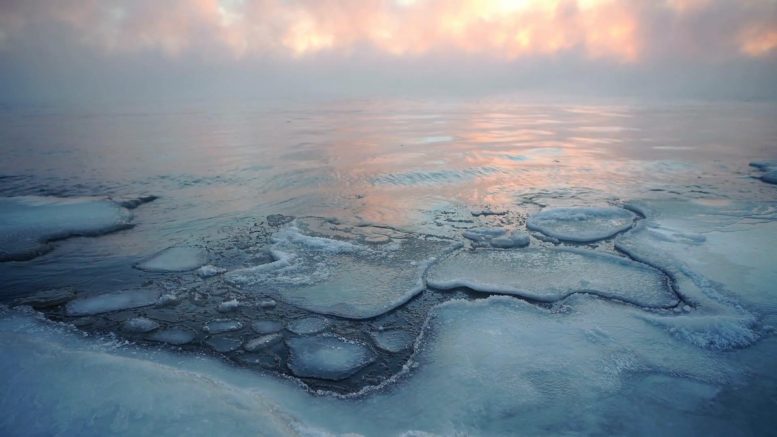
The loss of huge ice masses can contribute to the warming that is causing this loss and further risks. A new study now quantifies this feedback by exploring long-term if-then-scenarios. If the Arctic summer sea-ice were to melt completely, a scenario that is likely to become reality at least temporarily within this century with ongoing greenhouse gas emissions from burning fossil fuels, this could eventually add roughly 0.2°C (0.36°F) to global warming. It is, however, not in addition to IPCC projections of future warming since these already take the relevant mechanisms into account. Still, the scientists could now separate the effects of the ice loss from other effects and quantify it.
The 0.2°C is substantial, given that the global mean temperature is currently about one degree higher than in pre-industrial times, and governments worldwide agreed to stop the increase well below two degrees.
“If global ice masses shrink, this changes how much of the sunlight that hits Earth’s surface is reflected back into space. Decreasing ice cover in the Arctic exposes more of the darker ocean water that absorbs more energy,” says Nico Wunderling, lead author of the study. “This is referred to as albedo feedback. It’s like wearing white or black clothes in summer. If you wear dark, you heat up more easily.” Further factors include for instance the increase of water vapor in the atmosphere due to the warming if more ice is melting. Warmer air can hold more water vapor, and water vapor increases the greenhouse effect. The basic mechanisms are well-known since long, but the Potsdam scientists were able to actually calculate the overall amount of warming that can be triggered by global ice loss.
“This is not a short-term risk. Earth’s ice masses are huge, which makes them very important for our Earth system as a whole – it also means that their response to anthropogenic climate change, especially that of the ice sheets on Greenland and Antarctica, unfolds on longer timescales. But even if some of the changes might take hundreds or thousands of years to manifest, it’s possible we trigger them within just a couple of decades,” says Ricarda Winkelmann who leads the research group.
The scientists did comprehensive computer simulations. The effects are not always straightforward: for instance, if a massive ice cover on land is shrinking, there can still be snow – which still reflects the sunlight, just like the ice did. This is why, if the mountain glaciers and the ice on Greenland and West Antarctica would all disappear, the additional warming directly caused by the ice loss would likely be just an additional 0.2 degrees on top of the 0.2 degrees due to Arctic summer sea-ice melting. “Yet every tenth of a degree of warming counts for our climate,” says Winkelmann. “Preventing Earth system feedback loops, or vicious circles, is thus more urgent than ever.”
Reference: “Global warming due to loss of large ice masses and Arctic summer sea ice” by Nico Wunderling, Matteo Willeit, Jonathan F. Donges and Ricarda Winkelmann, 27 October 2020, Nature Communications.
DOI: 10.1038/s41467-020-18934-3
Never miss a breakthrough: Join the SciTechDaily newsletter.
Follow us on Google and Google News.
2 Comments
“Decreasing ice cover in the Arctic exposes more of the DARKER ocean water that absorbs more energy,”
This canard keeps being repeated without justification. For starters, for approximately half the year there is no sunlight to be absorbed. During the time sunlight is present, it is very weak because it passes through a long slant-range that scatters and absorbs the light more than at lower latitudes, and when it reaches the surface it is spread out over a large area as characterized by the Cosine Law, resulting in a low intensity. However, more importantly, Fresnel’s Equation shows that light reflected from water increases significantly in intensity starting at about 60 deg, and reaches 100% at the terminator (90 deg at Equinox). The Arctic water looks dark because there is very little sediment in suspension, and almost all the light is reflected in a thin sheaf of rays that can only be seen if looking towards the sun — then it is extremely bright!
https://wattsupwiththat.com/2016/09/12/why-albedo-is-the-wrong-measure-of-reflectivity-for-modeling-climate/
The actual article says, “In our simulations for the Arctic summer sea ice, the albedo during the summer months (June, July, August) is lowered to average values for open ocean waters instantaneously similar to Blackport and Kushner, …” Unfortunately, neither the authors of this article, or the cited source, specify what that albedo value is! Nor do they specify the latitude and method of measuring the albedo. Thus, no reviewer can actually independently do a sanity check on the assumed value, which is critical.
Furthermore, the authors state, “There is no comprehensively documented code for the Earth system model CLIMBER-2 available owing to a lack of comprehensive technical description, but the code is available upon request from M.W.” Thus, unless one obtains the code, is familiar with the language used in the model, and can devote the considerable time to understand the code and track down the variable used for albedo, the reasonableness of the assumption cannot be confirmed. This is no way to do science.