
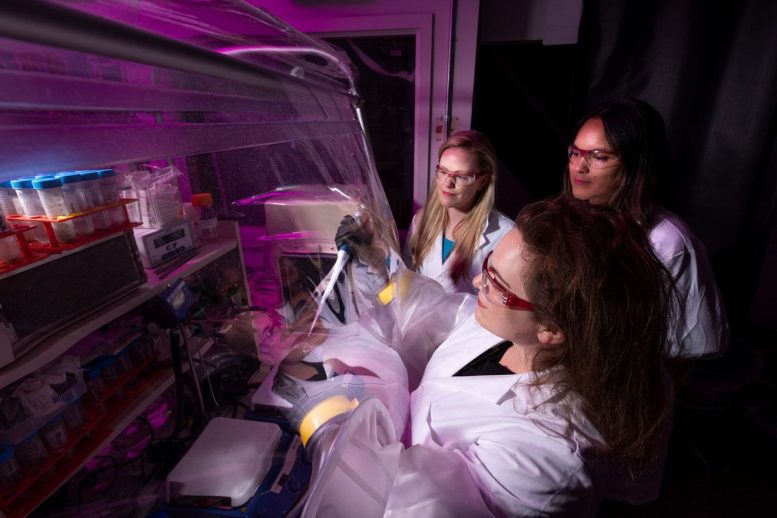
A specialized laboratory at JPL, designed to eliminate the chemical influence of modern organisms, allows scientists to investigate the chemistry that may have given rise to life.
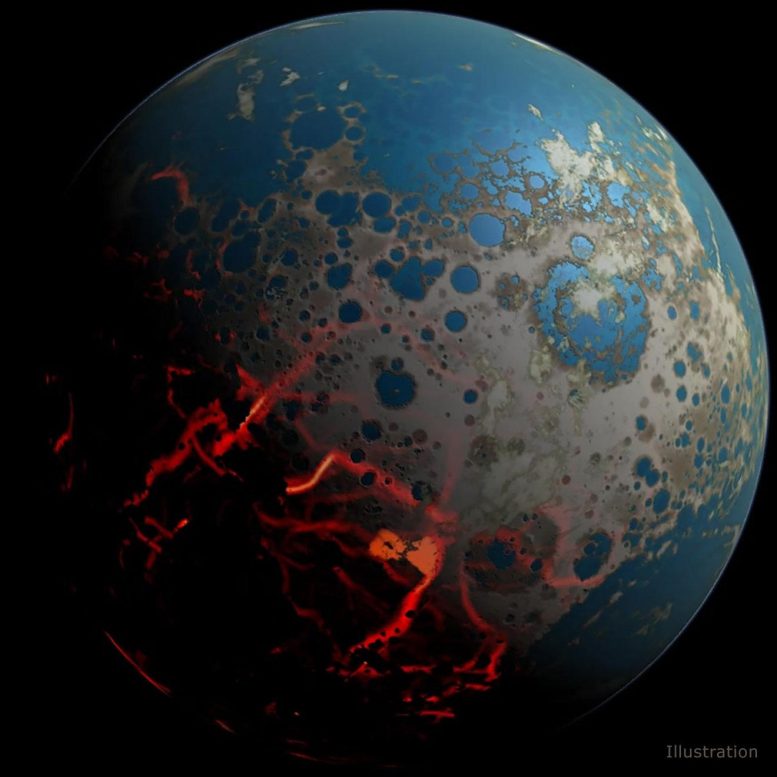
At NASA’s Jet Propulsion Laboratory’s Origins and Habitability Lab, you can find a world in a test tube. This is a simplified representation of the early Earth, reconstructed to resemble the conditions that existed on our planet around 4 billion years ago. Through this simulation, scientists are able to focus on the potential chemical reactions that occurred during that time, including those that could have played a crucial role in the development of life on Earth or could indicate the existence of life on other planets.
Last year, researchers in JPL’s Origins and Habitability Lab simulated the chemistry of early Earth and carried out a key chemical reaction involved in metabolism, the process living organisms use to convert fuel (such as sunlight or food) into energy. Did Earth’s first life forms create energy with the same chemical reactions used by living organisms today?
The first step to answering that question is finding out whether those reactions were even possible on early Earth. In living organisms, such reactions take place only inside a membrane (such as the protective wall of a living cell), which is just one reason why it’s an open question whether – and how – these reactions could have occurred before life formed.
The lab’s work belongs to a discipline known as astrobiology: the study of the origins, evolution, distribution, and future of life in the universe. The threads all tie together, so trying to understand how life formed on Earth would also help scientists search for life elsewhere. In fact, in another study, the lab team looked into how understanding the origin of life on Earth can also help scientists interpret the appearance of organic molecules (the chemical basis for living things on Earth) that might be found on another planet or moon.
But simulating the conditions found on Earth before life emerged is no easy task. Turning back the clock means taking into account how life has transformed our planet.
Something in the Air
There is essentially no place on Earth that’s not occupied by some form of life. Microorganisms can be found at the bottom of the ocean, in scalding hot geysers, and in rooms dedicated to removing those organisms.
Life forms have also transformed our planet’s chemistry. One of the biggest challenges with trying to create pre-life conditions in the lab is dealing with the presence of oxygen. Largely absent from Earth’s atmosphere before life emerged, it is now ubiquitous because so many life forms produce it. As a result, all of the lab’s origin-of-life experiments have to be conducted inside an airtight box, with an airlock for putting items in or taking them out. In addition to test tubes containing chemicals, any instruments used to analyze those chemicals must fit within the box, so there are some experiments the team can’t do in this setting.
Moreover, only one person can work in the box at a time, donning thick rubber gloves built into the sides of the container to move things around or use the equipment. Filters (which require regular cleaning) capture stray oxygen atoms. Even water has to go through a lengthy process to remove oxygen gas.
“Science is all about repetition,” said JPL research scientist Laurie Barge, who co-leads the Origins and Habitability Lab. “We want to do experiments again and again, and that’s hard to do when you have to spend so much time making sure that not even a tiny bit of oxygen has crept into your test tube.”
It took Barge and her team months to demonstrate that one chemical reaction involved in modern metabolism can take place under these early-Earth conditions. They plan to continue trying to simulate each step in the metabolism process and, at some point, they may find that a particular reaction can only occur inside a protective structure like a membrane. That might help narrow down when membranes became necessary in the emergence of life – a glimpse back in time.
Testing Hypotheses on Other Worlds
There’s another way that scientists could learn about the chemistry that took place, and potentially set the stage, for life on Earth: By studying a planet or moon with roughly the same raw ingredients that would have been found on early Earth. The location could be a lifeless moon in our own solar system or a planet around another star. Then Barge and her colleagues could test the ideas they’re investigating against an environment that isn’t constrained to the size of a glove box.
“It would be very interesting to validate and check some of our laboratory results against results from another world,” said Jessica Weber, a JPL research scientist in the Origins and Habitability Lab who led the metabolism work. “Finding an environment like this would help us better re-create early Earth in our lab experiments, and that would get us closer to answering some of those big questions about life on our own planet and potentially on others.”
References:
“Determining the “Biosignature Threshold” for Life Detection on Biotic, Abiotic, or Prebiotic Worlds” by Laura M. Barge, Laura E. Rodriguez, Jessica M. Weber and Bethany P. Theiling, 13 April 2022, Astrobiology.
DOI: 10.1089/ast.2021.0079
“Testing Abiotic Reduction of NAD+ Directly Mediated by Iron/Sulfur Minerals” by Jessica M. Weber, Bryana L. Henderson, Douglas E. LaRowe, Aaron D. Goldman, Scott M. Perl, Keith Billings and Laura M. Barge, 11 January 2022, Astrobiology.
DOI: 10.1089/ast.2021.0035
Never miss a breakthrough: Join the SciTechDaily newsletter.
Follow us on Google and Google News.
1 Comment
“trying to create pre-life conditions in the lab is dealing with the presence of oxygen. Largely absent from Earth’s atmosphere before life emerged,” That theory ignores the fact that the young Sun 4.5 billion years ago was less luminous but was emitting 4 to 8 time as much UV radiation than now. Thus any early evolution of DNA or protein amino acids would need UV protection. Stratospheric ozone is the only viable choice. And it needs oxygen. That oxygen was derived from the stratospheric UV dissociation of water vapor and the loss of light hydrogen to space. Thus it is unnecessary to have a clean room free of oxygen, but water is needed as are dry conditions for peptide bonds to form.