
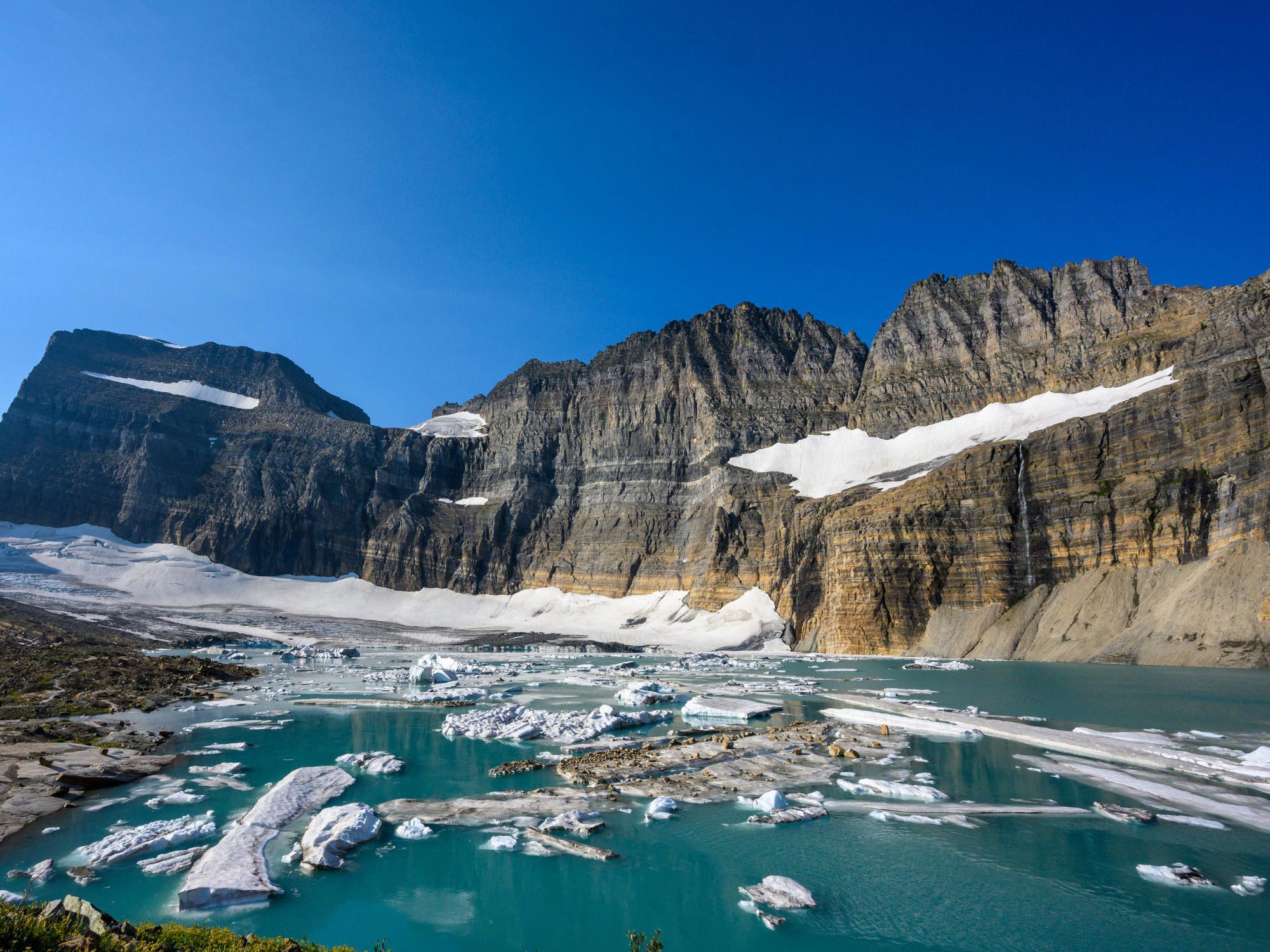
Over the past decade, ice loss in densely populated regions like Europe has accelerated at an increasingly rapid pace.
Between 2000 and 2023, all relatively small glaciers worldwide — excluding those in Antarctica and Greenland — lost approximately 5% of their total volume.
This equates to an average loss of 273 billion tons of ice per year, more than twice the amount lost from the Antarctic Ice Sheet during the same period. In Central Europe, particularly in the Alps, the decline was even more severe, with 39% of the ice mass disappearing.
Intensifying loss
Unsurprisingly, the amount of meltwater coming down varies per year. But the pattern that is becoming visible the researchers call shocking. Between 2012 and 2023, much more ice was lost (36% more meltwater) compared to the decade before.
It is not only about rising sea levels, says Bert Wouters. “We will directly notice the melting of these glaciers. Because they are located where many people live, it will affect drinking water supplies, in particular in South America and Asia. And the risk of flooding after the melt season also poses a danger.”
Combining global melt data
Bert Wouters is Associate Professor of Geoscience and Remote Sensing at TU Delft and ensured that the data from many studies together produced a solid estimate. “From the accessible glaciers, we have lots of field measurements. From all those other glaciers, we have data from satellites. The methods and thus the meltwater estimates were often varying. It was a big challenge to make it scientifically unified.”
The team of researchers, part of the Glacier Mass Balance Intercomparison Exercise (Glambie), succeeded. This resulted in an annual time series of glacier mass changes for all glacier regions globally from 2000 to 2023.
Reference: “Community estimate of global glacier mass changes from 2000 to 2023” by The GlaMBIE Team, 19 February 2025, Nature.
DOI: 10.1038/s41586-024-08545-z
Never miss a breakthrough: Join the SciTechDaily newsletter.
Follow us on Google and Google News.
7 Comments
Hair loss is still worse than ice loss, trust me.
“This equates to an average loss of 273 billion tons of ice per year, ….”
What is the point of telling the readers what the average ice loss per year is? I submit that no one reading it can subjectively relate to 273 billion tons of anything and only see it as a big number — even if it were stated in the context of Olympic swimming pools-equivalent. or dancing elephants. I could calculate the weight of water in an Olympic-size swimming pool, but off the top of my head — given a couple seconds — I doubt I would come very close to estimating it. Nobody can effectively distinguish 273 billion from infinity. Therefore, I believe the whole point of presenting a big number like that is to overwhelm the rational part of the brain to activate the subjective, emotional part of the brain. Tricking readers into suspending their rational thought processes isn’t what science is about. It should be the role of researchers and science writers to try to make the numerical measurements and specialized jargon of researchers comprehensible to laymen. Throwing out big numbers indistinguishable from the national budget is NOT the way to do it.
The cynic in me tends to believe that it is not incompetence of the researchers or science writers that leads to such common behavior (I have complained about this before.). The natural world is big, really, really big! Most people who live in cities don’t appreciate just how big any common feature, such as a mountain, is. So, if gigatons don’t result in a subjectively, mind boggling number, use tons, or even grams. Whatever will trigger an emotional response. In a word, I think that a writer has a hidden agenda when they throw out big numbers without justifying the use.
Using a percentage, such as 5%, suggests that the remaining small glaciers might last about another 20 years. That is understandable and useful information. Albeit, too simplistic. As the snow line retreats , the melting rate will probably decrease on the north slopes (shadowed) of glaciers in the Alps. Glacier National Park in the USA was so certain that their glaciers were going to melt away that they spent tax dollars to have signs printed up in anticipation of what they thought was inevitable. They have put those signs (hopefully) into storage. The problem is that the peak melting occurred on southern exposures, while some of the glaciers and snow fields on the north side have changed little in 100 years. It appears that the melting had more to do with decreased cloudiness and increased insolation than it did with increasing air temperatures.
I prefer 2.73 x 10 power 11. It helps cope with Vietnamese money. 1 million Dong is about approx $600, I forget which $. So a house costing $600 000 would be a approx 1 billion of the little Dongs. 1 billion modern Dong might not fill an Olympic swimming pool but the 1950s copper 1 Dong piece would be the foundation of a mineable resource……………Good job the VN government started printing paper money, or the price of copper would beyond that of gold and lots of Vietnamese would have had their pockets worn out through the wea rand tear of carrying Dong.
I prefer exponential also, but many readers here are probably unfamiliar with Scientific Notation.
However, that is side-stepping my claim that using very big numbers is done purposely to mislead and manipulate lay readers.
Deliberate use of Olympic-sized swimming pools certainly misleads me. I have never swum in one knowingly. 273 billion tons, or tonnes, whichever is preferred, is certainly a large number beyond the experience of just about everyone who has never been a bricklayer, but it is a better way of conveying the amount of whatever than just writing, “An extremely large amount of..XXXX..big enough to utterly boggle the tiny mind reading this article”. 273 billion is relatable to one’s wildest dreams of winning several national lotteries simultaneously, and thus is sort of comprehensible.
Glaciers forn and they dicipate with climatic changes through geologic time. It’s an old tradition.
We have got to stop these scare-mongering portrayals. Here is the perspective from a geologist. The Earth has been warming for 20,000 years, with a couple of cooling blimps, such as the Little Ice Age, which we are also now warming from. Yes, when the Earth warms, glaciers melt. This has happened repeatedly since the beginning of the Pleistocene. In fact, if you look at the temperature charts, this has been the mildest warming during that period. Additionally, as an ice mass shrinks, the rate of retreat increases. If I have a 10 lb block of ice and ten one lb blocks of ice, which will disappear more rapidly. Unless we enter another cooling trend, it is likely most glaciers will disappear. This is not our fault, and there is nothing we can do to stop it, nor should we. It is a natural process. The one ice mass that is safe from anywhere near complete melting is the Antarctic ice sheet, which has been around for 50 million years and has survived all previous interglacials because of its position on the pole and being encircled by the circumpolar ocean. Today, parts are melting, mostly due to sub-ice heating by volcanic processes and part is expanding. In reality, we are in very cold episode of Earth history. Only four other times, two in the Precambrian and two in the Paleozoic, do we have geological evidence of continental ice masses. The vast majority of Earth history has been much warmer and nearly completely ice free. This is a natural process, and we simply need to adapt, as did our prehistoric ancestors.