
Close Menu
    Facebook X (Twitter) Instagram
    SciTechDaily
    • Biology
    • Chemistry
    • Earth
    • Health
    • Physics
    • Science
    • Space
    • Technology
    Facebook X (Twitter) Pinterest YouTube RSS
    SciTechDaily
    Home»Technology»Above the Noise: Using Deep Learning for Higher Precision Measurements of Nanoscale Objects
    Technology

    Above the Noise: Using Deep Learning for Higher Precision Measurements of Nanoscale Objects

    By Osaka UniversityMay 13, 2021No Comments3 Mins Read
    Facebook Twitter Pinterest Telegram LinkedIn WhatsApp Email Reddit
    Share
    Facebook Twitter LinkedIn Pinterest Telegram Email Reddit
    Resistive Pulse Signals in Nanopore Sensing
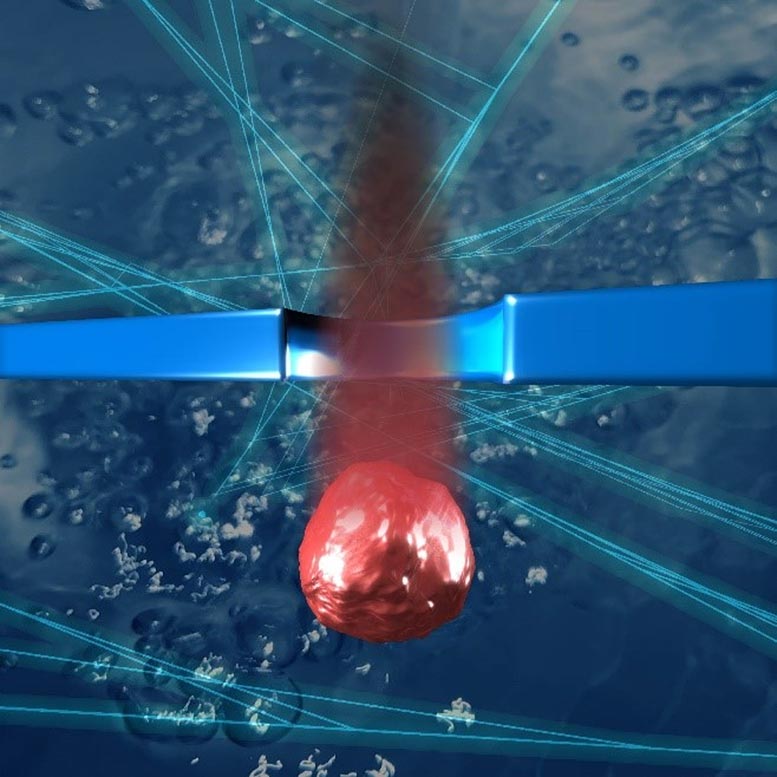
    Deep learning helps researchers to find hidden features in resistive pulse signals in nanopore sensing of nanoscale objects. Credit: Osaka University

    Researchers at Osaka University use deep learning to reduce noise in the electrical current data collected from nanopores, which may lead to higher precision measurements when working with very tiny experiments or medical diagnostics.

    Scientists from the Institute of Scientific and Industrial Research at Osaka University used machine learning methods to enhance the signal-to-noise ratio in data collected when tiny spheres are passed through microscopic nanopores cut into silicon substrates. This work may lead to much more sensitive data collection when sequencing DNA or detecting small concentrations of pathogens.

    Miniaturization has opened the possibility for a wide range of diagnostic tools, such as point-of-care detection of diseases, to be performed quickly and with very small samples. For example, unknown particles can be analyzed by passing them through nanopores and recording tiny changes in the electrical current. However, the intensity of these signals can be very low, and is often buried under random noise. New techniques for extracting the useful information are clearly needed.

    Now, scientists from Osaka University have used deep learning to “denoise” nanopore data. Most machine learning methods need to be trained with many “clean” examples before they can interpret noisy datasets. However, using a technique called “Noise2Noise,” which was originally developed for enhancing images, the team was able to improve resolution of noisy runs even though no clean data was available. Deep neural networks, which act like layered neurons in the brain, were utilized to reduce the interference in the data.

    “The deep denoising enabled us to reveal faint features in the ionic current signals hidden by random fluctuations,” first author Makusu Tsutsui says. “Our algorithm was designed to select features that best represented the input data, thus allowing the computer to detect and subtract the noise from the raw data.”

    The process was repeated many times until the underlying signal was recovered. Essentially, many noisy runs were utilized to produce one clean signal.

    “Our method may expand the capability nanopore sensing for rapid and accurate detection of infection diseases,” explains senior author Takashi Washio. “This research may lead to much more accurate diagnostic tests, even when the underlying signal is very weak.”

    Reference: “Deep learning-enhanced nanopore sensing of single-nanoparticle translocation dynamics” by Makusu Tsutsui, Takayuki Takaai, Kazumichi Yokota, Tomoji Kawai and Takashi Washio, 14 May 2021, Small Methods.
    DOI: 10.1002/smtd.202100191

    Never miss a breakthrough: Join the SciTechDaily newsletter.
    Follow us on Google and Google News.

    Artificial Intelligence Biotechnology Nanotechnology University of Osaka
    Share. Facebook Twitter Pinterest LinkedIn Email Reddit

    Related Articles

    Human Brain-Like Functions Emerge in Neuromorphic Metallic Nanowire Network

    Single-Stranded DNA and RNA Origami That Can Autonomously Fold Into Defined Structures

    Miniature System Can Encapsulate and Analyze Biomarkers in Sweat

    Black Butterfly Enhances Photovoltaic Light Absorption Up to 200 Percent

    New Technique Enlarges Tissue Samples, Making Them Easier to Image

    Programmable Biofilm-Based Materials That Self-Assemble

    A*STAR Researchers Develop High-Capacity Method to Purify Monoclonal Antibodies

    Scientists Develop Artificial Cilia

    New Class of Synthetic Vaccines Piggyback on 3-D DNA Nanostructures

    Leave A Reply Cancel Reply

    • Facebook
    • Twitter
    • Pinterest
    • YouTube

    Don't Miss a Discovery

    Subscribe for the Latest in Science & Tech!

    Trending News

    Popular Sugar-Free Sweetener Linked to Liver Disease, Study Warns

    What Is Hantavirus? The Deadly Disease Raising Alarm Worldwide

    Scientists Just Discovered How the Universe Builds Monster Black Holes

    Scientists Unveil New Treatment Strategy That Could Outsmart Cancer

    A Simple Vitamin May Hold the Key to Treating Rare Genetic Diseases

    Scientists Think the Real Fountain of Youth May Be Hiding in Your Gut

    Ravens Don’t Follow Wolves, They Predict Them

    This Common Knee Surgery May Be Doing More Harm Than Good

    Follow SciTechDaily
    • Facebook
    • Twitter
    • YouTube
    • Pinterest
    • Newsletter
    • RSS
    SciTech News
    • Biology News
    • Chemistry News
    • Earth News
    • Health News
    • Physics News
    • Science News
    • Space News
    • Technology News
    Recent Posts
    • Why Are So Many New Fathers Dying? Scientists Say the U.S. Has a Dangerous Blind Spot
    • Scientists Identify Simple Supplement That Greatly Reduces Alzheimer’s Damage
    • You May Have a Dangerous Type of Cholesterol Even if Your Tests Look Normal
    • Study Reveals Dangerous Flaw in AI Symptom Checkers
    • New MRI Breakthrough Captures Stunningly Clear Images of the Eye and Brain
    Copyright © 1998 - 2026 SciTechDaily. All Rights Reserved.
    • Science News
    • About
    • Contact
    • Editorial Board
    • Privacy Policy
    • Terms of Use

    Type above and press Enter to search. Press Esc to cancel.