
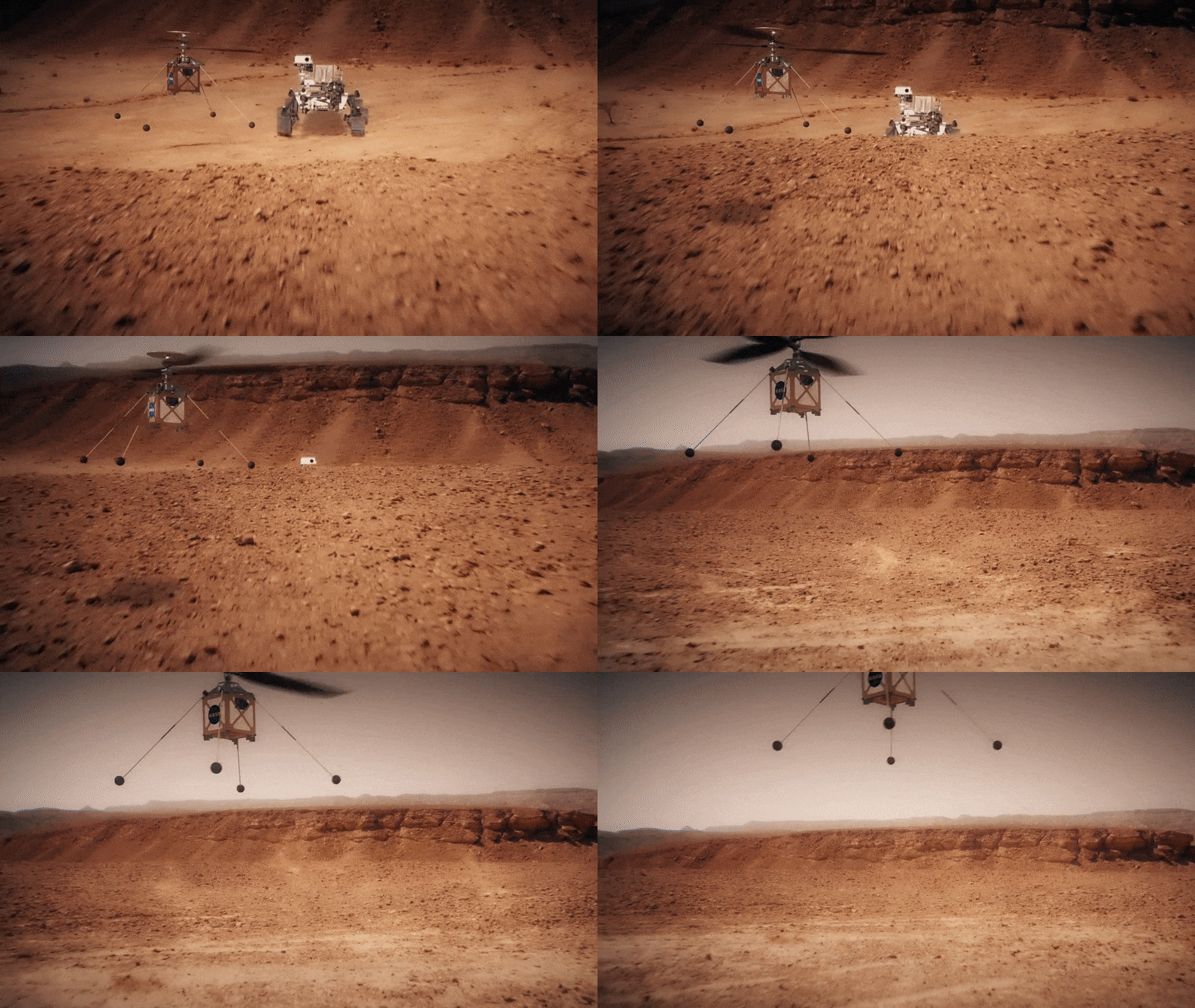
A new video of the helicopter’s third flight gives viewers the sensation of standing on the Red Planet and seeing the action firsthand.
When NASA’s Ingenuity Mars Helicopter took to the Martian skies on its third flight on April 25, the agency’s Perseverance rover was there to capture the historic moment. Now NASA engineers have rendered the flight in 3D, lending dramatic depth to the flight as the helicopter ascends, hovers, then zooms laterally off-screen before returning for a pinpoint landing. Seeing the sequence is a bit like standing on the Martian surface next to Perseverance and watching the flight firsthand.
Located on the rover’s mast, or “head,” the zoomable dual-camera Mastcam-Z imager provided the view. Along with producing images that enable the public to follow the rover’s daily discoveries, the cameras provide key data to help engineers navigate and scientists choose interesting rocks to study.
Ingenuity Flies in 3D: After the Mastcam-Z imager aboard NASA’s Perseverance rover captured Ingenuity’s third flight on April 25, the frames of the video that was stitched together were then reprojected to optimize viewing in an anaglyph, or an image seen in 3D when seen through color-filtered glasses. Credit: NASA/JPL-Caltech/ASU/MSSS
Justin Maki, an imaging scientist at NASA’s Jet Propulsion Laboratory in Southern California, led the team that stitched the images into a video. The frames of the video were reprojected to optimize viewing in an anaglyph, or an image seen in 3D when viewed with color-filtered glasses (you can create your own 3D glasses in a few minutes).
Maki’s been creating 3D imaging of Mars since his days as a graduate student processing images from NASA’s Sojourner, the first Mars rover in 1997. But this is the first time he’s created actual 3D video of an aircraft flying on Mars. “The Mastcam-Z video capability was inherited from the Mars Science Laboratory MARDI (MArs Descent Imager) camera,” Maki said. “To be reusing this capability on a new mission by acquiring 3D video of a helicopter flying above the surface of Mars is just spectacular.” The videos of the helicopter are the most extensive 3D video yet from the Mastcam-Z team.
The rover’s drivers and robotic-arm operators use a more sophisticated 3D system to understand exactly how things are positioned on Mars before planning the rover’s movements. But, according to Maki, team members have also been viewing still 3D images for rover-drive planning. “A helicopter flying on Mars opens a new era for Mars exploration. It’s a great demonstration of a new technology for exploration,” he added. “With each flight we open up more possibilities.”
Perseverance Rover’s Mastcam-Z Captures Ingenuity’s Third Flight: NASA’s Ingenuity Mars Helicopter takes off and lands in this video captured on April 25, 2021, by Mastcam-Z, an imager aboard NASA’s Perseverance Mars rover. As expected, the helicopter flew out of its field of vision while completing a flight plan that took it 164 feet (50 meters) downrange of the landing spot. Keep watching, the helicopter will return to stick the landing. Credit: NASA/JPL-Caltech/ASU/MSSS
The April 25 flight brought with it several other firsts, with Ingenuity rising 16 feet (5 meters), then flying downrange 164 feet (50 meters). That was a record until Ingenuity traveled 873 feet (266 meters) on its fourth flight, on April 30. For its fifth flight, on May 7, Ingenuity completed its first one-way trip, traveling 423 feet (129 meters), then reaching an altitude of 33 feet (10 meters) above its new landing field.
The flights began as a technology demonstration intended to prove that powered, controlled flight on Mars is possible. Now they will serve as an operations demonstration, exploring how aerial scouting and other functions could benefit future exploration of Mars.
Never miss a breakthrough: Join the SciTechDaily newsletter.
Follow us on Google and Google News.